I live in Japan, and Nikko is the day trip I keep coming back to. It is two hours north of Tokyo, and it delivers something the city cannot: a mountain valley full of cedar trees, a shrine complex so ornate it looks like it was carved by someone with unlimited budget and no editor, and a lake at 1,269 metres where the air is ten degrees cooler than Asakusa.
It is also the day trip people most often get wrong. They arrive at 11:30, discover the shrines close at 17:00, try to squeeze in Lake Chuzenji as well, and spend an hour of their life on a bus in a traffic jam. The good version of Nikko is entirely about leaving early and deciding, before you go, whether you are doing the shrines or the mountains. Not both.
The quick answer
- Take the Tobu line from Asakusa, not JR. A Limited Express (Spacia X, Spacia Kegon or Revaty Kegon) runs direct to Tobu-Nikko in about 1 hour 50 minutes for roughly ¥2,850–3,540 one way, reserved seat included.
- Only use JR if you hold a Japan Rail Pass. Shinkansen to Utsunomiya then the JR Nikko Line is about 100 minutes but costs around ¥5,500 without a pass.
- The NIKKO PASS world heritage area (¥3,000 adult / ¥1,500 child, 2 days) covers the round trip from Asakusa plus the shrine-area buses. It pays for itself on a single day trip. The Limited Express seat fee is extra.
- The NIKKO PASS all area (¥8,000 / ¥4,000, 4 days) only makes sense if you are going up to Lake Chuzenji or Yumoto Onsen, ideally staying a night.
- Toshogu admission is ¥1,600 for adults, ¥550 for elementary and junior high students. Open 08:00–17:00 April to October, 08:00–16:00 November to March.
- Leave Asakusa by 08:00. Anything later and you are rushing.
- All prices are approximate for 2026. Confirm before you book.
Getting there: Tobu from Asakusa is the honest answer
Nikko has two stations, Tobu-Nikko and JR Nikko, and they sit about three minutes’ walk apart at the bottom of the same street. Which one you use is purely a question of what ticket you are holding.
Tobu from Asakusa is the default. Limited Express trains leave Asakusa one to two times an hour and reach Tobu-Nikko in about 1 hour 50 minutes, with fares in the ¥2,850–3,540 range depending on the train and the season. Spacia X is the newest and nicest of them — there is a proper cafe counter on board, and the standard reserved seat is around ¥3,340. All Tobu Limited Express services require a reserved seat, so you cannot just walk on.
There is a cheaper way: ordinary and express trains on the same Tobu line cost about ¥1,400 one way. You will change trains one to three times and it takes at least half an hour longer. If you are travelling as a couple and saving ¥4,000 matters more than saving 40 minutes, it is a genuine option. If you are doing Nikko as a day trip, buy the seat.
JR via Utsunomiya takes the Tohoku Shinkansen from Tokyo or Ueno, then the local JR Nikko Line. With a tight connection it is about 100 minutes, which is the fastest option on paper, but it costs roughly ¥5,500 one way at full fare. It is fully covered by the Japan Rail Pass (commonly called the JR Pass), so if you are already holding one, this is free travel and you should take it. If you are not, it is poor value — this is exactly the kind of calculation I go through in Japan Rail Pass 2026: Is It Still Worth It?
Which Nikko Pass to buy (and when not to buy one)
Tobu sells two passes, and the difference between them is the single most useful thing to understand before you go.
| World Heritage Area | All Area | |
|---|---|---|
| Price (adult / child) | ¥3,000 / ¥1,500 | ¥8,000 / ¥4,000 |
| Valid | 2 consecutive days | 4 consecutive days |
| Round trip from Asakusa | Included | Included |
| Shrine-area buses | Included | Included |
| Buses to Lake Chuzenji / Yumoto | Not included | Included |
| Lake Chuzenji cruise, Okunikko | No | Yes (mid-April to 30 November) |
| Limited Express seat fee | Extra | Extra |
For a standard day trip built around Toshogu, Rinnoji and Taiyuin, the World Heritage Area pass at ¥3,000 is the obvious buy. The round trip alone at ordinary fares is ¥2,800, so the area buses come effectively free.
The All Area pass at ¥8,000 is a different proposition. The return bus to Chuzenji Onsen is ¥1,250 each way, and to Yumoto ¥1,950 each way, so it starts to work if you are going high into the mountains — and it works properly if you stay overnight and use all four days. Note that both passes exclude the Limited Express seat fee, which you buy separately.
If you are not buying a pass at all, the shrine-area bus is ¥350 one way, or ¥600 for a day pass from Tobu-Nikko Station. Honestly, the walk from the station to Shinkyo Bridge takes about 20–25 minutes slightly uphill and is pleasant in spring and autumn. In August heat or January ice, take the bus.
The shrine complex: what you actually pay for
Nikko’s UNESCO site is not one building, it is a forested hillside with several separate paid sites, each with its own ticket booth. There is no single combined ticket for all of them.
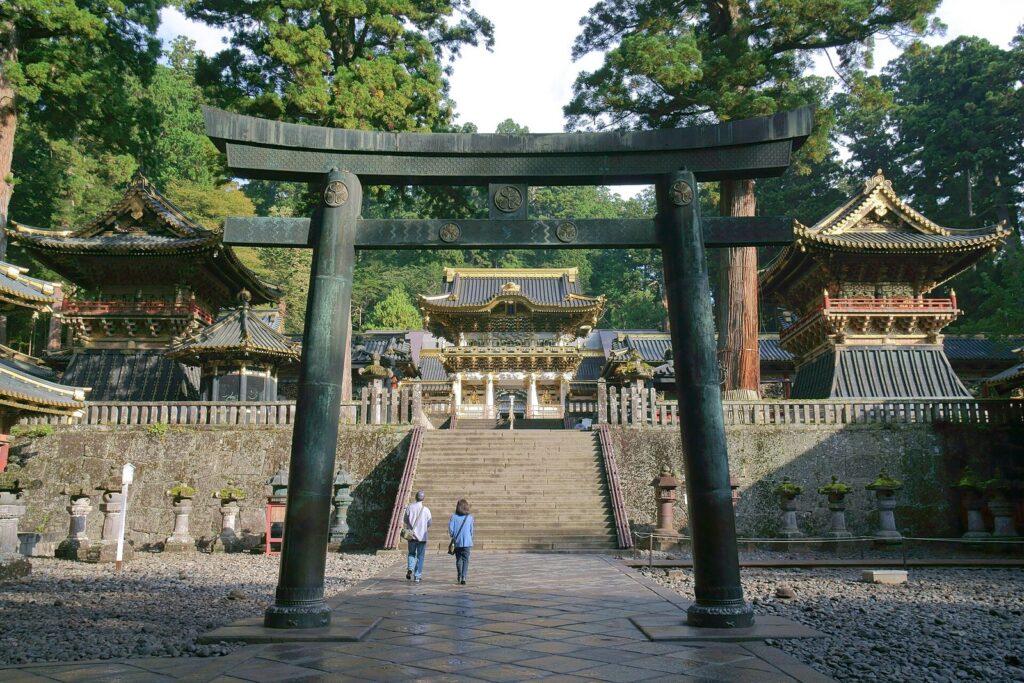
Toshogu is the one everyone comes for — the mausoleum of Tokugawa Ieyasu, founder of the shogunate that ran Japan for 250 years. It costs ¥1,600 for adults, ¥550 for elementary and junior high school students, or ¥2,400 for a combination ticket that adds the Treasure Museum. This is where you find the three wise monkeys, the sleeping cat, and the Yomeimon gate, which is so densely decorated that the old nickname for it translates roughly as “the gate you spend all day looking at.”
Taiyuin, the mausoleum of Ieyasu’s grandson Iemitsu, costs ¥550 and is quieter, greener and — this is a minority opinion I will defend — more beautiful than Toshogu. It is a five-minute walk further up the hill and most tour groups skip it.
Rinnoji’s Sanbutsudo hall is ¥400, or ¥900 for a combined Rinnoji ticket that includes Taiyuin. Three enormous gilded Buddha statues, and worth twenty minutes.
Futarasan Shrine grounds are free; its paid inner precinct is ¥300. Shinkyo Bridge, the red arch at the entrance to the whole area, is free to photograph and ¥300 if you want to walk on it — which takes about forty seconds. Photograph it and keep your ¥300.
Budget three to four hours for the shrine area at a pace that is not miserable.
Lake Chuzenji and Kegon Falls: only if you commit
Above the shrines, the road climbs the Irohazaka switchbacks to Lake Chuzenji at 1,269 metres and Kegon Falls, a 97-metre drop that is the best-known waterfall in Japan. The elevator down to the lower viewing deck is ¥570 for adults, ¥340 for children, open 08:00–17:00 in the warmer months and 09:00–16:30 from December to February.
The bus from Tobu-Nikko Station takes about 50 minutes and costs ¥1,250 each way in normal conditions. That last phrase is doing a lot of work. During autumn leaf season, traffic on the Irohazaka road can be severe and buses run badly late, especially on October weekends. I have heard of a 50-minute ride taking well over two hours.
So: if you want Chuzenji, go straight there in the morning and do the shrines in the afternoon, or accept that you are staying the night. Trying to do the shrines first and the lake at 15:00 in late October is how people end up standing at a bus stop in the dark. Compare this with somewhere like Hakone Guide: Onsen, Mt. Fuji Views and Art, which is genuinely designed as a loop — Nikko is not.
When to go
Autumn is the headline, and the colours move down the mountain in stages: Okunikko in early October, Lake Chuzenji in mid-October, the Irohazaka road in late October, and the town and shrines in early November. Weekdays in that window are dramatically better than weekends. Our guide to the Best Autumn Leaves Spots in Japan covers how this staggering works nationwide.
Summer is the quiet secret. Nikko town sits at around 550 metres and Chuzenji at 1,269, so when Tokyo is 36 degrees, the lake is genuinely comfortable — one of the reasons it appears in Where to Escape Japan’s Summer Heat. Winter is cold and can be icy underfoot, but Toshogu in snow with almost nobody there is one of the better things I have seen in this country. Spring is late here: cherry blossoms around the shrines usually run about two weeks behind Tokyo.
Should you stay the night?
For most first-time visitors on a tight schedule, no — Nikko works as a day trip, and it is in our roundup of the Best Day Trips from Tokyo for that reason. But if you have the days, staying in Nikko or Kinugawa Onsen turns a rushed itinerary into a relaxed one and gives you the shrines at 08:00 with nobody in them. There are ryokan with hot spring baths at both ends of the price range, and the arguments for and against are the same ones in Hotel vs Ryokan: Which Should You Book in Japan?
FAQ
Can I do Nikko and Lake Chuzenji in one day? Physically yes, comfortably no — and in October, probably not at all. Pick one, or stay overnight.
Is Nikko worth it if I have already been to Kyoto? Yes, and the reason is that it is not like Kyoto. Kyoto’s temples are restrained; Nikko’s Toshogu is deliberately overwhelming, built to project the power of a dynasty. Different argument, different aesthetic.
Do I need to book the train in advance? For Tobu Limited Express, yes — every seat is reserved. In autumn, Spacia X sells out days ahead. Ordinary trains need no reservation.
Are there luggage lockers? Yes, at Tobu-Nikko Station, though they fill up on busy mornings. If you are moving hotels the same day, forwarding your bag is easier — see What to Do With Your Luggage in Japan.
Is English signage good? At the station and the major shrines, yes. On rural buses, less so. Screenshot your return bus time before you leave the station.
The verdict
Nikko is worth a day of a first Japan trip if — and only if — you leave Tokyo early and choose your half. Take the 08:00-ish Tobu Limited Express from Asakusa, buy the ¥3,000 World Heritage Area pass, spend the morning and early afternoon at Toshogu and Taiyuin, eat yuba (tofu skin, the local specialty) somewhere on the main street, and be back in Tokyo for dinner. That is a genuinely great day.
If you want Lake Chuzenji and Kegon Falls as well, give Nikko two days and a night, buy the All Area pass, and let the mountain be the point rather than an add-on you sprint towards at four in the afternoon.
Written from Japan by the Wayfarer Japan team. Prices and schedules are approximate for 2026 — always confirm with the operator before booking.
Featured image: “Nikko toshogu shrine” by Koichi Sato, CC BY-SA 4.0, via Wikimedia Commons