I live in Japan, and every time I tell people in Tokyo that I’m heading up to Sapporo, I get the same reaction: “oh, for the snow festival?” Sapporo is far more than its February week of ice sculptures. It’s Hokkaido’s capital, a flat, easy-to-walk grid city of about 1.9 million people, built wide and American-style by design in the 1870s, and it works on a completely different rhythm than Tokyo or Osaka. Summers are mild when the rest of Japan is suffocating, autumn turns the city gold weeks before Honshu catches up, and winter buries it in some of the best snow on the planet.
This guide covers how to get in from the airport, what’s actually worth your time in the city itself, and how to time a visit around food, foliage or skiing, with the 2026 prices and hours I could confirm.
The quick answer
- Fly into New Chitose Airport (CTS), then take the JR Rapid Airport train to Sapporo Station — about 33–37 minutes, ¥1,230 basic fare plus roughly ¥800–1,000 if you reserve a U Seat.
- The city center is flat and walkable. Odori Park, Sapporo TV Tower, the Clock Tower and Susukino are all within 15–20 minutes on foot of each other, connected by an underground passage that matters a lot in winter.
- Late October to early November is peak autumn color, anchored by Hokkaido University’s Ginkgo Avenue, a free, seven-minute walk from Sapporo Station.
- Eat ramen, soup curry, and seafood from Nijo Market — this is the city most associated with Hokkaido’s miso ramen style and some of Japan’s best crab and sea urchin.
- Ski season at Sapporo Teine typically opens in late November, inside the city limits — no need to go further into Hokkaido unless you want bigger terrain.
- 👉 Booking.com Sapporo for where to stay — Susukino and the Odori/Sapporo Station area are the two bases worth comparing.
Getting in from New Chitose Airport
New Chitose Airport (CTS) sits about 40km southeast of the city, and the JR Rapid Airport line is the only real train option — there’s no competing private railway here the way there sometimes is elsewhere in Japan. Trains run roughly every 15 minutes, the fastest services take about 33 minutes, and the basic fare is ¥1,230. If you want a guaranteed seat, the U Seat reserved car adds about ¥800–1,000 depending on how you book it; unreserved cars are usually fine outside rush hour. A limousine bus is the backup option if you’ve got heavy luggage and don’t mind 60–80 minutes instead of 35.
If you’ve forgotten to sort out data before landing, don’t panic — the arrivals hall has eSIM and pocket WiFi counters, and convenience stores in the city sell SIM cards too. 👉 Klook has pickup-ready pocket WiFi and eSIMs you can activate before you land, which is the easier option if you’re also connecting onward to Tokyo or Osaka.
Getting around the city
Sapporo was laid out on a grid after the Meiji government decided to build a planned capital for Hokkaido, and it shows: addresses are literally numbered by block (like “Minami 1-jo Nishi 3-chome”), which makes navigation far more logical than in most Japanese cities once you get the hang of it. The subway has two main lines (Namboku and Tozai) plus the Toho line, a streetcar loop, and a genuinely useful underground pedestrian network — the Sapporo Chikagai — connecting Sapporo Station to Odori and beyond, which is the reason locals don’t dread January the way you’d expect.
A day pass on the subway costs around ¥830 for adults, worth it if you’re doing Odori, the TV Tower, Nijo Market and Susukino all in one day. For most visitors staying within the central grid, walking covers it.
What to see in the city center
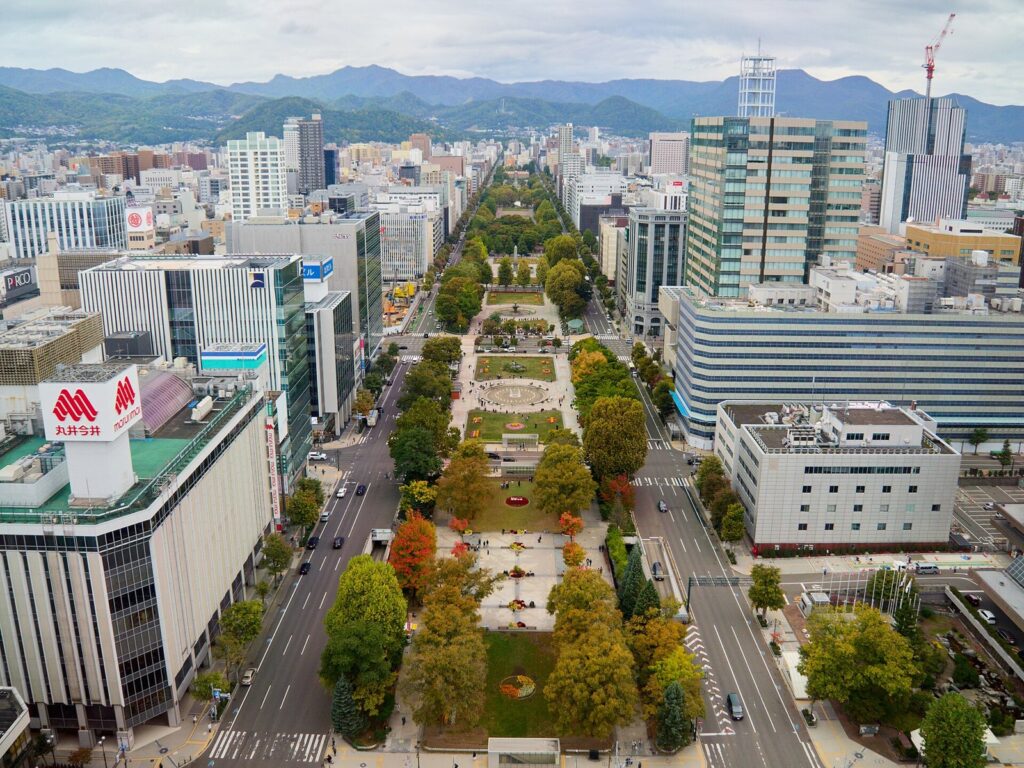
Odori Park is the spine of the city — a 1.5km green strip running east-west through downtown, free to walk any time, and the stage for the Snow Festival in February, the Lilac Festival in spring, and a summer beer garden. Sapporo TV Tower sits at its eastern end; the observation deck costs ¥1,200 for adults, open 9:00 to 22:00 with last entry at 21:50, and gives you a flat, grid-city view toward the Ishikari plain. A combo ticket with the Sapporo Clock Tower (a preserved 1878 building, one of Japan’s oldest Western-style structures) runs about ¥1,300.
Nijo Market, a short walk from Odori, has operated since the 1900s and is where to go for breakfast — stalls and small restaurants open from around 7:00, mostly closing by 17:00, serving the crab, salmon roe, and sea urchin that Hokkaido is known for. It’s touristy now, but the fish is real and the kaisendon (seafood rice bowls) are a legitimate way to start a day here.
For something sweeter, Shiroi Koibito Park, a chocolate-and-cookie theme park built around Hokkaido’s famous white-chocolate cookie, is open 10:00 to 18:00 (last entry 16:30) and makes a good rainy-day stop if you’re traveling with kids.
Mt. Moiwa and the city view
Mt. Moiwa is Sapporo’s answer to a quick nature escape — a ropeway followed by a short cable car (the Moriscar) takes you from street level to the 531m summit in about 10 minutes total, for a round-trip combo ticket of roughly ¥2,100 for adults. The night view is the one people photograph, but I’d actually recommend the late-afternoon ride in autumn, when you can watch the sun drop over the Sea of Japan before the city lights come on. It’s a 10-minute bus ride from the nearest subway station, not walkable from downtown.
Sapporo Beer Museum — and a 2026 change worth knowing
The Sapporo Beer Museum, housed in a red-brick former brewery building, used to be free to walk through self-guided. That changed on 1 July 2026: self-guided admission is now ¥1,000 for adults (free for ages 12 and under), while the 50-minute Premium guided tour runs ¥2,000 and includes two tastings. If you just want a beer, the Tasting Hall charges ¥450 a glass or ¥1,200 for a three-drink flight — you can skip the paid museum entirely and still get the full Sapporo Beer experience at the tasting counter.
Autumn in Sapporo: the Ginkgo Avenue
If you’re visiting in October, the single best free thing to do is walk Hokkaido University’s Ginkgo Avenue — about 380 meters, 70 ginkgo trees lining both sides of the road on the university’s Sapporo campus, a seven-minute walk from Sapporo Station’s north exit. Because Hokkaido’s winter arrives early, the trees turn gold all at once rather than straggling through weeks of color the way Kyoto’s maples do. Peak is typically late October to early November, and the university runs a Golden Leaf illumination event in late November once the color is at its most intense. It’s free, it’s inside the city, and almost no first-time visitor to Japan knows it exists.
Skiing: when the season actually starts
Sapporo Teine, the ski area used for the 1972 Winter Olympics, is the one genuinely inside city limits — about 40 minutes from Sapporo Station by bus. It typically opens for the season around 21 November, though exact dates shift with early snowfall. Lift tickets for the most recent full season ran about ¥9,400 for an adult day pass; 2026-27 season pricing wasn’t published as of this writing, so treat that as a reference point rather than a quote, and check Sapporo Teine’s official site or 👉 Klook closer to your travel date for current lift ticket availability. If you’re chasing deeper powder rather than convenience, Niseko and Rusutsu are both roughly 2 hours from Sapporo by bus or car, but that’s a separate trip, not a city day.
Where to stay
Susukino is Sapporo’s nightlife and dining district — ramen alleys, izakaya, and the city’s densest concentration of restaurants, a 10-minute subway ride or a flat 20-minute walk from Sapporo Station. The Sapporo Station / Odori area is quieter and more convenient if you’re making day trips or catching the airport train early. Both are within the same walkable grid, so the choice comes down to whether you want to fall out of a ramen shop at midnight or get on a train at 7am without rushing. 👉 Booking.com Sapporo
FAQ
Is Sapporo worth visiting outside of the Snow Festival? Yes — the Snow Festival (early February) is one week a year. Autumn for the Ginkgo Avenue and mild weather, summer for the Lilac Festival and beer gardens, and early winter for skiing all give you reasons to come that don’t involve ice sculptures or the festival crowds.
How many days do you need in Sapporo? Two full days covers the city center comfortably — one for Odori, the TV Tower, Nijo Market and Susukino, one for Mt. Moiwa, the Beer Museum and (in autumn) the Ginkgo Avenue. Add a third day if you want to day-trip to Otaru, a canal town about 40 minutes away by train.
Do I need the Japan Rail Pass for a Hokkaido-only trip? Usually not. If you’re flying directly into New Chitose and staying within Sapporo and nearby day trips like Otaru, a regional Hokkaido rail pass or just paying individual fares will be cheaper than the nationwide Japan Rail Pass. The nationwide pass only pays off if Hokkaido is one stop on a longer Honshu itinerary.
Is Sapporo expensive compared to Tokyo? Food and transport run slightly cheaper than Tokyo; hotels are comparable to similarly-sized Japanese cities and spike hard during the Snow Festival week, so book that period well in advance.
The verdict
Sapporo rewards visitors who come for something specific rather than just passing through — the Ginkgo Avenue in late October, a beer tasting that doesn’t require the museum fee, Mt. Moiwa at golden hour, a bowl of miso ramen after the subway’s stopped running on time. It’s compact enough to see properly in two days and different enough from Honshu that it doesn’t feel redundant if you’ve already done Tokyo and Kyoto. Just don’t assume it’s a one-season city — the version of Sapporo you get in October is nothing like the one you get in February, and both are worth planning around deliberately.
Written from Japan by the Wayfarer Japan team — we live here and travel this country constantly, so every guide comes from routes and places we actually use.