Most first-time visitors to Japan land in Tokyo, maybe make it to Osaka and Kyoto, and never see Kyushu at all. That’s a shame, because Fukuoka is one of the easiest Japanese cities to like: compact, flat, built around a bay, and famous for having invented the tonkotsu ramen that most of the world now thinks of as “Japanese ramen.” I’ve lived in Japan for years, and Fukuoka is the city I recommend to people who’ve already done the obvious first trip and want somewhere that still feels like a real Japanese city rather than a theme-park version of one.
This guide covers getting around, what the city is actually for, how the Nakasu yatai stalls work, and the day trips — Dazaifu and Yanagawa, mainly — that make Fukuoka worth two or three nights rather than a one-night stopover on the way to somewhere else.
The quick answer
- Fly into Fukuoka Airport (FUK), which is the single biggest advantage this city has: the subway ride to Hakata Station takes about five minutes. No other major Japanese city has an airport this close to its center.
- Stay near Hakata or Tenjin. Hakata has the Shinkansen station and better connections onward; Tenjin is the shopping and nightlife core, a short subway ride away.
- Eat Hakata-style tonkotsu ramen — thin noodles, pork-bone broth, and the option to order extra noodles (“kaedama”) once you’ve finished the bowl.
- Do the yatai stalls at night in Nakasu or Tenjin — bring cash, budget roughly ¥4,500–7,000 for a proper two-or-three-stall crawl, and go early if you want a seat.
- Day-trip to Dazaifu for the shrine and the surrounding old town, or to Yanagawa for a river-punting boat ride through a canal town, both under an hour from Hakata.
- 👉 Booking.com Fukuoka for where to stay — compare Hakata against Tenjin before you book.
Getting in and around
Fukuoka Airport to Hakata Station is a straight shot on the subway’s Airport Line — about five minutes, no transfer, for a fare of a few hundred yen. It’s genuinely one of the shortest airport-to-downtown rides of any major city in the world, let alone in Japan. (If you’re flying in and want the full breakdown of fares and the bus alternative, that’s covered separately — the short version is: take the subway unless your hotel is directly on a bus route.)
Within the city, the Fukuoka City Subway covers the center with three lines — Kuko (Airport), Hakozaki, and Nanakuma — and a one-day pass costs ¥660 for adults, ¥320 for children, covering unlimited rides. If you have a Visa, JCB or American Express contactless card, you can also just tap in and out at the gates; the system automatically caps your daily fare at around ¥640, which in practice is about the same as buying the paper pass without having to find a ticket machine. For a day that’s just Hakata and Tenjin on foot with one or two subway hops, you may not need the pass at all — a lot of the center is walkable.
If you’ve forgotten to sort out mobile data before landing, don’t worry — the arrivals hall has eSIM and pocket WiFi counters, and convenience stores across the city sell SIM cards too. 👉 Klook has eSIMs you can activate before you land, which is one less thing to deal with on arrival.
Hakata vs. Tenjin: where to base yourself
Hakata, built around Hakata Station, is where the Shinkansen and most intercity trains arrive, which makes it the practical choice if you’re connecting onward to places like Nagasaki, Kumamoto, or back up toward Osaka and Tokyo. It also has Canal City Hakata, a large shopping-and-entertainment complex built around an artificial canal, and is walking distance from Kushida Shrine, one of the city’s oldest.
Tenjin, a few minutes away by subway, is the denser commercial and nightlife core — department stores, the underground Tenjin Chikagai shopping arcade, and the biggest concentration of yatai stalls at night. Neither base is wrong; Hakata edges it slightly if you’re train-focused, Tenjin if you want to walk straight out into the evening food scene. 👉 Booking.com Fukuoka
Eating: ramen, and then the yatai
Fukuoka’s claim to ramen fame is Hakata ramen — thin, straight noodles in a cloudy, intensely porky tonkotsu broth, traditionally served in smaller portions specifically so you order a second one. That second order is the kaedama system: ask for “kaedama” and a fresh portion of noodles drops into your remaining broth for a small top-up fee, usually a few hundred yen. A bowl typically runs ¥700–¥1,200, and most shops are small counters where you order from a ticket machine at the door and eat fast — it’s not a lingering-over-dinner kind of meal, and that’s part of the experience.
For the evening version of eating out, Fukuoka’s yatai — small open-air food stalls, mostly clustered in Nakasu along the Naka River, with more in Tenjin and Nagahama — are a genuinely unusual thing to find in a modern Japanese city; most other places phased them out decades ago. Individual dishes run roughly ¥400–800, yakitori skewers ¥150–350 each, and a full sit-down at one stall with a bowl of ramen, a couple of small plates and a drink lands around ¥2,000–3,500 per person. Budget ¥4,500–7,000 per person if you’re doing a proper crawl across two or three stalls, which is the normal way to do it. The stalls run roughly 18:00 to 2:00, seat maybe eight to ten people each, and almost all of them are cash-only — bring yen in mixed denominations, because there’s no card machine at a card table sitting on a sidewalk.
What to see in the city
Kushida Shrine, tucked into the old Hakata district a short walk from Canal City, is the spiritual home of the Hakata Gion Yamakasa festival and worth a quiet half-hour even outside festival season. Canal City Hakata itself is more mall than monument, but its open-air canal design and evening fountain shows make it an easy stop between a shrine visit and dinner.
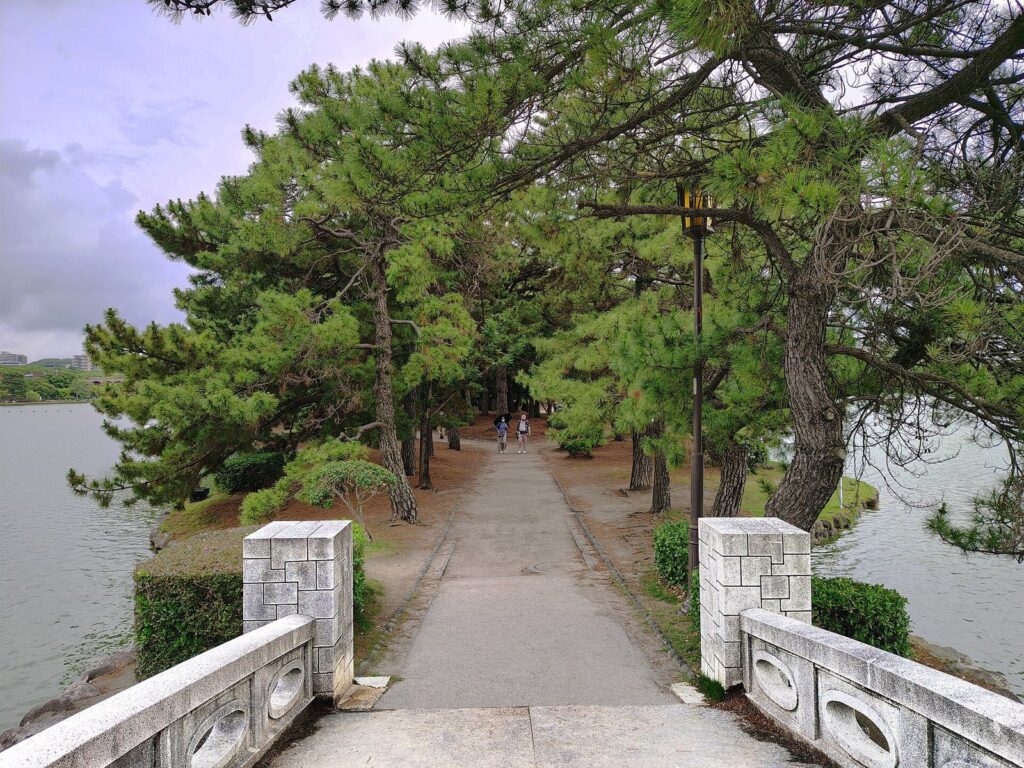
Ohori Park, over toward the bay near Fukuoka Tower, is a free, roughly 2km lakeside loop built from what used to be the outer moat of Fukuoka Castle — a genuinely pleasant walk, with the castle’s stone ruins still standing nearby and a traditional garden (Ohori Park Japanese Garden) at one end. Fukuoka Tower, a 234m seaside tower a short walk further on, costs ¥1,000 for adults (¥500 for school-age children, ¥200 for younger kids) with the observation deck open 9:30–22:00, last entry 21:30 — a reasonable sunset stop if you’re already in the Momochi area.
Festivals worth timing a trip around
If your dates line up, Fukuoka has two festivals that are worth genuinely planning around rather than stumbling into. Hakata Dontaku, held every year on 3–4 May during Golden Week, is one of Japan’s largest festivals by attendance — well over 600 performing groups and crowds in the millions over two days, centered on parades through the city. Hakata Gion Yamakasa runs from 1–15 July, building to the main event: teams racing enormous decorated floats through the streets starting at 4:59am on 15 July. Both turn the city into something genuinely different from an ordinary visit, and hotel prices rise accordingly — book well ahead if you’re coming for either one.
Day trips: Dazaifu and Yanagawa
Dazaifu, home to Dazaifu Tenmangu — one of Japan’s most important shrines, dedicated to the deified scholar Sugawara no Michizane and popular with students praying for exam success — is the easiest day trip from Fukuoka. From Hakata Station, take the JR line to Futsukaichi (roughly 15–25 minutes, around ¥340), then transfer to the Nishitetsu Dazaifu Line for the final five-minute hop (around ¥180); door to door it’s usually 30–60 minutes and a few hundred yen either way. Direct buses from Hakata Bus Terminal also run, taking about 40 minutes. Beyond the shrine itself, the approach street is lined with shops selling umegae-mochi (a grilled rice cake stuffed with sweet red bean), and the Kyushu National Museum sits a short walk away if you want one more stop.
Yanagawa, a canal town built on an old castle moat system, is the one to pick if you want something more scenic than another shrine. The draw is donkobune punting — a flat-bottomed boat poled through the town’s canals by a singing boatman — with a standard one-way course running roughly ¥1,600–2,200 for adults depending on the operator and season, taking around 40–60 minutes. From Nishitetsu Fukuoka (Tenjin) Station, a limited express gets you to Nishitetsu-Yanagawa in about 50 minutes. If you want to combine both towns in a single day, Nishitetsu sells a sightseeing ticket bundling rail travel to Dazaifu and Yanagawa with the punting tour, priced in the ¥3,600 range — worth comparing against buying each leg separately depending on how much you’re doing.
Both trips are comfortably doable as a half-day or full day out of Fukuoka and back, which is what makes basing yourself in the city for two or three nights, rather than one, worth the extra night’s hotel cost.
FAQ
How many days do you need in Fukuoka? Two full days covers the city center — ramen, the yatai, Ohori Park and Fukuoka Tower, Kushida Shrine and Canal City. Add a third day for either Dazaifu or Yanagawa, or a fourth if you want both.
Is Fukuoka worth it if I’ve already done Tokyo, Osaka and Kyoto? Yes, more than most “next step” Japan destinations. It’s smaller, easier to navigate, has its own distinct food identity, and the day trips feel genuinely different from anything near Kansai or Kanto.
Do I need the Japan Rail Pass for a Fukuoka trip? Only if Fukuoka is one stop on a longer multi-region itinerary that includes other Shinkansen travel — a nationwide pass rarely pays for itself if Fukuoka and its day trips are the whole trip, since the actual fares involved are modest.
Are the yatai stalls tourist traps? Some of the best-known ones near Tenjin and Nakasu are touristy by local standards, but the food is real and the format — eight stools around a tiny cart on a sidewalk — isn’t something a tourist trap can really fake. Go early (around 18:00–19:00) for a better seat and a calmer atmosphere than the later, louder crowd.
The verdict
Fukuoka doesn’t try to be Tokyo or Kyoto, and that’s exactly its appeal — it’s a genuinely livable, food-obsessed city that happens to have one of the best airport-to-downtown commutes anywhere, two classic day trips within an hour, and a street-food format that’s basically disappeared from the rest of urban Japan. Two or three nights is enough to eat well, see the center properly, and get out to Dazaifu or Yanagawa without rushing. If your Japan itinerary has room for one city beyond the standard Tokyo-Kyoto-Osaka loop, this is one of the strongest arguments for Kyushu over anywhere else.
Written from Japan by the Wayfarer Japan team — we live here and travel this country constantly, so every guide comes from routes and places we actually use.
Featured image: “Ōhori Park Matsushima viewed from Shōgetsubashi Ōhorikōen Chūō-ku Fukuoka 20260609 154945” by Hirho, CC BY 4.0, via Wikimedia Commons