The first thing that surprises people at a sumo tournament is how much of it is not fighting. A bout in the top division lasts a few seconds. The ritual before it lasts four minutes: salt thrown, feet stamped, two enormous men crouching, standing, walking back to their corners, and doing it again. Newcomers sometimes laugh. By the third bout, nobody is laughing, because you have worked out that the staring is the fight, and the collision is only the result.
I live in Japan, and sumo is the one traditional art that has never needed a revival or a tourist campaign to survive. It just kept going — through the fall of the shogunate, a serious attempt by modernisers to abolish it, war, television, and a run of scandals that would have killed most sports federations. Six times a year it takes over the afternoon television schedule, and the whole country half-watches it while doing something else.
Here is where it came from, and why the strange parts are the oldest parts.
The quick answer
- Sumo began as a religious act, not a sport. Wrestling at shrines was a way of asking the gods about the harvest, and the ring is still treated as sacred ground.
- The oldest written matches are mythological. The Kojiki has two gods wrestling for control of Japan; the Nihon Shoki describes a fatal bout traditionally dated to 23 BCE.
- Professional sumo is an Edo-period invention. From the 1600s, wrestlers fought at fundraising events for temples and shrines, and the ranking sheet, the stables and the six divisions all date from that era.
- It nearly died in the 1870s, dismissed as an embarrassing relic, and was saved largely because Emperor Meiji turned up to watch in 1884.
- There are six 15-day tournaments a year. Three in Tokyo (January, May, September), one each in Osaka, Nagoya and Fukuoka. The Tokyo autumn tournament runs September 13–27, 2026.
Gods, harvests and a fatal match
Two founding stories sit behind sumo, and they pull in different directions.
The mythological one is in the Kojiki (712). The god Takemikazuchi is sent to demand that the ruler of Izumo hand over the land; the ruler’s son Takeminakata challenges him to a trial of strength, loses, and flees. Sovereignty over Japan is settled by a wrestling match. If that origin story sounds familiar, it belongs to the same body of myth we cover in Shrines, Shinto and Japanese Mythology: A First-Timer’s Guide.
The semi-historical one is in the Nihon Shoki (720): a bout between Nomi no Sukune and Taima no Kehaya, traditionally dated to 23 BCE. It was not a sporting contest — Kehaya died of his injuries. Nomi no Sukune is still worshipped as the patron of sumo, at a shrine a short walk from the Kokugikan in Tokyo.
Underneath both stories is something plainer and probably older: village wrestling at shrine festivals, held to divine or secure a good harvest. Some shrines still hold these rites, and at Ōyamazumi Shrine in Ehime a wrestler performs alone against an invisible rice spirit — and loses, politely, because you do not beat a god.
From the imperial court to the battlefield
By the 700s sumo had been absorbed by the imperial court. The sumai no sechie was an annual event at which wrestlers were summoned from the provinces to compete before the emperor, framed as a ceremony for the year’s rice crop rather than entertainment. It ran for roughly four centuries and faded in the late 1100s, as the court lost power to the warrior class — the same shift that reshaped the city in The History of Kyoto: 1,000 Years as Japan’s Capital.
The samurai kept the wrestling and dropped the ceremony. Unarmed grappling was practical training for men who expected to end up on the ground in armour, and warlords patronised strong wrestlers the way they patronised swordsmiths. Oda Nobunaga is said to have staged a tournament at Azuchi Castle in 1578 with around 1,500 competitors, hiring the winners as retainers — the world of Samurai and Bushido: The Warriors Who Shaped Japan.
The Edo period: how it became a business
Peace under the Tokugawa shoguns left a lot of unemployed strong men and a lot of temples needing repairs. The answer was kanjin-zumo: ticketed wrestling staged to raise construction funds for shrines and temples. It was charity in the same sense that a stadium concert is charity, and it worked. By the 1700s sumo in Edo, Osaka and Kyoto was a professional industry with its own authority, its own stables, and printed ranking sheets — the banzuke, still published today in the same dense calligraphy, with rank shown by the size of your name.
Wrestlers became celebrities, their portraits sold by ukiyo-e artists alongside kabuki actors. Raiden Tameemon (1767–1825) won 254 top-division bouts and lost only 10, and remains the most feared name in the sport’s history, though he was never awarded the yokozuna title. Most of what a visitor sees today — the ring, the ranking system, the topknot, the referee’s costume, the stables where wrestlers live and train together — is Edo-period, not ancient.
Nearly abolished, then declared the national sport
The Meiji Restoration of 1868 almost finished it. In a Japan rebuilding itself along Western lines, half-naked men wrestling in loincloths looked like exactly the sort of thing foreigners should not see. There were serious calls to ban it, and an 1871 edict pushing men to cut off their topknots threatened the wrestlers’ most visible marker. Attendance collapsed.
What saved sumo was patronage. Emperor Meiji attended a tournament in 1884, and imperial approval reframed it overnight from an embarrassment into a national tradition. In 1909 the sport got its first permanent indoor arena in Ryogoku, named the Kokugikan — the “national sport hall.” The phrase stuck, which is why sumo is routinely called Japan’s national sport despite baseball and football being far more widely played.
The rest is modern history: radio in the 1920s, television from 1953, six tournaments a year from 1958. Takamiyama of Hawaii became the first foreign-born wrestler to win a top-division championship in 1972 and Akebono the first foreign-born yokozuna in 1993, after which Mongolian wrestlers dominated for two decades — Hakuho retired in 2021 with 45 championships, far more than anyone before him.
What the ritual actually means
Almost every strange element has a reason, and most of them are religious.
| What you see | What it is |
|---|---|
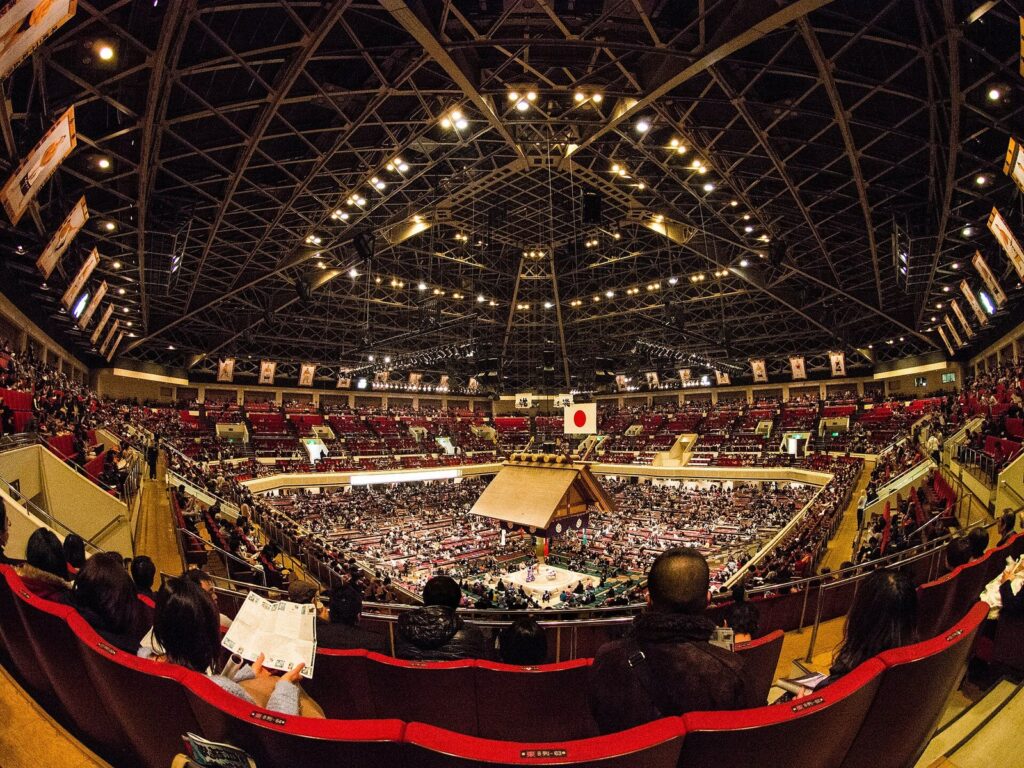
| The roof over the ring | Modelled on a Shinto shrine roof; the ring is sacred ground |
| Salt thrown before a bout | Purification, the same gesture used at shrines |
| The high leg stamps (shiko) | Driving evil spirits out of the earth |
| The referee’s robes | Court and priestly dress, not sports uniform |
| The white rope worn by a yokozuna | A shimenawa — the rope that marks a sacred object |
| The ring rebuilt in clay for every tournament | It is consecrated with a ceremony and buried offerings |
The rules are almost comically simple. Step out of the ring, or touch the clay with anything other than the soles of your feet, and you lose. There are no weight classes, no rounds and no clock. In the top division a wrestler fights 15 bouts across 15 days; eight wins is a winning record, and everything about your future depends on it.
Honesty demands the difficult parts too. The ring is still closed to women, a rule that drew fierce criticism in 2018 when women who climbed in to give first aid to a collapsing mayor were told over the loudspeaker to leave. A hazing death in 2007 and a match-fixing scandal in 2011 — which cancelled a whole tournament — forced real reform. Sumo’s conservatism is both why it survived intact and why it keeps colliding with the present.
Seeing it in 2026
As of the July 2026 tournament the sport has two yokozuna, Hoshoryu and Onosato, both of whom have spent the year fighting injuries, which has left the championship unusually open — a good year to watch, in other words.
- Tournaments: January, May and September in Tokyo (Ryogoku Kokugikan); March in Osaka, July in Nagoya, November in Fukuoka. Each runs 15 days, Sunday to Sunday. The autumn Tokyo tournament is September 13–27, 2026.
- Tickets: sold through the official Ticket Oosumo site roughly a month ahead — the September tournament went on sale August 8, 2026. Expect around ¥3,500–8,500 for chair seats and roughly ¥8,000–15,000 per person for the tatami box seats near the ring. Prices are approximate; check before booking.
- Same-day tickets: a small number of unreserved seats, around ¥2,200, are sold at the box office each morning, cash only. People start queuing before 8:00 am, and they go quickly at weekends and in the final days.
- Timing: doors open in the morning, but the lower divisions fight to a near-empty hall. The top division starts around 3:55 pm and finishes about 6:00 pm. Arriving around 2:00 pm is the sensible compromise.
- When there is no tournament: the Sumo Museum inside the Kokugikan is free outside tournament periods, Ryogoku is full of chanko nabe restaurants serving the stew wrestlers eat, and some stables let visitors watch morning practice — usually only through a guide, and always under strict silence-and-stillness rules.
Normal spectator manners apply, and they are the ones in Japan Etiquette: 15 Dos and Don’ts for Visitors: no flash photography, no wandering during bouts, and do not throw your seat cushion, however traditional that once was. If you are building a Tokyo trip around a tournament day, 15 Best Things to Do in Tokyo You Can Book Ahead and Where to Stay in Tokyo will help you place it.
FAQ
Is sumo actually Japan’s national sport by law? No. There is no legal designation. The name of the 1909 Kokugikan gave the sport the title informally, and it stuck.
How long is a bout? Usually a few seconds. Anything over a minute is a rarity and the crowd reacts accordingly.
Do wrestlers have to be huge? There is no weight limit, and the average top-division wrestler is around 160 kg, but smaller technicians win regularly. The crowd favourites are often the ones giving away 40 kg.
Can foreigners become sumo wrestlers? Yes, but each stable may have only one foreign-born wrestler at a time, which sharply limits the number in the sport.
Is watching a full day worth it? For most visitors, no. Come in the early afternoon for the upper divisions and the closing ceremonies, which is what regulars do.
The verdict
Sumo is often sold to visitors as an ancient sport, and that is only half right. The wrestling is ancient; the sport around it is a very Japanese piece of Edo-period showmanship, rescued by an emperor, wrapped in Shinto ritual, and defended ever since by an institution that would rather be criticised than change.
Watching it, that is exactly what comes across. The salt, the stamping and the long staring contests are not padding around the action. They are the older thing, and the two seconds of collision at the end is what got added later.
Written from Japan by the Wayfarer Japan team.
Featured image: “Inside the Ryogoku Kokugikan at the 2014 January Sumo Tournament” by Gregg Tavares, CC BY 2.0, via Wikimedia Commons