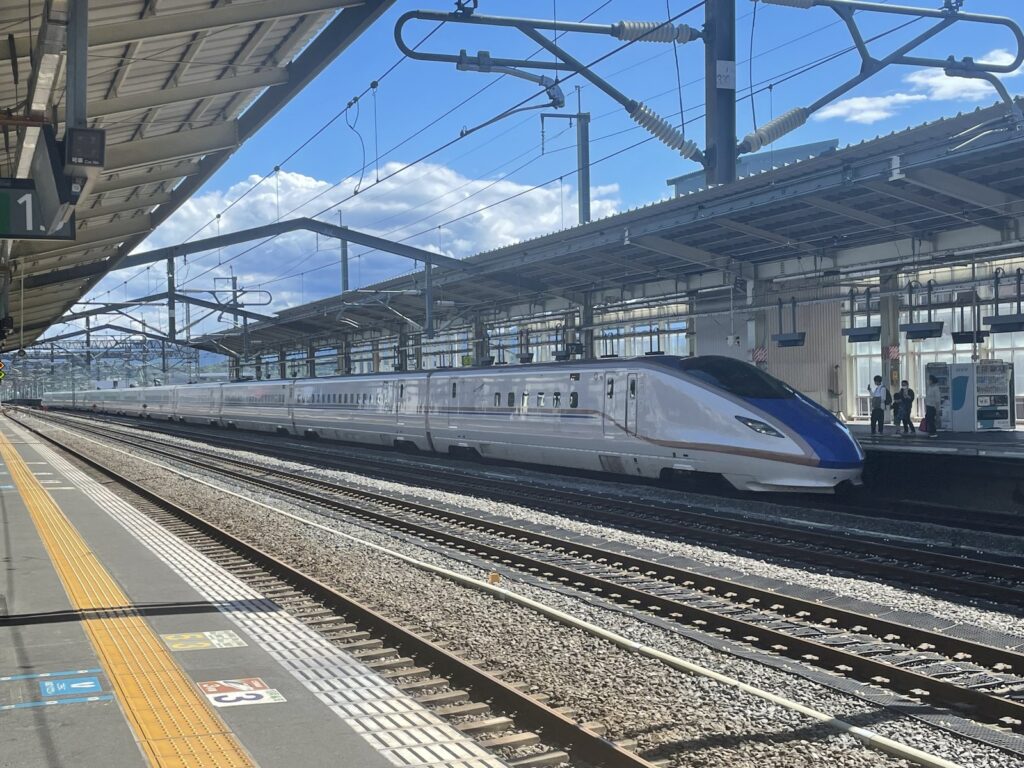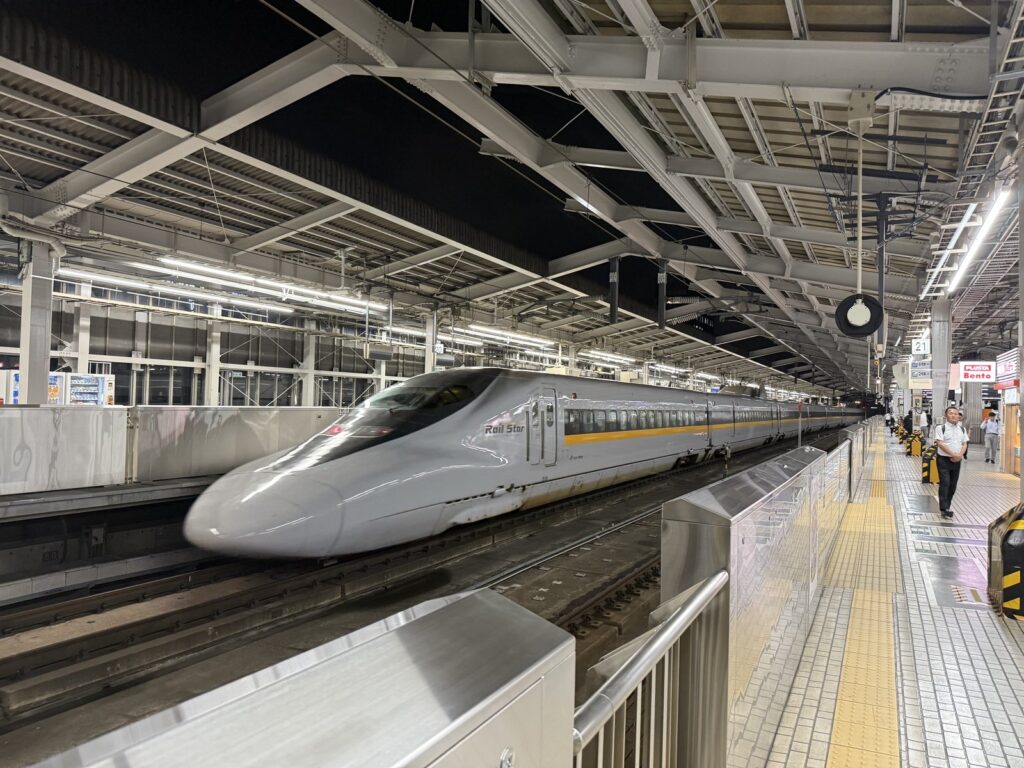
I live in Japan and I book shinkansen seats the boring way, several times a year: phone out, three taps, done. Visiting friends usually arrive imagining something far more complicated — a queue, a Japanese-only website, a mysterious deadline they have already missed. It isn’t like that. But there is one genuinely confusing part, and it’s this: there is no single shinkansen booking system. Which website you use depends on which line you’re riding, and nobody tells you that up front.
This guide sorts that out, then walks through the actual reservation, seat by seat. If you haven’t ridden one yet, read How to Ride the Shinkansen: A First-Timer’s Guide first for the basics of the two-ticket system — here I’m going one level deeper into the booking itself.
The quick answer
- Tokaido / Sanyo / Kyushu Shinkansen (Tokyo–Nagoya–Kyoto–Osaka–Hiroshima–Hakata–Kagoshima): use smartEX, in English, with an overseas credit card.
- Tohoku / Hokkaido / Joetsu / Hokuriku / Yamagata / Akita: use JR-EAST Train Reservation (the English face of eki-net).
- Reservations open exactly one month before departure, at 10:00 Japan time — and that is the same moment for every channel, online or at a window.
- Reserving costs nothing extra if you have a Japan Rail Pass, and roughly ¥720–¥1,200 more than a non-reserved seat if you’re paying cash.
- A suitcase over 160cm (height + width + depth) needs a specific “oversized baggage” seat, booked in advance and free. Skip it and it’s ¥1,000 on board.
- You do not need to reserve every trip. Off-peak on the Tokaido line, non-reserved cars are fine. During Obon, Golden Week and New Year, reserve.
Step 1: work out which system is yours
This is the step everyone skips, and it’s the reason people end up convinced the booking site is broken. It isn’t broken; they’re on the wrong one.
smartEX covers the Tokaido, Sanyo and Kyushu Shinkansen — that’s Tokyo, Shinagawa, Shin-Yokohama, Nagoya, Kyoto, Shin-Osaka, Okayama, Hiroshima, Hakata, Kumamoto, Kagoshima-Chuo. It’s run by JR Central and JR West, has a proper English app and website, and accepts Visa, Mastercard, JCB, American Express, Diners Club and Discover cards issued outside Japan. For most first trips — Tokyo to Kyoto and back — this is the only system you need.
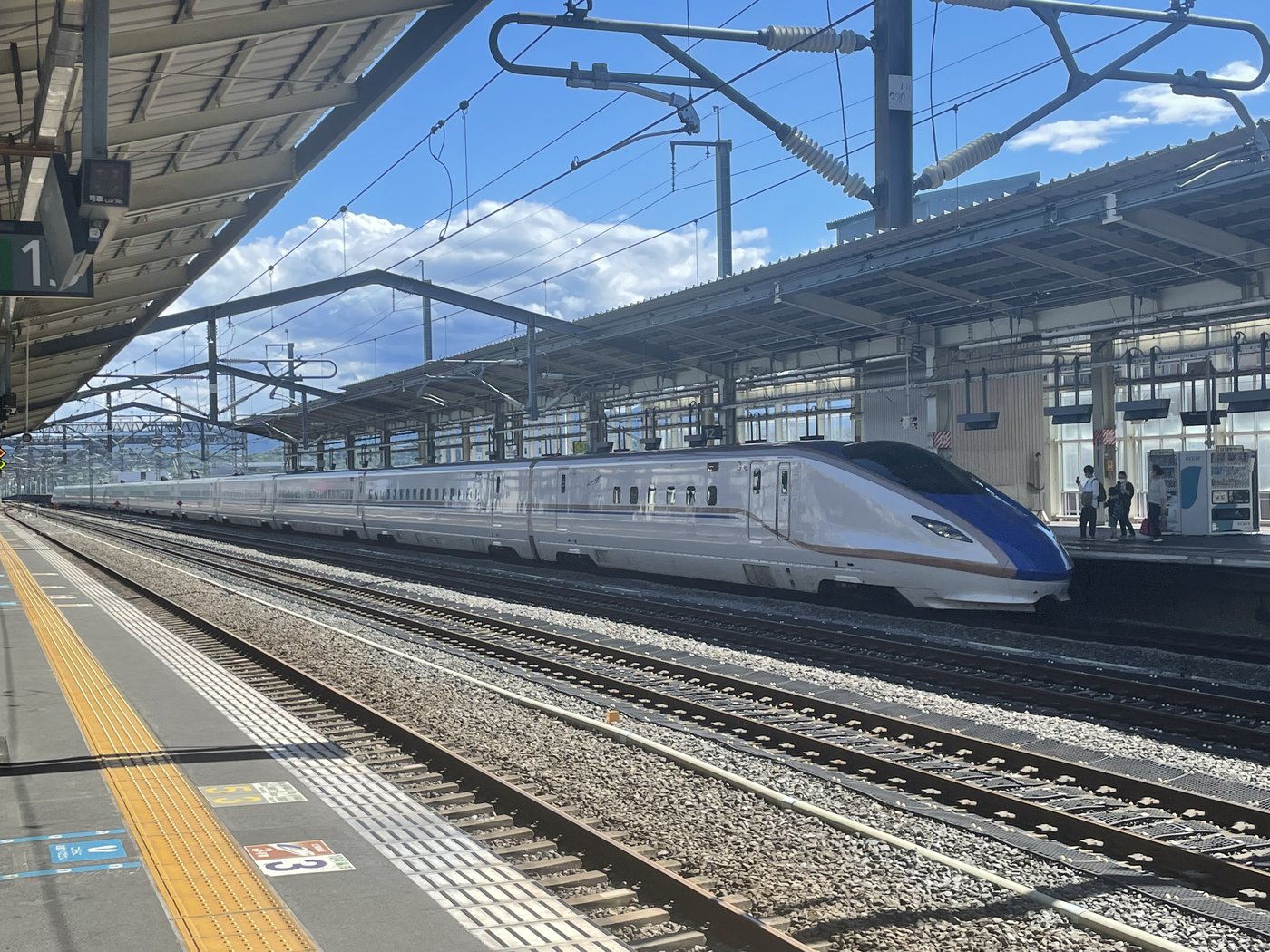
JR-EAST Train Reservation (on eki-net.com) covers everything heading north and west from Tokyo: Sendai, Aomori, Hakodate and Sapporo, Niigata, Nagano, Toyama and Kanazawa. It’s also in English, and it has the nicest seat map of the lot. I use the Japanese-language eki-net myself; the tourist-facing English version is the same booking engine with the labels translated.
JR-WEST online train reservation (e5489) overlaps with smartEX on the Sanyo line and adds JR West’s limited expresses — useful if your trip involves the Thunderbird to Kanazawa or the Haruka to Kansai Airport, less so otherwise.
You do not need accounts on all three. Pick the one matching your route and ignore the rest.
Step 2: know when the doors open
Reserved seats go on sale one month before the departure date, at 10:00 JST, to the minute. Travelling on 10 November? Booking opens 10 October at 10:00 Japan time. This is a nationwide JR rule, not a website quirk, and it applies identically at ticket windows, machines and online — nobody gets early access.
For 99% of journeys that’s irrelevant, because trains don’t sell out. It matters for the New Year peak, the first Nozomi of a Golden Week Saturday, Gran Class on the Hokuriku line, and popular scenic limited expresses. If your trip is one of those, set an alarm.
smartEX has a nice safety net here: you can put in an advance request up to a year ahead, choosing from the provisional timetable, and the system confirms it automatically from 05:30 on the morning reservations actually open. You get the seat without staying up.
At the other end, smartEX lets you reserve or change right up to four minutes before departure. I’ve done this on a platform more than once. The station machines and windows will sell you a reserved seat for a train leaving in three minutes too, if there’s space.
Step 3: make the reservation
The flow is the same on both main systems.
- Create the account before you fly. It takes five minutes — name as printed on your passport, email, credit card. Doing it on airport wi-fi with a queue behind you is miserable.
- Enter route, date and time. Search by departure time or arrival time; the results list every train with seat availability marked.
- Choose the class: Ordinary reserved, Green Car (first class, wider seats, quieter — worth it on long runs), or on the Tohoku and Hokuriku lines, Gran Class, which is closer to business-class air travel.
- Pick your actual seat from the map. Both systems let you choose, and this is where a little local knowledge pays off.
- Pay, and choose how you’ll board.
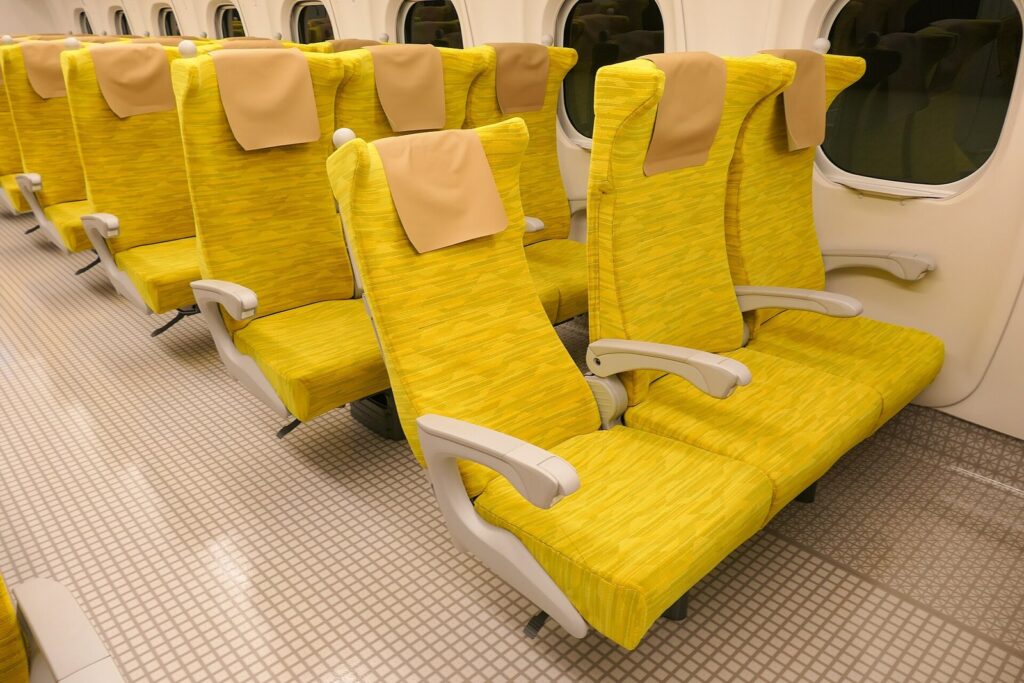
On the Tokaido line, ordinary cars are laid out 3+2. The E seat is the window on the two-seat side — no middle neighbour, and going west from Tokyo it’s the side Mt Fuji appears on, about 40 minutes out of Tokyo, weather permitting. The D seat is the other window. Row 1 in each car has a bulkhead in front with legroom and, on newer sets, space for a bag; the last row of any car has that useful gap behind the seat backs where a carry-on fits without a reservation.
For boarding: link a Suica, PASMO, Welcome Suica or PASMO PASSPORT to your smartEX account by entering the card’s 17-digit ID (it’s printed small on the back), then just tap the shinkansen gate with that card. No paper at all. If you’d rather not link a card, smartEX generates a QR code per booking, and you can also collect a paper ticket from any machine at the station. If you’re still deciding how to handle IC cards generally, How to Use a Suica Card in Japan covers it.
Step 4: the luggage rule that costs ¥1,000
On the Tokaido, Sanyo and Kyushu Shinkansen, any bag whose height + width + depth totals 160cm to 250cm requires a seat with an oversized baggage area — the back row of the car, with locked storage space behind it. Reserving it costs nothing extra, but it must be done when you book. Turn up with a big case in a normal seat and staff will charge ¥1,000 and stow the bag elsewhere.
A typical 28-inch or 30-inch check-in suitcase is over the line. A standard carry-on is not, and fits in the overhead rack or behind the last row. These seats are limited and they do go first on busy days, which is a second, quieter reason to book early. The other option is to not carry the case at all — send it ahead by takkyubin for around ¥2,000–¥2,500 and travel with a day bag, which is what I’d do; What to Do With Your Luggage in Japan explains that system.
Reserving with a Japan Rail Pass
If you hold a Japan Rail Pass (commonly called the JR Pass), seat reservations are free and unlimited. There is no reason to sit in a non-reserved car with a pass in your pocket.
Three ways to do it:
- Ticket machines: scan the QR code printed on your pass, enter your passport number, choose the train. Green reserved-seat machines at major stations do this in English.
- Ticket offices (Midori no Madoguchi): slower at peak times, but staff can handle awkward multi-leg routes.
- Online, through the JAPAN RAIL PASS Reservation site or JR-EAST Train Reservation, then collect the ticket at a machine.
The one catch: the pass does not cover Nozomi or Mizuho trains outright. You can ride them, but you pay a supplement — roughly ¥4,960 Tokyo to Shin-Osaka in 2026 — on top of the pass. Hikari and Sakura are included and only about 15–20 minutes slower on that route, so most pass holders simply take those. Whether the pass makes sense at all is a separate calculation, covered in Is the Japan Rail Pass Worth It? and, for shorter trips, Regional JR Passes: Which One Should You Buy?
What it costs without a pass
Tokyo to Shin-Osaka on a Nozomi, ordinary reserved, is about ¥14,720 bought at a station window and ¥14,520 through smartEX in 2026 — the online price is consistently a couple of hundred yen lower, which is small but free. A non-reserved seat on the same run saves roughly ¥720 in the ordinary season, a bit more at peak times.
Those are approximate figures and fares do change; check the exact amount when you book. Japan Train Fares Explained breaks down why a shinkansen ticket is really two charges added together.
If you can commit to a specific train weeks ahead, smartEX’s early-bird discount fares (EX Hayatoku) cut more meaningfully — they’re limited in number and inflexible, but on Tokyo–Hiroshima the saving is real.
Dates when you must reserve
On the Tokaido and Sanyo lines, Nozomi runs with no non-reserved cars at all during Japan’s peak travel windows. In 2026 those are Golden Week (24 April–6 May), Obon (7–16 August), Silver Week (18–23 September) and year-end/New Year (25 December–5 January 2027), and JR Central has extended the policy to several three-day weekends: 10–12 October, 21–23 November, 9–11 January 2027 and 20–22 March 2027.
On those dates, no reservation means no Nozomi — though Hikari, Kodama, Sakura and Tsubame keep their non-reserved cars, so you’re never actually stranded. Outside those windows the Nozomi’s non-reserved cars are cars 1, 2 and 3; Hikari and Kodama have more.
FAQ
Do I need to reserve at all? Not usually. On a Tuesday in February, walk to the platform, board a non-reserved car, sit down. Reserve when you’re travelling as a group, carrying big luggage, moving on a Friday evening or Sunday afternoon, or travelling in the peak periods above.
Can I change my reservation? On smartEX, yes — as many times as you like before departure, at no charge, within three months of purchase. Cancelling refunds the fare minus a fee of about ¥320 for ordinary seats. This flexibility is the best argument for booking online rather than buying paper at the window.
I missed my train. Is the ticket dead? On the Tokaido/Sanyo lines, a missed reserved-seat ticket normally still lets you ride a non-reserved car on a later train the same day. Don’t rely on it for discount fares, and ask staff rather than guessing.
Can I book before arriving in Japan? Yes. Both main systems accept overseas cards and overseas addresses. Just remember the one-month window — booking a Tokyo–Kyoto trip six weeks out simply isn’t possible yet.
Are seats reserved for a specific train, or the whole day? A specific train, specific car, specific seat. Board any other train and your seat isn’t yours.
Is the Green Car worth it? On a two-and-a-half-hour run with luggage and a laptop, I think so — 2+2 seating, more recline, calmer car. On a 40-minute hop, no.
The verdict
Shinkansen reservations look intimidating and take about three minutes. Work out which system covers your line, make the account before you fly, remember that booking opens one month ahead at 10:00 Japan time, and check whether your suitcase crosses the 160cm line. Everything else — seat maps, Fuji-side windows, Green Car — is refinement.
And if you get to the station having booked nothing at all, on most days of the year you’ll still be on a train within 20 minutes. That’s the quiet luxury of the system here: it rewards planning, but it doesn’t punish you for skipping it.
Written from Japan by the Wayfarer Japan team — practical, honest advice from people who actually live here.
Featured image: “N700S 725-8104 3-seats” by MaedaAkihiko, CC BY-SA 4.0, via Wikimedia Commons