I live in Japan, and I have watched a lot of visitors stand at the edge of a famous garden, take a photo in about eight seconds, and walk on. It is understandable. Nothing is labelled, nothing moves, and what you are looking at is mostly gravel and shrubs.
But a Japanese garden is not scenery. It is a composition, closer to a painting than to a park, and almost every element answers a design problem someone worked on for years. Once you know what the designer was after, the eight seconds becomes twenty minutes — one of the cheapest upgrades available to a Japan trip, since most gardens cost less than a coffee.
The quick answer
- Three main types, not interchangeable: the pond stroll garden (walk through it), the dry garden or karesansui (sit and look at it), and the tea garden or roji (pass through it on the way somewhere).
- Water is always present, even when there is none. Raked gravel is a sea; a flat stone spanning it is a bridge.
- Nothing is symmetrical or centred. Stones are set in odd-numbered groups, often threes.
- The view is composed from specific spots — a veranda, a turn in the path. The entrance is the one place it was not composed for.
- Distant mountains are part of the design, a technique called shakkei, borrowed scenery.
- Cheap: Ryoan-ji ¥600, Tenryu-ji’s garden ¥500, Kenroku-en ¥320, Rikugien ¥300 (2026 figures, worth re-checking).
The oldest garden manual in the world is Japanese
Japan has been arguing about how to place a rock for a thousand years. The Sakuteiki, compiled in the 11th century and generally attributed to the nobleman Tachibana no Toshitsuna, is the oldest surviving text on garden design anywhere, and it opens with instructions on setting stones rather than on planting anything.
Its most quoted line tells the designer to follow the request of the stone — set it the way its shape and weight want it to sit, rather than forcing it into a plan. That sounds mystical until you see a badly placed rock, which looks as wrong as a chair on its side. The manual also warns that certain placements bring misfortune: gardens here began as an extension of religion, not decoration.
Type one: the pond garden you walk into
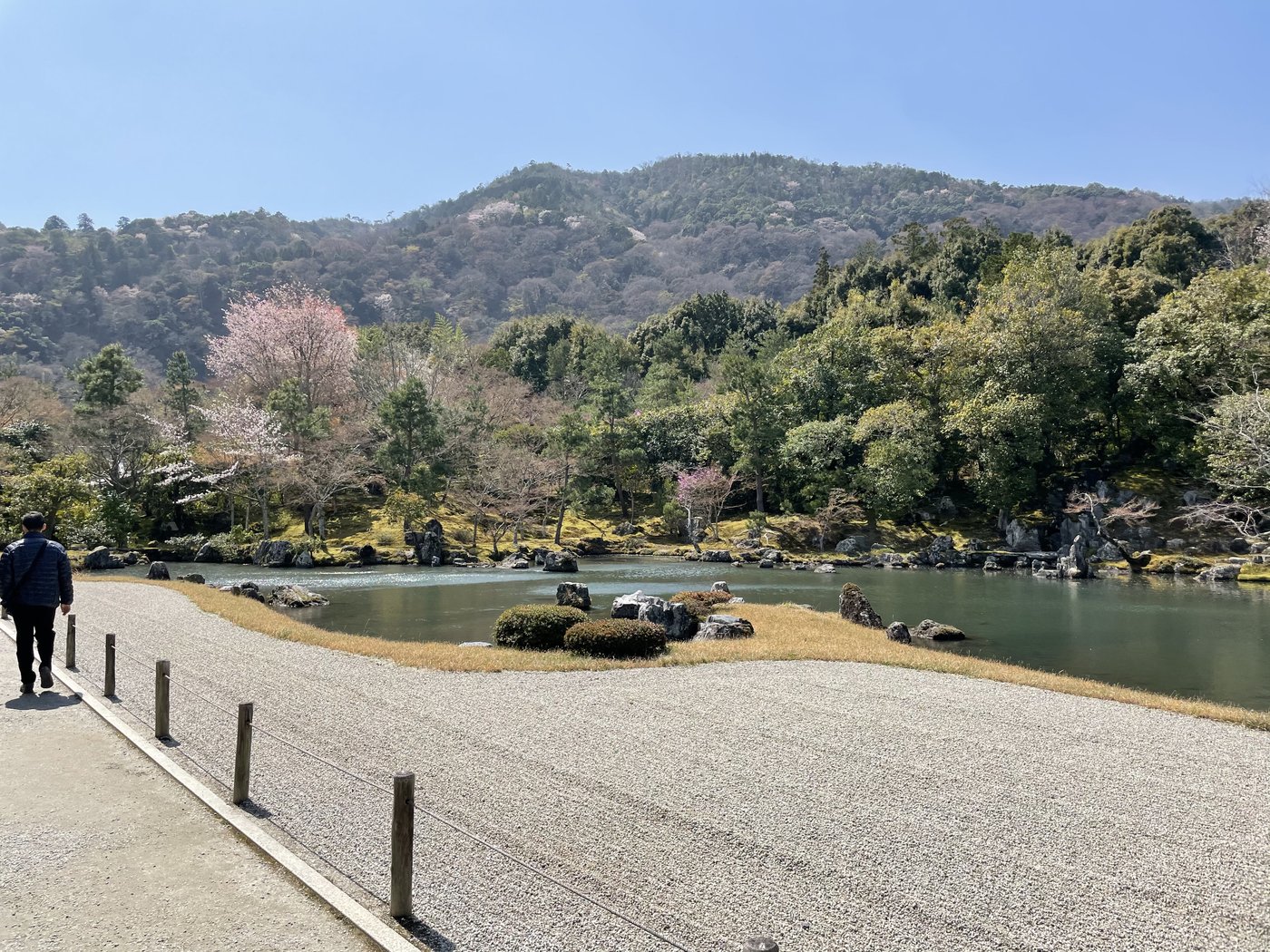
The oldest style, and the one most visitors already have in their heads: a pond, an irregular shoreline, one or more islands, a path that loops the whole thing.
The islands are usually not just islands. A tall vertical rock arrangement is often Horai, the mythical isle of the immortals from Chinese legend. A long low island with a stone “head” is a turtle; a spread of upright stones is a crane — a thousand and ten thousand years of life respectively, a garden wishing longevity on the family that owns it.
The Edo-period stroll garden, kaiyu-shiki, turns this into a sequence. The path deliberately blocks and reveals the view — miegakure, hide-and-reveal — so the garden unfolds like a scroll instead of showing itself at once. Tokyo’s Rikugien is the extreme case: it was built to recreate eighty-eight scenes from classical waka poetry, so a nineteenth-century guest could walk the loop and recognise the poems.
Type two: the dry garden you are not supposed to enter
Karesansui — literally dry mountain water — is the style people mean when they say “Zen garden.” It emerged in the Muromachi period at Zen temples, where the garden became something to contemplate from a fixed position rather than walk through.
Ryoan-ji in Kyoto is the famous one: fifteen stones in five groups on a rectangle of raked white gravel, framed by an oil-stained clay wall that was never meant as a neutral backdrop. The standard telling is that from any single seated position on the veranda you can see only fourteen of the fifteen. Whether that was intended is unknown — nobody is sure who designed it, or exactly when — but it makes the point the style is built on: you are not given the whole thing.
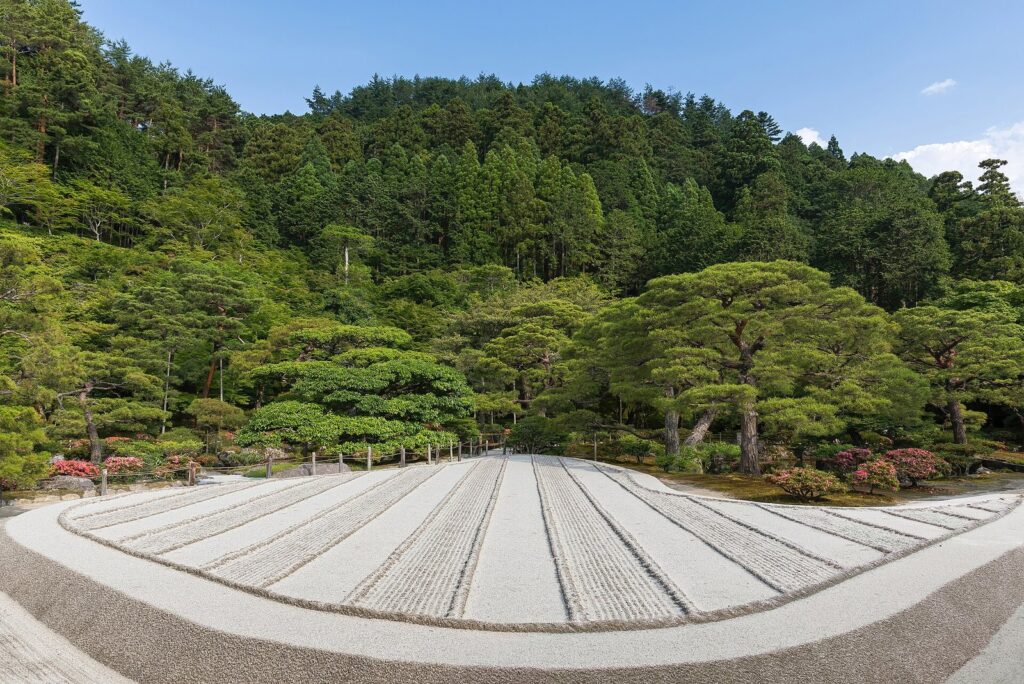
The gravel is raked into lines that read as water, and moss at a stone’s base reads as a forested shore. The empty area is not filler; ma, the interval between things, is an active element here in the way a rest is part of a piece of music. It is the same instinct that produced wabi-sabi, which I cover in Wabi-Sabi: The Japanese Art of Beauty in Imperfection. Practical note: you sit on the wooden veranda, shoes off, and the gravel is never walked on.
Type three: the tea garden, which is a corridor
The roji — “dewy ground” — is the small garden you cross to reach a tea house, and it is the least photogenic and most purposeful of the three. Its entire job is to reset your head between the street and the tea room.
Everything in it is functional in a psychological way. Irregular stepping stones (tobi-ishi) force you to look down and slow to a set pace. A stone basin (tsukubai) sits low enough that you must crouch to rinse your hands and mouth. Plantings are deliberately plain — mostly evergreen, few flowers — so nothing competes with the single arrangement waiting inside. Sen no Rikyu, who shaped all this in the sixteenth century, is said to have watered the path just before guests arrived so the moss looked freshly rained on. The Japanese Tea Ceremony: History and Meaning covers what happens once you are through the door.
Borrowed scenery, and the gardeners who protect it
Shakkei is the technique of pulling something outside the garden — a mountain, a temple roof, a stand of cedars — into the composition, then framing it with a clipped hedge or a gap in the trees so it reads as part of the garden rather than as background. Entsu-ji in northern Kyoto is the textbook case: a low hedge and a screen of trunks turn Mount Hiei into the garden’s back wall.
This is also why Japanese gardeners prune so aggressively. A pine here is shaped by hand, needle cluster by needle cluster, over decades — partly for its own form, partly to keep the sightline to the borrowed view open. Maintenance is not upkeep, it is the ongoing act of design. At Kenroku-en in Kanazawa, the yukitsuri ropes go up on the pines from around 1 November, cones of rope hung from poles to stop snow snapping the branches.
The Adachi Museum of Art in Shimane, which has topped a well-known annual ranking of Japanese gardens for over twenty years, takes the framing idea to its limit: its gardens are viewed only through windows, like hanging scrolls, and cannot be walked in at all. Admission is ¥2,500, or ¥2,400 for adults showing a foreign passport.
How to actually look at one
- Find the seat. A veranda, a bench or a widening in the path is where the composition resolves. Sit and give it five minutes.
- Look for the odd numbers. Groups of three stones — tall, medium, low — are everywhere, echoing a Buddhist triad.
- Check what has been hidden. If the path bends for no reason, something is being kept from you until the next turn.
- Look up and out. Ask what the designer let you see beyond the wall, and what they blocked.
- Go early. Most temple gardens open at 8:00 or 8:30, and a dry garden with six people on the veranda is a different thing from one with sixty. The religious background is worth a look too — see Shinto vs Buddhism: Japan’s Two Religions Explained.
FAQ
Are Japanese gardens expensive to visit? Usually no. Ryoan-ji ¥600, Tenryu-ji’s garden ¥500 (¥300 more for the buildings), Okayama’s Koraku-en ¥500, Shinjuku Gyoen ¥500, Kenroku-en ¥320, Rikugien ¥300. The exceptions are Ginkaku-ji, which doubled to ¥1,000 for high-school age and above in April 2026, and the Adachi Museum at ¥2,500. Many temples take cash only, so carry coins. Figures are approximate — confirm before you go.
Do any require booking? Two. Saiho-ji, the moss temple in Kyoto, is reservation-only — ¥4,000 plus a small online fee, and you copy a sutra before being let into the garden. Katsura Imperial Villa runs Imperial Household Agency tours at ¥1,000, bookable online about three months ahead.
What is the best season? All four are designed for, which is the point. Spring for cherry and fresh moss, autumn for maples, winter for structure and snow — a snow-covered dry garden is arguably the best version of it. Summer is hot but the moss is greenest. For timing autumn colour, see Best Autumn Leaves Spots in Japan: Where and When to See Koyo (2026).
If I only see one, which? Ryoan-ji for the dry garden, Tenryu-ji for a pond garden with a borrowed mountain behind it, Kenroku-en if you are heading to Kanazawa.
The verdict
A Japanese garden gives back exactly as much as you bring to it. Walk past and it is shrubbery. Know that the gravel is an ocean, the three stones are a mountain range, the bend in the path is deliberate and the hill on the horizon was written into the plan four hundred years ago, and it becomes one of the most concentrated things you can see in this country.
You do not need the vocabulary. Just sit down for five minutes and assume everything in front of you was placed on purpose, because it was. Kyoto has the greatest concentration of them — I list the ones worth building a day around in Best Things to Do in Kyoto: Temples, Gardens and More (2026).
Written from Japan by the Wayfarer Japan team.
Featured image: “Dry-sand Zen garden made of beige stripes a sunny day at Higashiyama Jisho-ji Buddhist temple Ginkaku-ji Kyoto Japan” by Basile Morin, CC BY-SA 4.0, via Wikimedia Commons