I live in Japan, and the geisha is the subject visitors arrive with the most confident wrong ideas about. Usually those ideas came from one novel and one film, both made by people outside the profession, and both of which the most famous living geiko has spent two decades objecting to.
The real history is stranger than the fiction. It involves male party entertainers, an eighteenth-century licensing office, a rule about which way you tie your belt, and a profession that now numbers roughly two hundred and fifty women in the whole of Kyoto.
The quick answer
- Geisha means “arts person” — gei (art) plus sha (person). Not “courtesan.” Courtesans were a separate, legally distinct profession called yujo, and the highest ranking of them were oiran.
- The first geisha were men, working the pleasure quarters as jesters and drummers from the 1600s.
- In Kyoto they are not called geisha. A full professional is a geiko; an apprentice is a maiko.
- There are about 250–260 left in Kyoto across five districts, roughly 70 of them maiko (Ookini Zaidan figures, approximate and falling).
- Most “maiko” you see in daylight are tourists in a makeover studio’s costume. Real ones are almost always moving, at dusk, and in a hurry.
- Photographing them on Gion’s private streets is banned and carries a ¥10,000 penalty. Public streets are fine — but ask first.
- You can see them legitimately at seasonal public dances or Kamishichiken’s summer beer garden, from about ¥2,000, no introduction needed.
The first geisha were men
In the pleasure quarters of seventeenth-century Japan, the entertainment at a party was provided by men — taikomochi, “drum bearers,” also called hokan. They told jokes, played the drum and managed the mood of the room. They were, in effect, professional party hosts, and they were the original geisha.
Women began doing the same work around the 1750s, in Edo’s Fukagawa district and inside the licensed quarter at Yoshiwara. They were called onna geisha to distinguish them from the men, and within about thirty years they had comprehensively taken over. The male line never quite died: a handful of taikomochi still work in Japan today.
The rule that separates them from courtesans
This is the part the fiction gets wrong, and it was settled by law, not by custom.
By 1779 the authorities had set up a registry office, the kenban, to license geisha and police what they did. The reason was commercial: licensed courtesans were the quarter’s paying business, and geisha were undercutting them by being cheaper and better company. So the rules drew a hard line. A geisha sold performance — shamisen, dance, song, conversation — and was forbidden from competing for the courtesans’ trade.
There was even a dress code you can still read at a glance. Courtesans tied the obi in an elaborate knot at the front. Geisha tied theirs at the back, like any other woman. If you see a photograph of a spectacular front-tied obi captioned “geisha,” you are looking at an oiran — almost certainly a modern costume experience, since licensed prostitution ended in Japan in 1958 and the profession went with it.
Maiko and geiko: the five-year apprenticeship
Kyoto keeps its own vocabulary. A maiko — “dance child” — is an apprentice, usually starting at fifteen or sixteen after finishing compulsory school. Before that comes about a year as shikomi, living in the okiya (the house that sponsors her), doing chores, learning Kyoto dialect and going daily to lessons in dance, shamisen, tea and drum — then a short minarai period of “learning by watching” at real parties, saying almost nothing.
She then works as a maiko for around five years before erikae, the “collar change” — swapping the red embroidered under-collar for a white one — and becoming a full geiko, usually around twenty or twenty-one. From then she works independently for as long as she likes; some geiko are in their seventies.
Telling them apart is easy once you know: a maiko wears her own hair, styled and slept on a wooden neck-rest, with seasonal flower ornaments (hana-kanzashi) that change monthly, a trailing darari obi almost five metres long, and tall wooden okobo sandals. A geiko wears a wig, a short tied obi and far more restrained everything. The apprentices are the showy ones — the opposite of what most visitors assume.
The five flower towns
Kyoto’s districts are called hanamachi, “flower towns,” and there are five: Gion Kobu (the largest and most prestigious), Gion Higashi, Miyagawa-cho, Pontocho and Kamishichiken. The last, up by Kitano Tenmangu shrine, is the oldest and calmest — seven teahouses built in the fifteenth century, reportedly from timber left over from the shrine’s reconstruction.
The work happens at an ochaya, a teahouse, which serves no meals — food is brought in from a nearby restaurant. The event is an ozashiki, a banquet where geiko and maiko dance, play, pour and run drinking games such as konpira fune fune. Traditionally the fee was measured by how long an incense stick took to burn, and the bill was never presented at the table; it arrived later, at the house, on trust.
That is why teahouses run ichigen-san okotowari — “no first-time customers.” It is less snobbery than an unsecured credit system. Reckon on ¥50,000 and up per person if a hotel concierge or specialist agency arranges an introduction. I have never been to one, and neither have most Japanese people.
What Memoirs of a Geisha got wrong
Arthur Golden’s 1997 novel, and the 2005 film, gave the English-speaking world its mental image of this profession. Mineko Iwasaki, once the top-earning geiko in Gion Kobu, gave Golden extensive interviews, was named in his acknowledgements against her wishes, and then sued him — she said the book’s treatment of mizuage misrepresented her life and the profession, and that being identified exposed her to serious backlash. The case settled in 2003. Her own account, Geisha, a Life, is the better book.
The practical upshot for a visitor: the women you may glimpse in Gion are skilled performing artists who trained for years, and they are at work. Treat the encounter the way you would treat passing a violinist on the way to a concert.
How to actually see one, respectfully
The rules first. Since April 2024, Gion’s private alleys are closed to visitors — signs in Japanese and English mark them, and photographing geiko or maiko there carries a ¥10,000 penalty. Public streets such as Hanami-koji and the Shirakawa canal are open, but ask before photographing anyone, and never follow, block or touch. The rule came after years of tourists physically grabbing maiko.
The honest options, cheapest first:
| Option | When | Rough cost |
|---|---|---|
| Kamishichiken Beer Garden | 1 Jul – 5 Sep, evenings | ~¥2,000 starter set |
| Miyako Odori (Gion Kobu) | April | ¥2,000–¥7,000 |
| Gion Corner sampler show | Most evenings | ¥5,500 general seat |
| Gion Odori (Gion Higashi) | Early November | Around ¥5,000 |
| Ozashiki via introduction | Year-round | ¥50,000+ per person |
The seasonal public dances are the real thing and remarkably cheap. Miyako Odori runs the whole of April at the Gion Kobu Kaburenjo; Miyagawa-cho, Pontocho and Kamishichiken each stage their own in spring, and Gion Higashi’s Gion Odori comes in November. Dates and prices shift yearly, so confirm before booking.
If you are here in summer, Kamishichiken’s beer garden is the accessible one: the district opens its theatre courtyard from early July to early September, evenings only, with maiko and geiko in yukata taking orders and chatting between tables. It is informal, slightly surreal, and the best value in this subject; our Japan in Summer: Surviving the Heat, Festivals and Obon guide covers what else is on then.
FAQ
Are geisha prostitutes? No. They were a legally separate profession from courtesans by the 1770s, and licensed prostitution was abolished in Japan in 1958. The association comes from the occupation-era “geisha girls,” who were not geisha.
Can men be geisha? Yes, and they were first. A small number of male taikomochi still perform.
Is it rude to photograph a maiko in the street? On Gion’s private alleys it is prohibited and fined. Elsewhere it is legal but she is at work — ask, accept a no, and do not follow her. See our Japan Etiquette: 15 Dos and Don’ts for Visitors for the wider picture.
How do I know if I am looking at a real maiko? Time of day and speed. Real maiko appear mostly around dusk and walk purposefully. Someone posing for photos at two in the afternoon is almost certainly a visitor from a makeover studio — a perfectly nice thing to do, just not the same thing.
Are there geisha outside Kyoto? Yes. Tokyo has active districts in Asakusa, Kagurazaka, Akasaka and Shimbashi, and there are others in Kanazawa and Niigata. Outside Kyoto they are called geisha, not geiko.
The verdict
The geisha is not a relic and not a fantasy: it is a working performing-arts profession, about two hundred and fifty women strong in Kyoto, whose apprenticeship still takes five years. Knowing it began with men, and that the courtesan connection was outlawed in the eighteenth century, changes what you see when a figure in a trailing obi crosses Hanami-koji at dusk.
You do not need an introduction or ¥50,000 to appreciate it. Buy a ¥4,000 seat at a spring dance, or a ¥2,000 beer in Kamishichiken in August, and put the phone down when someone walks past. For the backdrop, see The History of Kyoto: 1,000 Years as Japan’s Capital, and The Japanese Tea Ceremony: History and Meaning for the discipline underpinning the training.
Written from Japan by the Wayfarer Japan team. Prices and dates are 2026 figures and approximate — confirm before you book.
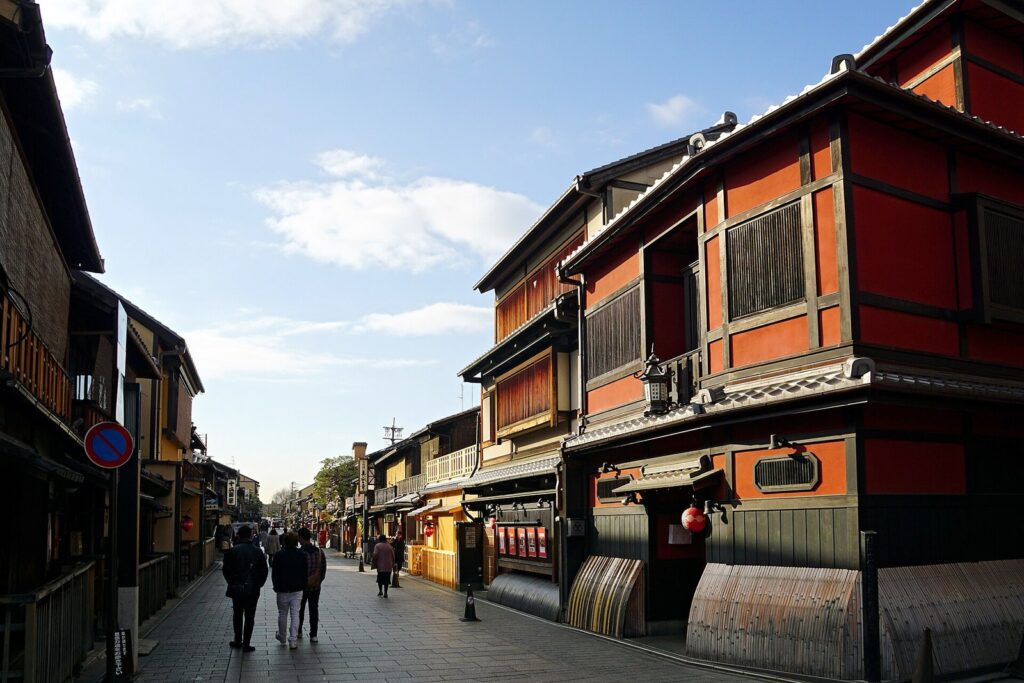
Featured image: “150124 Gion Kyoto Japan01s3” by 663highland, CC BY 2.5, via Wikimedia Commons