I live in Japan, and Kamakura is the day trip I recommend more than any other — not because it is the most spectacular, but because it is the one that is almost impossible to get wrong. One train from Tokyo, no reservation, no pass arithmetic, about an hour. You step off into a town of temple gates, wooded hills and a beach, and you are back in the city for dinner.
It was the seat of Japan’s first shogunate from 1185, which is why a small coastal town of 170,000 people has the temple density of a former capital. It also has a problem: everyone else has worked this out too. The trick to Kamakura is not choosing what to see — it is choosing which quarter of town to spend your day in, and knowing which train to avoid.
The quick answer
- Take the JR Yokosuka Line from Tokyo Station, direct to Kamakura in 55–60 minutes for ¥1,034 with an IC card (¥1,040 paper). From Shinjuku or Shibuya, the Shonan-Shinjuku Line runs direct in about the same time and for about the same money.
- Covered by the Japan Rail Pass (commonly called the JR Pass). The Enoden local line is not.
- Get off at Kita-Kamakura, one stop early, if you want the Zen temples — then walk into town. It is the single best move on this list.
- The Great Buddha (Kotoku-in) is ¥300, plus ¥50 to walk inside the statue. Hase-dera is ¥400. Both take cash at the gate.
- The Enoden coastal line is charming and badly overcrowded. Kamakura to Hase is ¥200, Kamakura to Enoshima ¥260 and 25 minutes. Trains run every 12 minutes and are four cars long.
- Passes: the Enoden one-day Noriorikun is ¥800, the bus-and-Enoden Kamakura Free Kankyo Tegata is ¥900, and Odakyu’s Enoshima-Kamakura Freepass from Shinjuku is ¥1,640. Most people need none of them.
- Leave Tokyo by 08:30. Temples close between 16:00 and 17:30.
Getting there: genuinely one train
From Tokyo Station, Yokosuka Line trains leave from the deep underground platforms (allow ten minutes to walk down) and run through Shinagawa, Yokohama and Ofuna to Kamakura — 53.9 km, about 55 minutes, ¥1,034 on a Suica or PASMO. From Shinjuku, Shibuya or Ebisu, Shonan-Shinjuku Line trains run to Kamakura directly, though not every train continues past Ofuna, so check the destination on the platform display.
No reservation exists to make and no limited express is involved. Tap in, sit down. If you want a guaranteed seat both ways, these trains carry double-decker Green Cars: because Tokyo–Kamakura is just over the 50 km line, the fee is ¥1,000 with an IC card rather than ¥750, and buying a paper Green ticket instead of tapping costs ¥260 more. Buy it on your phone or at the platform machine, then tap the card on the ceiling reader above your seat.
If you have not sorted out an IC card yet, our guide Suica, PASMO and Welcome Suica covers which one you can actually get, and Is the Japan Rail Pass Worth It? explains why a single day trip like this almost never justifies a rail pass on its own.
Kita-Kamakura: get off one stop early
The stop before Kamakura is Kita-Kamakura, and it is where the two great Zen temples are. Engaku-ji (¥500) is a thirty-second walk from the platform; Kencho-ji (¥500), Japan’s oldest Zen training monastery, is fifteen minutes further along the road. Meigetsu-in (¥500) sits between them and is the hydrangea temple — in June the approach is a wall of blue, with an extra ¥500 for the rear garden and a queue to match.
From Kencho-ji it is a pleasant twenty-minute downhill walk into central Kamakura, which means you see the quiet half of town first and arrive at the main street on foot rather than fighting the crowd at Kamakura Station.
The Enoden, and the honest problem with it
The Enoshima Electric Railway — the Enoden — is the little green-and-cream line that runs from Kamakura along the coast to Fujisawa, at points close enough to the houses to see into people’s kitchens. It is genuinely lovely and it is genuinely overwhelmed: four-car trains every twelve minutes, a congestion rate that hit 146% in the 2024 financial year, and queues at Kamakura Station on peak weekends that have run past an hour. During Golden Week, Kamakura City and the railway operate a priority-entry lane at Kamakura Station between 12:00 and 16:00 for local residents holding proof of address, which tells you everything about how bad the middle of the day gets.
What I would actually do: ride the Enoden early or late, not between 11:00 and 15:00. The walk from Kamakura Station to the Great Buddha takes about 25 minutes through ordinary residential streets and is frequently faster than the train on a busy Sunday. Or start at the far end — take JR to Fujisawa and ride the Enoden inbound, against the flow.
Which pass, if any
| Pass | Price (adult) | Covers | Worth it? |
|---|---|---|---|
| None — just your IC card | — | Everything, pay as you go | Usually the right answer |
| Enoden 1-day “Noriorikun” | ¥800 | The whole Enoden line, all day | Only if you make 4+ hops along the coast |
| Kamakura Free Kankyo Tegata | ¥900 | Local buses from Kamakura Station east exit plus Enoden Kamakura–Hase | Good if you are doing the eastern temples by bus |
| Odakyu Enoshima-Kamakura Freepass | ¥1,640 from Shinjuku | Round trip Shinjuku–Fujisawa, all Enoden, Odakyu to Katase-Enoshima | Good if you are pairing Kamakura with Enoshima |
The Noriorikun is sold at Enoden stations and as a digital ticket in Odakyu’s EMot app; the Kankyo Tegata is sold at the Enoden windows at Kamakura and Hase and at the Keikyu bus counters, and comes with small discounts at around seventy shops and temples.
One correction worth making, because older blogs and a lot of AI-written pages still recommend it: the JR “Kamakura-Enoshima Pass” no longer exists. JR East discontinued it in March 2020. If a site is still telling you to buy one, it has not been updated in six years.
A route that works
Morning, north: Kita-Kamakura → Engaku-ji → Meigetsu-in → Kencho-ji → walk down to Tsurugaoka Hachimangu, the shrine at the head of the town’s central avenue. Entry to the shrine grounds is free (the treasure hall is ¥200). Then eat on Komachi-dori, the crowded souvenir street running back to the station.
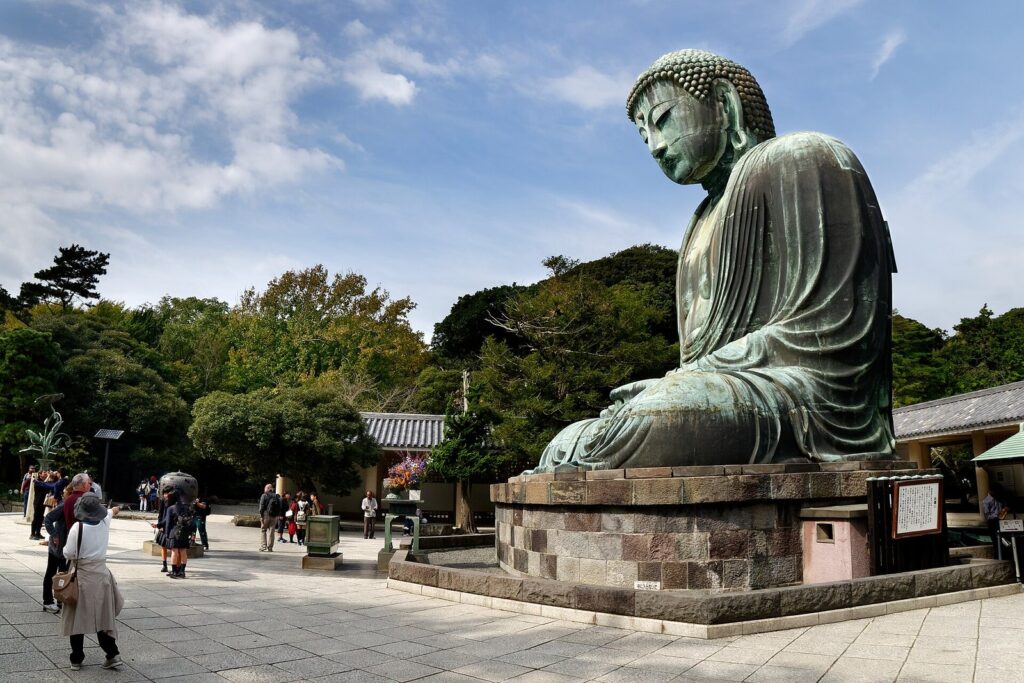
Afternoon, west: Enoden or walk to Hase. The Great Buddha at Kotoku-in — 13.35 metres of bronze, cast in 1252, sitting in the open air since a tsunami took its hall in 1498 — costs ¥300, with ¥50 more to duck inside the hollow statue. Open 08:00–17:30 April to September and 08:00–17:00 October to March, with the interior closing at 16:30. Five minutes away, Hase-dera (¥400) has the better view: a hillside garden, a sea terrace looking over Sagami Bay, and a cave you shuffle through bent double. In June its hydrangea path runs on ¥500 timed tickets on top of admission.
Alternative afternoon, east: skip the coast entirely and take a bus toward Jomyoji for Hokoku-ji (¥400), a small temple with two thousand stalks of bamboo behind it and a tea house where ¥600 buys matcha and a sweet with the grove in front of you. Open 09:00–16:00, cash only, closed 29 December to 3 January. It is the one place in Kamakura where I have reliably found quiet.
If you would rather have the history explained as you walk it — and Kamakura genuinely rewards that, since half of what you are looking at is thirteenth-century politics in stone — a small-group guided walk is a reasonable spend.
👉 Klook Kamakura guided walking tour
Walkers: the Kuzuharaoka–Daibutsu hiking trail links Kita-Kamakura to the Great Buddha over the ridge in about two hours, and the Tenen course runs east; both were closed for years after the 2019 typhoons and are open again, with the Tenen route’s last closure lifted on 10 March 2026 after a fallen tree was cleared. Wear real shoes — these are muddy forest paths, not paved walkways.
Eating: shirasu, and the season nobody warns you about
Kamakura’s local dish is shirasu — whitebait, caught in Sagami Bay, eaten either boiled (kama-age) or raw (nama-shirasu) over rice. The raw version is the one people come for, and it is not available from 1 January to 10 March, when the Kanagawa fishery is closed. The season opens on 11 March. Even in season, a rough sea means no catch that morning, so a shop’s “sold out” sign is honest rather than a brush-off. Boiled shirasu is available year-round.
The Slam Dunk crossing
The level crossing at Kamakura-Kokomae, where the Enoden passes between a school gate and the sea, is the opening shot of Slam Dunk, and it now draws thousands of people a day standing in a live road to photograph it. Kamakura City has added multilingual signs, security staff and an official designated photo spot in the park just west of the crossing, and has resorted to crowdfunding to pay for the guards. Take the photo from the park, keep out of the roadway, and do not stand on the tracks. Residents live there.
Practical notes
- Bring cash. Temple gates are cash-only, including the Great Buddha and Hokoku-ji. Convenience-store ATMs in town take foreign cards — see Cash or Card in Japan for which ones.
- Forgot something? Do not stress. There is a large convenience store cluster around Kamakura Station, and a Uniqlo one stop away in Ofuna. Umbrellas are ¥700 at any 7-Eleven, and summer here is hot and humid enough that you will want one for shade as much as rain — our Japan in Summer guide covers surviving it.
- Coin lockers at Kamakura Station fill by mid-morning on weekends. If you are moving hotels the same day, forward the bag instead.
- Weekday over weekend, always. The difference is not marginal; it is the difference between a nice town and a queue.
- Kamakura is an easy day from anywhere central in Tokyo, so there is no need to move hotels for it — Where to Stay in Tokyo covers picking a base, and Best Day Trips from Tokyo compares this against Hakone, Nikko and Kawagoe.
FAQ
Is Kamakura worth it if I only have a week in Japan? Yes, if you want one day out of the city and do not want to spend it on trains. It is the shortest of the major Tokyo day trips. If you want mountains and hot springs instead, take Hakone; for shrines in a forest, see our Nikko Day Trip from Tokyo.
How long do I need? Six to seven hours on the ground covers two of the three areas comfortably. All three is a rush.
Can I do Kamakura and Enoshima in one day? Yes — they are on the same Enoden line and pair naturally. Do Kamakura’s temples in the morning and Enoshima in the late afternoon, when the island’s sunset over Sagami Bay is the point.
Is the Great Buddha in Kamakura or Nara? Both cities have one. Nara’s is bigger and indoors; Kamakura’s is outdoors and, to my eye, better for it. See our Nara Day Trip guide for the other.
Do I need to book anything in advance? No. Nothing in Kamakura requires a reservation — not the trains, not the temples.
The verdict
Kamakura is the low-effort, high-return day trip from Tokyo, and the only planning it needs is two decisions made before you leave: get off at Kita-Kamakura and walk down, and stay off the Enoden in the middle of the day. Do that, budget about ¥3,000 for trains and ¥1,500 for admissions, bring cash and shoes you can walk hills in, and you get thirteenth-century Japan, a beach and a bamboo grove between breakfast in Tokyo and dinner back there.
Written from Japan by the Wayfarer Japan team. Prices and schedules are approximate for 2026 — always confirm with the operator before booking.
Featured image: “Kamakura – Grand Bouddha” by Gilles Desjardins, CC BY-SA 4.0, via Wikimedia Commons