I live in Japan, and the question I get most often from friends before they visit is not about trains or money. It is some version of: how am I supposed to read anything?
The honest answer is that you are not, and you will be fine anyway. Every major station, airport and tourist site here signs in English, and a phone camera translates a menu in about two seconds. But the mix of scripts on a single shop sign is not decoration — it is doing real work, and twenty minutes of understanding turns a wall of symbols into something you can partly read.
The quick answer
- Japanese uses three scripts simultaneously: kanji (characters borrowed from Chinese), hiragana and katakana (two sets of 46 basic phonetic characters each), plus the Roman alphabet for things like “JR” and “Wi-Fi”.
- Kanji carry meaning, hiragana handles grammar, and katakana marks foreign words — which is why katakana is the single most useful script for a visitor.
- There are 2,136 jōyō (common-use) kanji on the official list; Japanese children learn 1,026 of them in primary school.
- You need to learn none of it. Signs are bilingual, stations are numbered, and translation apps work well on printed text.
- Learning roughly fifteen kanji — entrance, exit, men, women, open, reserved — is a genuinely good use of an hour on the flight.
- As of a December 2025 Cabinet notification, Japan’s official romanisation rules switched to Hepburn-style spelling after 71 years. Existing signs and names do not have to change, so you will keep seeing both.
Why one language needs three alphabets
Japan had a spoken language and no writing when Chinese characters arrived, roughly in the fifth century, largely via the Korean peninsula. Those characters were designed for Chinese, a language with completely different grammar, and the fit was terrible. Japanese has verb endings, particles and politeness levels; Chinese characters have none of that machinery.
The first workaround, man’yōgana, used kanji purely for their sounds, ignoring meaning. It worked, but one syllable took a full character of a dozen strokes. So by the Heian period (794–1185) two shortcuts had evolved out of it.
Hiragana came from writing man’yōgana fast and cursive until the characters softened into loops. It became the script of court poetry and prose — Murasaki Shikibu wrote The Tale of Genji, arguably the world’s first novel, largely in it around the year 1000 — and it was long called onnade, “women’s hand”, because the male officialdom of the time considered Chinese characters the serious option.
Katakana came from the opposite direction: Buddhist monks annotating Chinese scripture chipped fragments off kanji as shorthand notes in the margins. That origin still shows. Hiragana is round and flowing (あ, の, ま); katakana is angular and clipped (ア, ノ, マ).
Today the division of labour is tidy. In 東京に行きます (Tōkyō ni ikimasu, “I’m going to Tokyo”), the kanji 東京 and 行 carry the meaning, and the hiragana に and きます glue it together grammatically. Kanji make the sentence scannable — your eye lands on the meaning-blocks and skips the connective tissue, which is why Japanese text can be read quickly without spaces between words.
Katakana is the visitor’s cheat code
Katakana’s modern job is to flag words imported from other languages, mostly English. Which means that if you can read katakana, you can read a startling amount of a Japanese menu without knowing any Japanese at all — the word is often just English with Japanese syllables.
| Katakana | Sounds like | Means |
|---|---|---|
| ビール | bīru | beer |
| コーヒー | kōhī | coffee |
| チケット | chiketto | ticket |
| タクシー | takushī | taxi |
| ホテル | hoteru | hotel |
| トイレ | toire | toilet |
| カード | kādo | card |
| バス | basu | bus |
Two things trip people up. Japanese has no standalone consonants except n, so every consonant gets a vowel attached — “milk” becomes ミルク, miruku. And there is no l; it merges with r. Once you accept that “hoteru” is “hotel”, most of the list decodes itself.
The catch is that some katakana words have drifted from their English meanings. マンション (manshon) is an ordinary concrete apartment building, not a mansion. バイキング (baikingu, “Viking”) means a buffet. A サービス item is a freebie. Read katakana as a hint, not a guarantee.
The kanji actually worth knowing
Ignore the 2,136 for now. This is the short list that does real work on a trip, and most of it is pattern-matching rather than reading.
| Kanji | Meaning | Where you’ll see it |
|---|---|---|
| 入口 / 出口 | entrance / exit | Stations, buildings |
| 東 西 南 北 口 | east / west / south / north exit | Large stations |
| 男 / 女 | men / women | Toilets, onsen curtains |
| 駅 | station | Everywhere |
| 円 | yen | Every price tag |
| 大人 / 小人 | adult / child | Ticket machines |
| 指定席 / 自由席 | reserved / non-reserved seat | Shinkansen platforms |
| 特急 / 急行 / 各駅停車 | limited express / express / local | Platform displays |
| 営業中 / 準備中 | open / not yet open | Restaurant door signs |
| 定休日 | regular closing day | Shop windows |
| 無料 / 有料 | free / paid | Lockers, luggage storage |
| 押 / 引 | push / pull | Doors |
| 禁煙 | no smoking | Restaurants, platforms |
男 and 女 are the two to memorise properly. Onsen and public baths often use only a fabric curtain in Japanese, sometimes with 湯 (“hot water”) instead of any English, and the colours are not a reliable guide — I’ve covered the rest of that in Your First Onsen: Etiquette, Tattoos and Where to Go. On a train platform, 指定席 versus 自由席 is the difference between a seat you booked and a queue you join; How to Reserve Shinkansen Seats explains which you want.
Reading a station sign in five seconds
Japanese station signage is one of the best-designed systems in the country, and it is built for people who cannot read Japanese.
The standard board gives the station name in kanji, hiragana underneath, and romanised letters below that. Arrows on either side point to the previous and next stations. Since the 2000s, most operators have added station numbers: a letter code for the line and a two-digit number for the stop, so Ginza station on the Ginza Line is G-09 and Tokyo on the Yamanote Line is JY 01. Count the numbers and you never need the names — useful on the Tokyo subway, where several stations share nearly identical kanji. Getting Around Tokyo: Subways, Trains and Tips goes deeper on the network itself.
Why the same place has two spellings
You will see 新橋 written as both Shimbashi and Shinbashi, and Tokyo written as Tōkyō, Tokyo and occasionally Tôkyô. None is a mistake; Japan has had two competing romanisation systems for decades.
Kunrei-shiki, made official by a 1954 Cabinet notification, is consistent with Japanese phonology and spells things si, tu, hu. Hepburn, devised by an American missionary in the nineteenth century, spells the same sounds shi, tsu, fu — closer to how an English speaker would guess. Schools taught the first; railways, passports and street signs used the second.
In December 2025 that finally resolved: the government issued a new Cabinet notification making Hepburn-style spelling the standard, replacing the 1954 rule after 71 years, with primary-school teaching following from the 2026 school year. Notably, the revision does not require existing personal names, organisation names or older documents to change — so the signs already up will stay as they are. The macrons over long vowels (Tōkyō) also come and go depending on who printed the sign. Treat spelling variation as noise, and match on the kanji or the station number if you need certainty.
FAQ
Do I need to learn any Japanese writing before visiting?
No. Airports, Shinkansen, subways, major museums and most chain restaurants sign in English, and the big cities have English menus more often than not. Learning the fifteen kanji above is a comfort upgrade, not a requirement.
Which script should I learn if I only learn one?
Katakana. It has 46 basic characters, it takes a few hours, and it unlocks menus, convenience-store shelves and shop signs immediately.
Do translation apps actually work here?
On printed text, very well. A phone camera pointed at a menu or a ticket machine gives you a usable translation, offline if you download Japanese in advance. It struggles with handwriting, stylised shop calligraphy and vertical text, so photograph flat, well-lit printed pages when you can.
Why is some text written vertically?
Traditionally Japanese runs top-to-bottom, right-to-left, and that survives in novels, menus, temple inscriptions and shop noren curtains. Horizontal left-to-right is now the default for anything digital. Japanese readers switch without thinking.
What are the small characters printed above kanji?
Furigana — hiragana pronunciation guides, used in children’s books, manga and for rare characters. Even Japanese adults meet kanji they cannot read; the system has an official escape hatch built in.
The verdict
Japanese writing looks impenetrable because it is genuinely three systems running at once, and that is a historical accident rather than a design: characters built for another language, patched twice by people who needed to write their own.
For a trip, the practical takeaway is small. Learn katakana if you have a spare evening, memorise 男 and 女, recognise 入口 and 出口, and let your phone handle the rest. What you get in return is not efficiency — it is that shop signs stop being wallpaper. A sign reading ラーメン 大盛り無料 becomes “ramen, large portion free”, and you have read a sentence in Japanese on your second day. For more of the cultural background behind what you’re looking at, see Wabi-Sabi: The Japanese Art of Beauty in Imperfection and The History of Kyoto: 1,000 Years as Japan’s Capital.
Written from Japan by the Wayfarer Japan team. Details are 2026 figures and approximate — confirm before you travel.
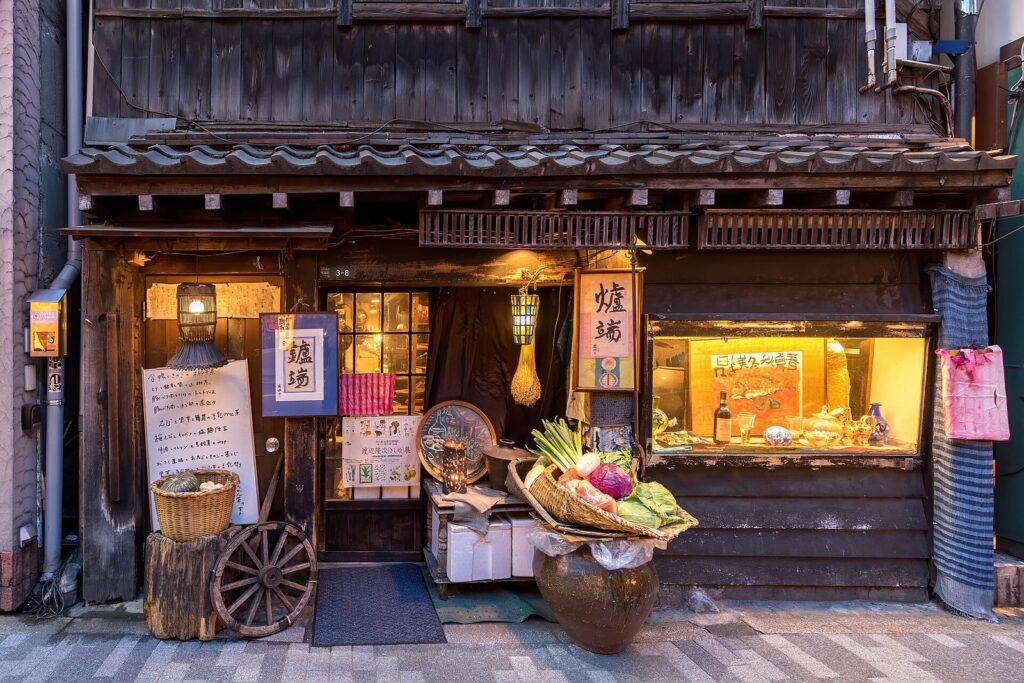
Featured image: “Illuminated facade of a restaurant serving traditional food with fresh vegetables in Chiyoda, Tokyo” by Basile Morin, CC BY-SA 4.0, via Wikimedia Commons