I live in Japan, and Yokohama is the airport transfer I get asked about most after central Tokyo. It surprises people to learn that Haneda is closer to Yokohama than it is to Shinjuku — the airport sits on the bay roughly halfway between the two cities, and the train ride south takes under half an hour. If you are basing yourself in Yokohama, arriving at Haneda, or catching a cruise from Osanbashi Pier, this is one of the easiest transfers in the country.
The one thing that trips visitors up is that there is no JR line to Haneda at all. Every JR Pass instinct you have will be wrong here. Here is how the route actually works.
The quick answer
- Default choice for almost everyone: the Keikyu line from any terminal to Yokohama Station — about 25–30 minutes, ¥370–400, trains roughly every 10–20 minutes.
- Lots of luggage, or staying in Minato Mirai? The limousine bus to YCAT (Yokohama Station east side) is ¥800, takes around 30–40 minutes, and you keep your suitcase in the hold.
- Travelling as a family, or landing very late? A flat-fare taxi to central Yokohama runs about ¥8,800 plus tolls (¥10,300 between 22:00 and 05:00), booked in advance.
- Holding a Japan Rail Pass (commonly called the JR Pass)? It does not cover Keikyu. Your only pass-covered route is the Tokyo Monorail to Hamamatsucho, then JR south to Yokohama — roughly an hour, and honestly not worth the detour unless the pass is already in your hand.
- Arriving after midnight? There is a 1:20 a.m. night bus from Haneda to Yokohama Station and Sakuragicho for ¥2,000. Trains stop just after midnight.
Prices are 2026 figures and are approximate — fares and timetables change, so confirm before you book.
The options at a glance
| Keikyu train | Limousine bus (YCAT) | Taxi (flat fare) | Monorail + JR | |
|---|---|---|---|---|
| Time to Yokohama Station | 25–30 min | 30–40 min | 30–45 min | About 60 min |
| Cost (one way) | ¥370–400 | ¥800 | ~¥8,800 + tolls | ¥520 + ¥530 (free with JR Pass) |
| Luggage | On board with you | In the hold | Boot | On board, two changes |
| Frequency | Every 10–20 min | Every 15–20 min | On demand | Every few minutes |
| Best for | Almost everyone | Heavy bags, Minato Mirai hotels | Families, late arrivals | JR Pass holders only |
Option 1: The Keikyu line (what I would take)
Keikyu has stations directly under all three Haneda terminals, so you never step outside. From Terminal 3 — where most international flights arrive — Yokohama is ¥370 (¥363 with an IC card). From Terminals 1 and 2 it is ¥400 (¥397 with IC). Keikyu’s own guide puts the journey at 28 minutes; in practice it lands between 25 and 30 depending on the service.
The critical detail: not every Keikyu train from Haneda goes to Yokohama. The line splits at Keikyu Kamata, with half the trains heading north to Shinagawa and central Tokyo, and half heading south towards Yokohama. Before you board, check the destination on the front of the train and on the platform display. Southbound trains show Yokohama, Kanazawa-Bunko, Zushi-Hayama, Uraga or Misakiguchi. If it says Shinagawa, Asakusa or Narita, that is the wrong direction — though it is a forgiving mistake, because you simply get off at Keikyu Kamata and cross to the southbound platform. The fare is the same either way.
Most southbound services are marked Express (急行), with some Limited Express runs. Off-peak they come every 15–20 minutes; in the morning rush it is closer to every 10. There is no reserved-seat or luxury option on this route and no extra charge for luggage — just an ordinary commuter train with fairly generous door space.
Tap in with Suica or PASMO and you are done. If you have not sorted a card yet, our guide Suica vs PASMO vs Welcome Suica covers which one makes sense — and if your phone supports it, adding Suica to Apple Wallet before you fly means you can walk straight from baggage claim to the platform without queueing at a machine.
Option 2: The limousine bus to YCAT
The airport bus runs to YCAT — the Yokohama City Air Terminal, attached to the east side of Yokohama Station. It costs ¥800 for adults and ¥400 for children one way, up from ¥650 after a fare revision on 1 February 2026, so treat older figures you find online as out of date. Buses leave every 15–20 minutes during the day, take around 24–40 minutes depending on traffic on the Bayshore Route, and you buy your ticket at the terminal machines or tap an IC card or contactless credit card at the door.
The bus wins in exactly one situation: you have big suitcases and your hotel is near Yokohama Station or Minato Mirai. Your bags go under the bus, you sit down once, and YCAT drops you at street level with taxis and hotel shuttles right there. There is no toilet on board, and seats are first-come-first-served rather than reserved.
A separate Keikyu bus route runs from Haneda into the Minato Mirai and Sakuragicho hotel district — useful if you are staying at one of the bayfront hotels, though it takes 40–60 minutes and fares on the Yokohama routes changed in early 2026, so check the operator’s page rather than trusting a blog figure.
Option 3: Taxi and pre-booked transfers
Yokohama taxi companies run flat fares to and from Haneda, which removes the meter anxiety. For Naka-ku and Nishi-ku — that covers Yokohama Station, Minato Mirai, Chinatown and Yamate — the standard figure is ¥8,800 between 05:00 and 22:00, and ¥10,300 for the late-night band, with expressway tolls charged on top. You need to book ahead; you cannot flag one of these at the rank.
For two people that is hard to justify against a ¥400 train. For a family of four arriving at 11 p.m. with four suitcases and a stroller, it is entirely reasonable. As a resident I take the train every time, but I have put visiting friends with small children in a pre-booked transfer more than once and never heard a complaint.
👉 Klook Haneda private airport transfer
Option 4: The Japan Rail Pass route (and why it is a trap)
No JR train reaches Haneda. JR East is building the Haneda Airport Access Line, but it is targeted for fiscal 2031 — that is, by March 2032 — so it is irrelevant for any trip you are planning now.
That leaves pass holders with one covered option: the Tokyo Monorail to Hamamatsucho (¥520, 13 minutes on the fast service), then a JR train south to Yokohama (¥530, about 30 minutes via Shinagawa). Total time is around an hour with a luggage-unfriendly change at Hamamatsucho, versus 28 minutes on Keikyu for ¥400. If your pass is already active, it saves you the fare. If you would be activating it purely for this trip, do not bother — our guide Is the Japan Rail Pass Worth It? runs the numbers on when the pass actually pays.
Getting to your actual destination in Yokohama
Yokohama Station is the hub, but very few visitors are staying at the station itself. From there:
- Minato Mirai (Landmark Tower, Cup Noodles Museum, the ferris wheel): Minatomirai Line, one stop, ¥200 (¥193 IC), about 3 minutes.
- Motomachi-Chukagai (Chinatown, Yamate, Osanbashi cruise pier): Minatomirai Line to the end of the line, ¥230 (¥224 IC), about 10 minutes.
- Sakuragicho: JR Negishi Line or the subway, one stop, about ¥150.
- Shin-Yokohama (for the Shinkansen): JR Yokohama Line, about 11 minutes and ¥170 — some trains run through from Yokohama Station, otherwise change at Higashi-Kanagawa. The Blue Line subway does it direct in about the same time for ¥220. There is also a direct airport bus from Haneda to Shin-Yokohama for ¥1,000, which takes 30–50 minutes and is the smarter call if you are connecting straight to a bullet train with luggage.
Keikyu also runs directly onward from Haneda towards Zushi-Hayama, which puts Kamakura within reach without going into Tokyo at all — worth knowing if you are combining the two, and covered in our Kamakura Day Trip guide.
Landing late, or leaving early
Haneda handles flights around the clock, and this is where the plan can break.
- Last trains: the final Keikyu departure that reaches Yokohama leaves Terminal 3 around 00:01, arriving 00:24 (with a change at Keikyu Kamata). Immigration and baggage reclaim can easily eat 45 minutes, so a landing after 23:00 is not a safe bet for the train.
- Last bus: the YCAT bus runs until 23:30, reaching Yokohama Station just after midnight.
- Night bus: there is a 1:20 a.m. departure to YCAT, arriving 2:02 and continuing to Sakuragicho, at ¥2,000 for adults and ¥1,000 for children, paid on board.
- Otherwise: a metered taxi, or wait it out. Haneda Terminal 3 has 24-hour seating, showers and a handful of places to eat, and plenty of people simply sit out the four hours until first light.
Going the other way, aim to leave Yokohama Station at least two hours before an international departure, and be aware that the Bayshore Route backs up badly on Sunday evenings — take the train if you are cutting it close.
Where to stay if Yokohama is your base
Yokohama is a genuinely underrated place to sleep. Hotel rates run meaningfully below central Tokyo, rooms tend to be larger, the bay views from Minato Mirai are the real thing, and you are 30 minutes from Haneda and about 30 minutes from Shibuya. For a first-time visitor who wants Tokyo access without Tokyo prices, it works — and Chinatown, Sankeien Garden and the harbour front give the city its own reason to exist beyond commuting. If you are weighing it against staying central, our Where to Stay in Tokyo guide lays out the trade-offs.
FAQ
Is Haneda actually closer to Yokohama than to Tokyo Station?
By train, roughly the same — 28 minutes to Yokohama, about 30 to Tokyo Station via Shinagawa. Geographically Haneda sits on the border, so neither city has much of an edge.
Can I use my Japan Rail Pass on the Keikyu line?
No. Keikyu is a private railway and the pass does not cover it. The pass covers the Tokyo Monorail and JR trains from Hamamatsucho onwards.
Do I need to reserve a seat on the Keikyu train?
No. There are no reserved seats on this route. Just tap in and board.
What if I land at Narita instead?
Narita to Yokohama is a much longer haul — roughly 90 minutes to two hours by the Narita Express, which does run direct to Yokohama Station. Our Haneda vs Narita guide covers why the airport you choose matters more than most people expect.
Do I need cash?
Barely. The trains, the buses and the taxi rank all take IC cards or contactless credit cards. Cash or Card in Japan? covers where cash still genuinely matters.
I forgot to buy an IC card before leaving the airport. Is that a problem?
Not at all. You can buy a paper ticket from any machine, and IC cards are sold at Yokohama Station too. Almost nothing you forget for a Japan trip is unfixable here — umbrellas are at every convenience store, clothes at Uniqlo, and a power bank from any electronics shop or a ChargeSPOT rental stand.
The verdict
Take the Keikyu train. It is under ¥400, under half an hour, runs from directly beneath your terminal, and drops you at the transport hub of the city. Check the destination board so you head south rather than north, and that is the whole skill.
Switch to the YCAT bus if you are travelling heavy and staying near the station, and to a pre-booked flat-fare taxi if you are landing late or wrangling small children. Ignore the Japan Rail Pass on this particular leg — the covered route costs you half an hour and an awkward transfer to save ¥400.
Written from Japan by the Wayfarer Japan team. Prices and times are 2026 figures and approximate — always confirm before booking.
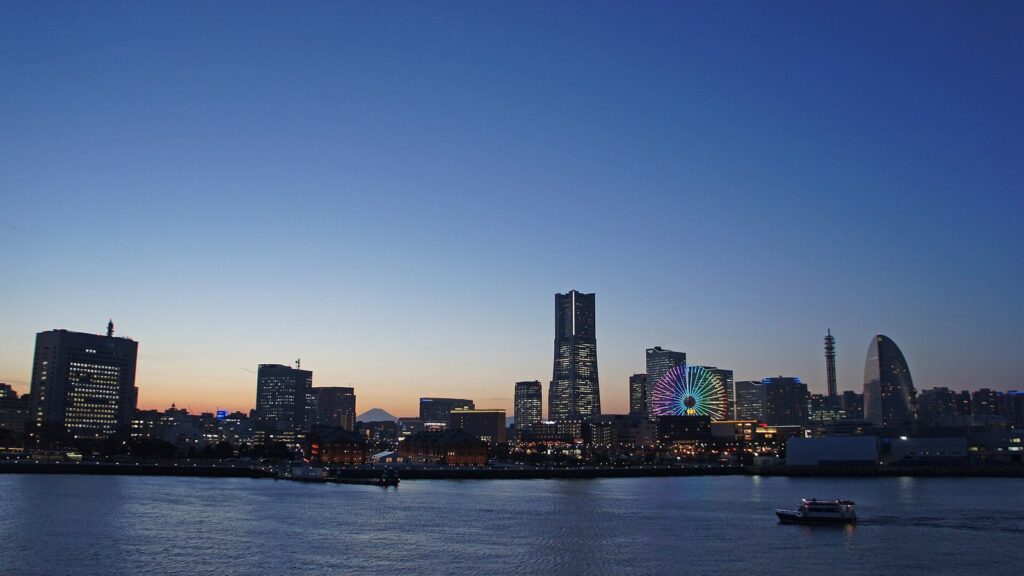
Featured image: “Cityscape of Yokohama; January 2014 (02)” by 淳平 筈井, CC BY 2.0, via Wikimedia Commons