Kanazawa gets left off a lot of first-time Japan itineraries, and that’s a shame, because it’s one of the easiest “second cities” to reach and one of the most rewarding. It survived the Edo period as the seat of the wealthy Maeda clan without being flattened by WWII bombing or the postwar rebuilding boom that reshaped so much of urban Japan, so its castle town layout, samurai districts and geisha quarters are still mostly intact. I live in Japan, and Kanazawa is the city I recommend most often to travelers who’ve already done Tokyo and Kyoto and want somewhere that feels different but isn’t a hassle to get to.
Since the Hokuriku Shinkansen extension opened in 2015, Kanazawa has been a straight shot from Tokyo in about two and a half hours — no transfers, no ferries, no regional flight. It also pairs naturally with Kyoto and Osaka if you’re doing the Kansai loop. Below is what actually matters for a first visit: how to get there, what to see, and how much time to give it.
The quick answer
- Getting there: Hokuriku Shinkansen from Tokyo Station, about 2.5–3 hours depending on the train (Kagayaki is fastest), roughly ¥14,000–16,000 one-way. Fully covered by the Japan Rail Pass and the regional Hokuriku Arch Pass.
- From Kyoto/Osaka: About 2.5 hours via limited express train (the Tsuruga shinkansen extension has shortened this route further; check current transfer points, as this line has changed more than once in recent years).
- How long to stay: One full day covers the highlights; two days lets you slow down and add a craft workshop or a day trip.
- Don’t miss: Kenrokuen Garden, Higashi Chaya geisha district, Omicho Market, Kanazawa Castle Park, and at least one gold leaf or lacquerware shop.
- Best season: Spring cherry blossoms and autumn foliage are both excellent here — Kenrokuen is genuinely one of Japan’s best gardens for koyo (autumn leaves), with free night illuminations on select November evenings.
Getting to Kanazawa
From Tokyo, take the Hokuriku Shinkansen directly from Tokyo Station. The Kagayaki service is the fastest at around two and a half hours; the Hakutaka stops more often and takes closer to three to three and a half hours. Seat reservations are worth making in advance during peak seasons — the same booking logic applies here as on any other Shinkansen route, so if you haven’t reserved a seat on a bullet train before, it’s worth reading up on how seat reservation actually works before you go.
From Kyoto or Osaka, the route runs via limited express service, with total journey times around two and a half hours. This corridor has been reshaped by shinkansen extensions in recent years, so double-check the current fastest routing and transfer station before you book — rail infrastructure in this part of Japan is still evolving.
👉 Klook Hokuriku Shinkansen tickets
If you’re already holding a Japan Rail Pass for a wider trip, Kanazawa is fully covered and makes an easy add-on rather than a separate expense.
What to see in Kanazawa
Kenrokuen Garden
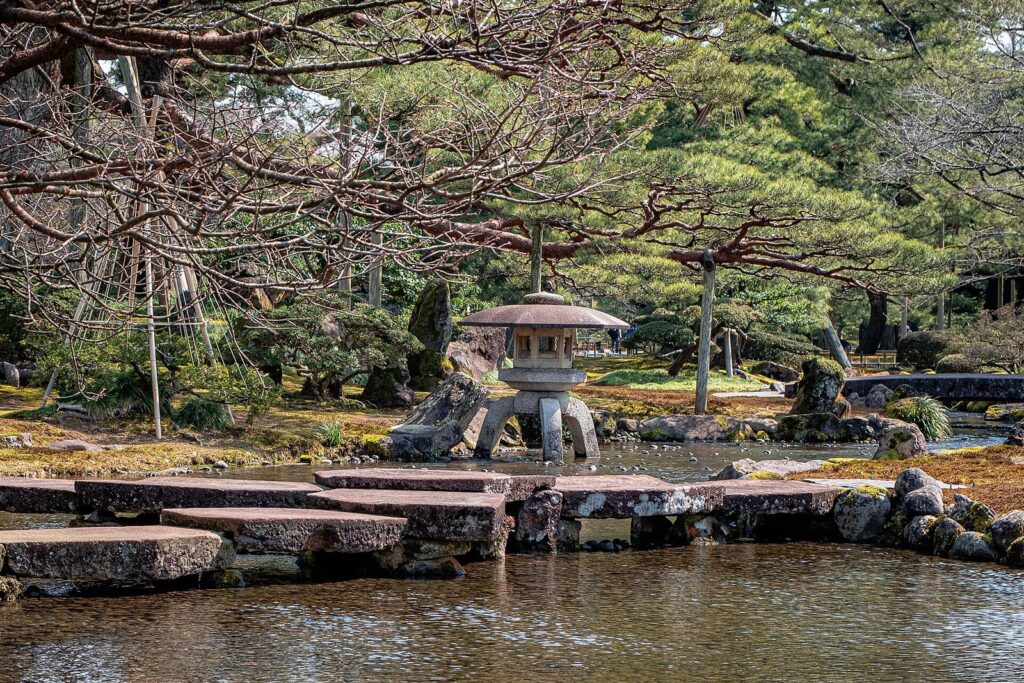
Kenrokuen is ranked as one of Japan’s three great gardens, alongside Okayama’s Korakuen and Mito’s Kairakuen, and it earns the reputation. It was developed over roughly two centuries by the Maeda clan and designed around the six essential qualities of a perfect garden in classical Chinese garden theory — spaciousness, seclusion, artifice, antiquity, water sources and panoramic views.
Admission is around ¥320 for adults (a combined ticket with Kanazawa Castle Park costs a bit more). Regular hours run roughly 8:00 to 17:00, adjusted seasonally. In autumn, look out for the yukitsuri — rope supports strung from central poles to protect pine branches from heavy snow — which are as much a sculptural feature as a practical one. On select November evenings the garden opens for free night illumination, when the yukitsuri ropes and foliage are lit up; the exact dates shift year to year, so confirm before you plan a trip around it.
Higashi Chaya District
This is Kanazawa’s best-preserved geisha (geigi, in the local term) entertainment district, with wooden teahouse facades and lattice windows dating back to the early 1800s. Unlike Kyoto’s Gion, where geisha spotting has become a source of tension with residents, Higashi Chaya is quieter and more about walking the streets and stepping into converted teahouses that now operate as cafes, gold leaf shops and craft galleries. It’s about 20 minutes on foot from Kenrokuen, or a short ride on the Kanazawa Loop Bus to the Hashibacho stop.
Omicho Market
Kanazawa’s “kitchen” for nearly 300 years, and the best place in the city for fresh Sea of Japan seafood — crab in winter, sweet shrimp (amaebi) most of the year. Plenty of stalls sell kaisendon (seafood rice bowls) for lunch, and it’s a good, unglamorous counterpoint to the gardens and geisha streets.
Kanazawa Castle Park
The castle itself burned down repeatedly over the centuries and what stands today is a careful modern reconstruction using traditional joinery methods, without nails. It sits directly across from Kenrokuen, so the two are easily combined in one visit.
Gold leaf and crafts
Kanazawa produces over 99% of Japan’s gold leaf, a legacy of Maeda-era patronage of the arts. You’ll see it everywhere — on lacquerware, in cosmetics, even dusted onto soft-serve ice cream as a novelty. If you want a real souvenir rather than a snack photo, look for gold-leaf lacquerware or Kutani-yaki porcelain, both produced locally.
👉 Klook Kanazawa gold leaf workshop experience
A simple one-day plan
Morning: arrive by Shinkansen, drop bags (station lockers or your hotel), head straight to Kenrokuen and Kanazawa Castle Park. Midday: walk or bus to Omicho Market for a seafood lunch. Afternoon: Higashi Chaya district for tea, crafts and photos. If you have energy left, the 21st Century Museum of Contemporary Art, a short walk from Kenrokuen, is worth an hour for its famous swimming pool installation and rotating exhibitions.
If you forgot an umbrella or need a phone charger, don’t worry about it — Kanazawa has the same convenience stores and drugstores as anywhere else in Japan, so anything you left behind is a five-minute walk away.
Where to stay
Staying near Kanazawa Station is the most practical option for a short visit, with easy access to the loop bus and a wide mix of business hotels. For something more atmospheric, a handful of ryokan near Higashi Chaya or Kenrokuen put you within walking distance of the sights, which is worth considering if this is your one splurge night on the trip — the same logic that applies to choosing a hotel versus a ryokan anywhere else in Japan applies here too.
FAQ
Is Kanazawa worth a day trip from Kyoto or Tokyo? It’s possible from Tokyo (about 5 hours round trip on the train alone), but an overnight stay lets you see the city properly and catch it in the early morning or evening light, when it’s much quieter.
Is Kanazawa expensive? No more than any other mid-sized Japanese city. Accommodation is generally cheaper than Kyoto or Tokyo for comparable quality, and food at Omicho Market is reasonably priced outside the priciest sit-down counters.
Can I use the Japan Rail Pass to get there? Yes — the Hokuriku Shinkansen route from Tokyo is fully covered.
Is Kanazawa good in winter? Yes, if you don’t mind grey skies and rain or snow — the Sea of Japan coast gets more precipitation than the Pacific side in winter. Crab season at Omicho Market runs through the colder months, which is a genuine highlight for seafood fans.
How does Kanazawa compare to Kyoto? Smaller, quieter, and far less crowded, with a similar density of historic streets and gardens packed into a much more walkable area. It’s not a replacement for Kyoto, but a strong complement to it.
The verdict
Kanazawa rewards travelers who’ve already covered the Tokyo–Kyoto–Osaka basics and want a city that still feels like a discovery. The Shinkansen access makes it low-effort to reach, and the combination of a top-tier garden, an intact geisha district and a genuinely great market means you don’t need to manufacture reasons to fill a day. One full day works; two lets you breathe.
Written from Japan by the Wayfarer Japan team — practical, honest travel advice from residents who actually live here.
Featured image: “A stone lantern in the Kenrokuen Garden, Kanazawa (53621201284)” by Winniepix, CC BY 2.0, via Wikimedia Commons