I live in Japan, and every October my social media fills up with the same word: koyo, the turning of the leaves. But long before anyone was posting photos of Kyoto’s maples, the Japanese had already given this obsession a name: momijigari, literally “hunting for autumn leaves.” It’s one of those small phrases that opens up a much bigger story about how Japan relates to the changing seasons, and it’s worth knowing before you plan a trip around Japan in autumn.
Momijigari isn’t really hunting anything, of course. It’s the practice of traveling out to see autumn foliage at its peak, often with a very specific set of rituals attached: a scenic viewpoint, a shared meal, sometimes poetry, and a particular kind of quiet appreciation for something that is, by nature, about to disappear.
The quick answer
- Momijigari (紅葉狩り) means “red leaf hunting” — the Japanese custom of traveling to view autumn foliage, especially maple (momiji) leaves
- It began among Heian-period (794-1185) court aristocrats in Kyoto as an elegant outdoor pastime combined with poetry and banquets
- The word “gari” (hunting) is a holdover from an era when it referred to foraging or seeking out something beautiful, not just killing game
- It’s tied to mono no aware, the aesthetic idea that beauty is more moving because it doesn’t last
- The custom spread to ordinary people during the Edo period (1603-1868), around the same time cherry blossom viewing became a mass activity
- Today it’s the autumn equivalent of hanami, complete with illuminated night viewings, roadside food stalls, and dedicated foliage forecasts
Where the word actually comes from
The “gari” in momijigari is the same character used in words for hunting animals — it shows up in shigari (deer hunting) and similar terms. But its meaning had already broadened by the time it attached itself to leaves. Historians trace the word’s drift toward “seeking out” seasonal beauty, the same logic behind hanagari (flower hunting), an older term that eventually gave way to hanami for cherry blossoms specifically.
There’s also a color shift buried in the word’s history. Early written references to autumn leaf appreciation, going back to the Nara period, sometimes describe the color as yellow rather than red — Japan’s autumn palette includes plenty of ginkgo gold alongside maple crimson. By the Heian period, red had become the dominant association, and “momiji-gari” (red-leaf hunting) settled into the form still used today.
Born in the Heian court
Momijigari’s documented origins sit firmly in the Heian period, when Kyoto’s aristocracy turned nearly every seasonal shift into an occasion for refined entertainment. Nobles organized excursions to scenic spots around the capital specifically to view the changing maples, and these outings came bundled with poetry composition, music, and often a banquet laid out beneath the trees.
This wasn’t casual sightseeing. Heian court culture ran on a dense system of aesthetic references, and autumn leaves were loaded with meaning that any well-educated noble was expected to recognize instantly. The custom appears in the Tale of Genji, the 11th-century novel that doubles as a detailed record of Heian aristocratic life. One of its most quoted scenes, in the chapter known as “The Sacred Tree,” uses an autumn setting to underscore a parting between two lovers — the fading season mirroring the fading relationship. That pairing of autumn imagery with emotional weight wasn’t incidental; it was the whole point.
Mono no aware: why fading leaves matter more than fresh ones
If you spend any time reading about Japanese aesthetics, you’ll eventually run into mono no aware, often translated loosely as “the pathos of things.” It’s the idea that transience itself is part of what makes something beautiful — that a maple leaf at its most brilliant red, day or two before it falls, carries more emotional weight than the same leaf in the stable green of summer.
This is the same philosophical thread that runs through hanami and cherry blossoms, and it’s worth understanding if you’re comparing the two seasons. Cherry blossoms fall almost as soon as they open, which makes their beauty feel abrupt and startling. Autumn leaves take weeks to turn, deepening gradually from green to gold to red before they drop — a slower, more contemplative kind of impermanence. Classical Japanese poetry treats autumn as the season most saturated with aware, precisely because the change is visible and drawn out rather than sudden.
From court ritual to national pastime
For centuries, momijigari stayed largely within reach of the aristocracy and, later, the samurai and merchant classes who had the leisure time and travel means to pursue it. That changed in the middle of the Edo period, in the 18th century, when improved roads, growing prosperity among urban commoners, and a culture of domestic travel and pilgrimage made seasonal excursions accessible to far more people. Autumn leaf viewing spread out of Kyoto’s aristocratic gardens and into temple grounds, mountain trails, and famous scenic spots across the country, becoming something much closer to the popular activity it is today.
That Edo-era democratization is part of why Japan now has such a dense network of famous koyo destinations rather than just one or two elite sites — from Kyoto’s temple gardens to Nikko, Hakone, and countless mountain valleys, each region built its own local tradition around the same underlying custom.
How momijigari looks today
Modern momijigari keeps the bones of the old custom while adding some distinctly contemporary features. Temples and gardens across the country hold special night illumination events (raitoappu) during peak season, lighting up maple trees against dark water or old wooden architecture — a dramatic, almost theatrical version of the quiet Heian-era viewing party. Seasonal food stalls sell roasted sweet potatoes, chestnuts, and momiji tempura (actual battered and fried maple leaves, a specialty around Osaka’s Minoh). Weather services publish detailed koyo forecasts every autumn, tracking the “red leaf front” as it moves from Hokkaido down to Kyushu over about two months, the same way they track cherry blossoms in spring.
If you want to actually plan a trip around this, Wayfarer Japan’s guide to the best autumn leaves spots in Japan covers where and when to go for peak color by region. It pairs well with the broader rundown of what’s changed for travelers heading to Japan in autumn, since typhoon season and the Silver Week holiday both affect timing.
FAQ
Is momijigari the same as hanami? They’re built on the same idea — traveling somewhere scenic to appreciate a seasonal natural spectacle — but hanami refers specifically to cherry blossom viewing in spring, while momijigari refers to autumn leaf viewing. Some writers call momijigari “the hanami of autumn.”
Why is it called “hunting” if nothing is being hunted? “Gari” originally meant hunting game, but it broadened over time to mean actively seeking out something, including seasonal beauty. The word survived even after its literal meaning no longer applied.
When did momijigari become popular outside the aristocracy? Historians generally point to the mid-Edo period, in the 1700s, when rising prosperity and travel infrastructure let ordinary townspeople take part in seasonal excursions that had previously been the preserve of the court and samurai class.
Do modern Japanese people still think of it as a tradition, or is it just “seeing pretty leaves”? Both, honestly. Most people today go simply because the leaves are beautiful, without consciously thinking about Heian poetry. But the vocabulary, the seasonal forecasts, and the specific etiquette around visiting temple gardens all trace directly back to the older custom.
Where did the connection to maple leaves specifically come from, given Japan has many autumn colors? Ginkgo, gingko-adjacent yellows, and other foliage are all part of Japan’s autumn palette, but maple (momiji) became the culturally dominant symbol by the Heian period, likely because of its vivid red and its frequent appearance in classical poetry.
The verdict
Momijigari is a good reminder that a lot of what looks like simple sightseeing in Japan has centuries of accumulated meaning underneath it. You don’t need to know any of this history to enjoy a walk through a red-leafed temple garden in November, but knowing it changes what you’re looking at — not just a nice view, but the latest version of a habit that Heian aristocrats were already refining over a thousand years ago. If you’re visiting during koyo season, it’s worth building in at least one unhurried afternoon at a garden or shrine, rather than treating it purely as a photo stop.
Written from Japan by the Wayfarer Japan team, who spend their autumns chasing the same red leaves the Heian court did.
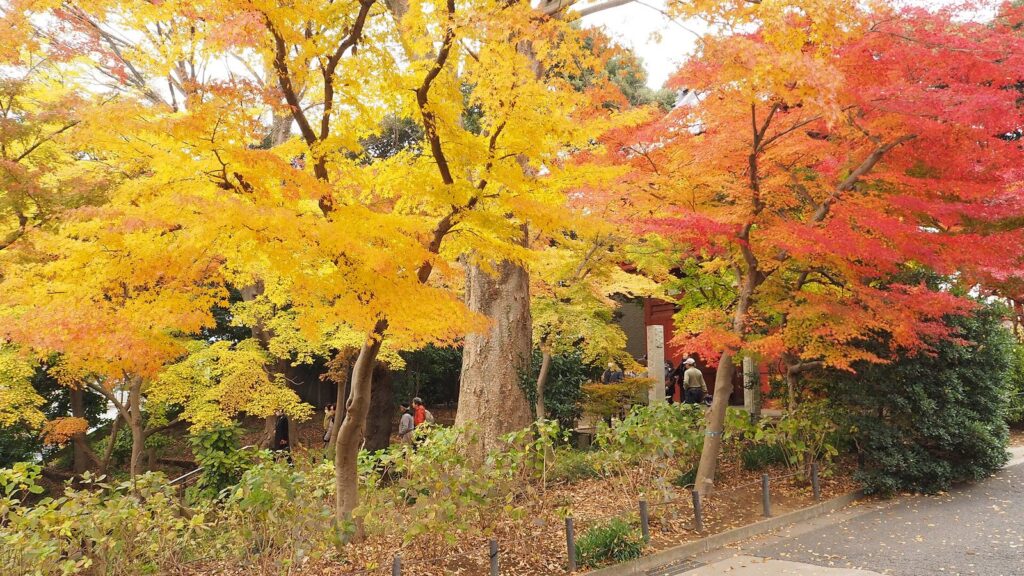
Featured image: “Autumn at Hondo-ji temple, Chiba; November 2017 (01)” by Hetarllen Mumriken, CC BY-SA 2.0, via Wikimedia Commons