Every December, Tokyo strings up Christmas lights, pipes carols into department stores, and sells out of Christmas cake weeks in advance. It looks, for a few days, like any Western capital in winter. Then December 26 arrives and the illuminations come down overnight. Christmas in Japan is a date for couples and a marketing event for KFC; it was never a public holiday and isn’t a family occasion here. The holiday that actually matters — the one that shuts down banks, empties the cities and sends tens of millions of people back to their hometowns — is Shogatsu, the Japanese New Year, starting about a week later.
If you’re visiting Japan over the turn of the year, Shogatsu will shape your trip whether you plan for it or not. Restaurants close for days, trains run on special holiday timetables, and the one thing that stays open — the neighborhood konbini — becomes genuinely useful. Here’s what the holiday is, why it’s treated so differently from Christmas, and what you’ll actually see if you’re here for it.
The quick answer
- Shogatsu runs roughly December 29 to January 3, with January 1 as the only official public holiday — but most of the country treats the full week as time off.
- Banks, government offices and small, family-run restaurants close; convenience stores, major train lines and most big-chain restaurants stay open.
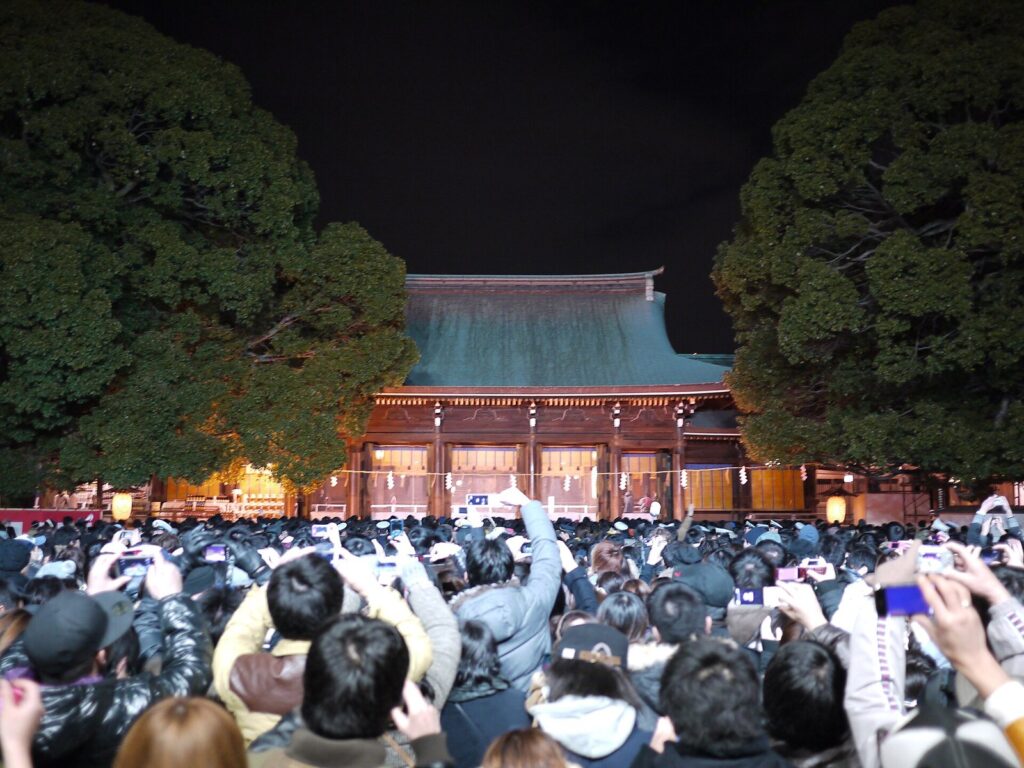
- Hatsumode (the year’s first shrine or temple visit) is the single biggest New Year activity — Meiji Shrine in Tokyo alone draws around 3 million visitors in the first three days of January.
- Osechi (elaborate cold New Year food), otoshidama (cash gifts for children), nengajo (New Year postcards) and joya no kane (108 temple bells rung at midnight) are the core traditions.
- None of this requires tickets or reservations to witness — just an awareness of what’s closed and a willingness to stand in a crowd at a shrine.
Why Christmas never caught on as a family holiday
Japan is overwhelmingly non-Christian, and Christmas arrived here in the 20th century as an imported, commercial season rather than a religious one. It slotted neatly into an existing gap in the calendar — a festive, lights-and-shopping occasion in late December — without displacing anything, because nothing like it already existed in that slot. Japanese culture didn’t need Christmas to fill the role of “the big family gathering,” because that role was already occupied, a few days later, by the New Year.
That’s the key difference from the West, where Christmas and New Year’s Eve are often treated as one extended holiday with Christmas as the main event. In Japan they’re unrelated. Christmas Eve is closer to Valentine’s Day — a date night and a particular kind of sponge cake with strawberries — while Shogatsu is the one everyone actually travels home for, the equivalent of Christmas and Thanksgiving combined.
What actually closes, and what doesn’t
This is the part that trips up visitors who plan a Japan trip around New Year without checking first. Government offices typically close from around December 29 through January 3, and banks follow a similar window. Department stores, many museums, and a large share of independent restaurants and small shops close for several days too — some owners use it as their only real break of the year.
What stays open: convenience stores (7-Eleven, FamilyMart, Lawson), most train and subway lines on a modified holiday schedule, taxis, and the larger chain restaurants and hotels that cater to tourists. This is the week our guide to why Japan’s convenience stores are amazing earns its keep — konbini become one of the few reliable places for a hot meal, cash from an ATM, or basic supplies on January 1 or 2.
Shrines, by contrast, have never been busier.
Hatsumode: the year’s first shrine visit
Hatsumode, literally “first visit,” is the custom of going to a shrine or temple in the first few days of January to pray for good fortune in the year ahead. It’s less a religious obligation than a cultural reflex — most people who do it would call themselves non-religious the rest of the year, which fits the same casual, present-tense relationship with Shinto and Buddhism we cover in our guide to shrines, Shinto and Japanese mythology.
The scale surprises most visitors. Meiji Shrine in Tokyo is the busiest hatsumode destination in the country, drawing roughly 3 million visitors across the first three days of January — more than any other shrine or temple in Japan. Expect a slow, shuffling queue on January 1 itself; arriving on January 2 or 3, or later in the evening, is noticeably calmer. Sensoji in Asakusa, Fushimi Inari in Kyoto, and Kawasaki Daishi near Tokyo also draw serious crowds.
Once you’re at the front, the ritual is simple: toss a coin into the offering box, bow, clap twice, make a silent wish, and bow once more. Many people also buy an omikuji (paper fortune) or a new omamori (protective charm) to replace last year’s, which is traditionally returned to the shrine to be ritually burned.
Joya no kane: 108 bells at midnight
At Buddhist temples across the country, midnight on December 31 is marked by joya no kane — a large temple bell rung exactly 108 times. The number corresponds to the 108 earthly desires (bonno) that Buddhist teaching says cause human suffering; each ring cleanses one before the new year begins. At some well-known temples, visitors can take a turn on the rope themselves if they join the queue early enough.
Osechi, toshikoshi soba and the New Year table
New Year food in Japan is as codified as a Christmas dinner, just built around different dishes. Osechi ryori is a set of small, colorful, intentionally long-lasting dishes packed into stacked lacquer boxes (jubako) — simmered black soybeans (kuromame) for good health, sweet chestnut-and-sweet-potato paste (kuri kinton) for wealth, rolled kelp (kobumaki) for happiness. The dishes keep for days on purpose, so households don’t have to cook during the first days of the year, traditionally a rest period even in the kitchen.
On New Year’s Eve, the standard meal is toshikoshi soba — “year-crossing noodles” — eaten for their long, easily cut shape, symbolizing letting go of the old year cleanly. On January 1, it’s common to drink otoso, a spiced sake, and eat ozoni, a mochi-based soup whose recipe varies strongly by region.
Otoshidama and nengajo
Children are usually the happiest people in Japan during Shogatsu, thanks to otoshidama — small cash gifts from parents, grandparents and relatives, handed over in decorated paper envelopes and scaled roughly to the child’s age. Nengajo, New Year’s greeting postcards, are the other major tradition, though a fading one: Japan Post has historically delivered hundreds of millions of them on January 1 specifically, many carrying a lottery number for a small prize drawing. Younger generations increasingly swap the custom for a text message, but post offices still run dedicated nengajo sales campaigns every December.
What this means for your trip
If your trip overlaps with December 29 to January 3, build in slack. Don’t plan a schedule around a specific small restaurant, shop or museum being open — check in advance, since a meaningful share of them won’t be. Trains keep running but on adjusted timetables, so double-check last-train times if you’re out late. Hotel and flight prices climb too, since this is also peak domestic travel season as millions of residents head to their hometowns — book ahead if you haven’t already.
On the upside, this is one of the few times a visitor can watch an entire country observe the same ritual at once. Standing in a hatsumode queue near midnight, a bell tolling somewhere nearby, is a genuinely different experience of Japan than the regular tourist season offers — and like most of Japan’s etiquette, the rule is simple: watch first, copy quietly, and you’ll be welcome.
FAQ
Is Japan open for tourism over New Year?
Yes, but with real gaps. Convenience stores, most train lines, taxis and major hotels operate normally. Many restaurants, small shops, museums, banks and government offices close for several days, roughly December 29 to January 3.
Do I need to book anything for hatsumode?
No reservation is needed or possible — it’s an open, public custom. Just expect queues at major shrines on January 1, shorter ones by January 2 or 3.
Is Christmas celebrated in Japan at all?
Yes, but as a commercial, romantic occasion rather than a family or religious one — illuminations, date-night dinners, and a specific Christmas cake tradition. It isn’t a public holiday.
What should I eat if I’m here for New Year?
Try to find osechi at a department store food hall (many sell pre-made sets for takeaway) or toshikoshi soba on December 31 at any soba shop still open.
Which shrine is best for a tourist to experience hatsumode?
Meiji Shrine in Tokyo and Fushimi Inari in Kyoto are the two most accessible major sites for visitors, both well connected by train and used to large crowds.
The verdict
Shogatsu is the New Year Japan actually takes seriously, and it’s worth understanding before you land here in late December, if only so you’re not caught out by a shuttered restaurant or a bank that won’t open for a week. But it’s also worth seeking out on purpose: a hatsumode queue at a major shrine, a bowl of toshikoshi soba on the 31st, the distant sound of a temple bell ringing 108 times past midnight — these are some of the most genuinely Japanese moments a visitor can witness, and none of them require a ticket.
Written from Japan by the Wayfarer Japan team — real experience, honest advice, no fluff.
Featured image: “Hatsumoude, New Year's visits to a shrine” by Yoshikazu Takada, CC BY 2.0, via Wikimedia Commons