I live in Japan, and Kobe is the day trip I send people on when they tell me Osaka and Kyoto are starting to blur together. It is twenty minutes from Osaka by train, it has a harbor, a mountain you can ride a cable car up, a genuinely good Chinatown, and the beef everyone has heard of and almost nobody has eaten correctly. It is also, compared to Kyoto on a Saturday, close to empty.
Kobe’s shape is unusual for a Japanese city: it is squeezed onto a narrow strip between Mt. Rokko and Osaka Bay, which is why the mountain, the port and the downtown core all sit within a twenty-minute walk of Sannomiya Station. You do not need a plan with six stops. You need three, done properly, with time left over to sit somewhere with a view.
The quick answer
- From Osaka Station, take the JR Special Rapid Service to Sannomiya: about 20 minutes for ¥420. Hankyu and Hanshin trains from Osaka-Umeda run to Kobe-Sannomiya in 25–30 minutes for ¥320–¥330 and are the cheaper, slightly slower option.
- From Kyoto, the Shinkansen to Shin-Kobe is fastest: about 28–30 minutes, ¥2,870 unreserved, fully covered by the Japan Rail Pass (commonly called the JR Pass) on Hikari trains. A regular JR limited express or rapid service to Sannomiya is cheaper but takes closer to an hour.
- Sannomiya, not Shin-Kobe, is Kobe’s real center. Shin-Kobe is the Shinkansen stop, one subway stop or a 15-minute walk from downtown.
- Kobe beef for lunch is genuinely affordable: proper lunch steak sets run roughly ¥3,500–¥6,000 per person, well under half of dinner prices at the same restaurants.
- Mt. Rokko cable car: ¥1,550 round trip (¥800 one-way), 10 minutes up from Rokko Cable Shimo Station, running 08:00–20:00.
- Nunobiki Herb Garden ropeway: ¥2,500 round trip with garden admission, 10 minutes from Shin-Kobe Station on foot to the base station.
- Kitano’s ijinkan (foreigner’s houses) district is free to walk through; individual houses charge ¥500–¥800 each, with combination tickets if you want several.
Getting there: three reasonable options, one clear winner for most people
From Osaka Station, the JR Special Rapid Service (Shinkaisoku) runs to Sannomiya in about 20 minutes for ¥420, with departures every 10–15 minutes through the day — no reservation, no limited express fee, just tap an IC card and sit down. If you are closer to Umeda’s private-line terminals, Hankyu (Osaka-Umeda to Kobe-Sannomiya, ¥330) and Hanshin (Osaka-Umeda to Kobe-Sannomiya, ¥320) both run direct in 25–30 minutes and are marginally cheaper, though slower and with more stops.
From Kyoto, the fastest route is the Shinkansen to Shin-Kobe: 26–30 minutes, ¥2,870 for an unreserved seat, and covered by the Japan Rail Pass. If you do not hold a pass and want to save money, a regular JR rapid/limited-express combination via Osaka takes closer to 55–70 minutes for under ¥2,000 — worth it if you are not in a hurry, not worth it if your day in Kobe is already short. See our Japan Rail Pass Worth It? guide and How Japan’s Train Fares Work if the base-fare-plus-surcharge system is still confusing.
If you have not sorted an IC card yet, our Suica, PASMO and Welcome Suica guide covers which one you can actually buy as a visitor; every train mentioned here accepts one.
Sannomiya vs. Shin-Kobe: do not get these confused
Sannomiya Station is Kobe’s actual downtown — the shopping streets, Chinatown, the harbor and Kitano are all within 10–20 minutes on foot or a short subway ride from here. Shin-Kobe Station, where the Shinkansen stops, sits at the base of the mountains about 15 minutes’ walk (or one Seishin-Yamate subway stop) from Sannomiya. If you arrive by Shinkansen, your first move is almost always toward Sannomiya, not a reason to linger at Shin-Kobe itself — though the Nunobiki ropeway base station is a short walk from Shin-Kobe, which makes it a sensible first stop before you head downtown.
Mt. Rokko and Nunobiki: the mountain side of Kobe
Kobe’s whole identity is “city wedged against a mountain,” and the two easiest ways to feel that are both a short walk from the Shinkansen station.
Nunobiki Herb Garden sits on the slope directly above Shin-Kobe Station — walk about ten minutes uphill to the ropeway’s lower station. The ropeway climbs over Nunobiki Falls (one of Japan’s oldest named waterfalls, mentioned in classical poetry) to a terraced herb garden with a view back over the harbor. Round trip with garden admission is ¥2,500 for adults (¥1,250 for elementary/junior-high students), or ¥2,000 after 17:00 for the evening rate, when the garden’s night illumination and the city lights below make it worth the later visit if you are staying in Kobe rather than day-tripping back to Osaka.
Mt. Rokko is the bigger excursion: take the Hankyu or JR line to Rokko Station, a bus to Rokko Cable Shimo Station, then the Rokko Cable Car (¥1,550 round trip, 10 minutes, running 08:00–20:00) up to Rokko Sanjo at 737 meters. From there, a connecting bus reaches the Rokko Garden Terrace and the mountaintop’s lookout points, which rank among Japan’s “three great night views” alongside Hakodate and Nagasaki — the lights of Kobe, Osaka and Osaka Bay spread out together after dark. This is a half-day commitment on its own and is best treated as an alternative to the harbor rather than an add-on to it, unless you are staying overnight.
The harbor and Chinatown: the flatter, faster half
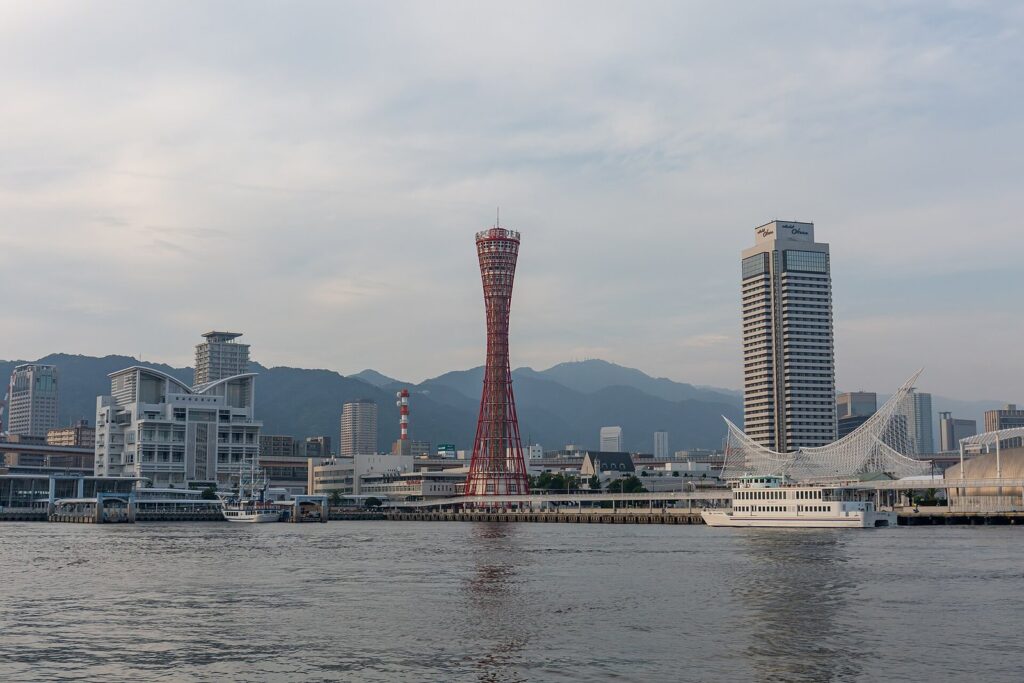
Meriken Park and Kobe Harborland, a 15-minute walk from Sannomiya, are Kobe’s answer to a waterfront evening: the red-framed Kobe Port Tower, closed for seismic reinforcement from 2021 and reopened in April 2024 with a new rooftop observation deck, a rotating café, and 360-degree views over the harbor; the Kobe Maritime Museum next door; and Harborland’s shopping and restaurant complex just across the water. The Port Tower’s rooftop deck is the new reason to go up — it was not there before the renovation.
A ten-minute walk the other direction from Sannomiya is Nankinmachi, Kobe’s Chinatown, three short, lantern-strung streets of steamed buns, takoyaki-adjacent street food and Chinese-Japanese fusion snacks. It is small compared to Yokohama’s Chinatown, walkable in under an hour, and a reasonable lunch stop if you are not doing a sit-down beef meal.
Kitano: the ijinkan district
Up the hill behind Sannomiya, Kitano-cho is where foreign merchants and diplomats built Western-style houses after Kobe’s port opened to foreign trade in 1868. A few dozen of these ijinkan survive as a walkable, hillside neighborhood of European facades, cafes and small museums. Walking the streets costs nothing; individual houses — the Weathercock House (¥500), the Moegi House (¥400, ¥650 combined with the Weathercock House), and a handful of oddities like the Kobe Mysterious Consulate of Trick Art (¥800) — charge separately, and combination tickets covering several houses run roughly ¥650–¥3,000 depending on how many you want to see. Budget an hour if you are only walking through, two if you are going inside two or three houses.
Eating Kobe beef without overpaying
Kobe beef is Tajima-strain wagyu raised within Hyogo Prefecture and graded to a strict standard — not every wagyu steak sold in Japan labeled “Kobe beef” meets it, and not every restaurant selling genuine Kobe beef charges Ginza prices. The trick that most visitors miss: go for lunch, not dinner.
Lunch steak sets at well-regarded teppanyaki and steakhouse spots around Sannomiya typically run ¥3,500 to ¥6,000 per person for 100–150g of real Kobe beef cooked in front of you, against ¥8,000–¥25,000 for the equivalent dinner course at the same restaurant. The beef itself does not change at lunch; the price structure does, the same way a hotel restaurant’s lunch set undercuts its dinner menu everywhere in Japan. If a full teppanyaki lunch is more commitment than you want, a handful of casual counters around Sannomiya and Motomachi sell smaller Kobe beef steak sandwiches and bowls for ¥1,500–¥2,500 — a reasonable way to say you have had it without booking a table.
If you would rather have this arranged for you — table booked, English menu, no guesswork about which restaurant is using the real grade — a guided food tour or a pre-booked teppanyaki reservation takes the risk out of it.
👉 Klook Kobe beef teppanyaki experience
A route that works
Morning: Arrive via Shinkansen to Shin-Kobe, walk up to Nunobiki Herb Garden, ride the ropeway down, then walk or subway to Sannomiya.
Midday: Lunch at a Kobe beef lunch set near Sannomiya, then walk up into Kitano to see two or three ijinkan houses.
Afternoon: Walk down through Sannomiya to Nankinmachi for a snack, then on to Meriken Park and Harborland for the Port Tower and the waterfront.
If staying overnight instead of day-tripping: swap the harbor afternoon for Mt. Rokko, timed to be at the summit for sunset into the night view.
Practical notes
- Forgot a jacket or an umbrella? Do not stress. Sannomiya has the same convenience-store density as any Japanese city center, plus a Uniqlo and several department stores right by the station — nobody needs to pack for every contingency when Kobe can supply it on arrival.
- This is an easy base-free day trip from Osaka or Kyoto. Most visitors do not need a Kobe hotel at all; see Where to Stay in Osaka if you want Kobe as one day inside a longer Kansai stay.
- Coin lockers at Sannomiya and Shin-Kobe fill up on weekends by late morning; if you are carrying luggage through on a travel day, our Coin Lockers and Luggage Storage in Japan guide covers the backup options.
- Weekdays are noticeably quieter than weekends for Kitano and the beef restaurants specifically — Kobe does not have Kyoto-level crowding even on a Saturday, but the best-known steakhouses still fill their lunch sittings.
FAQ
Is a Kobe day trip worth it from Osaka or Kyoto? Yes — it is one of the shortest worthwhile day trips in Kansai, closer than Nara from Osaka and comparable in time to Kyoto to Osaka itself. See Day Trips from Tokyo for the equivalent list if you are based further east instead.
How much time do I need? A full day (roughly 9:00–18:00) covers the harbor, Kitano and a proper lunch comfortably. Adding Mt. Rokko turns it into a long day or a reason to stay overnight.
Can I do Kobe and Himeji in the same day? Technically yes by Shinkansen, but it rushes both. Kobe rewards slower walking more than ticking off sights, and Himeji Castle alone deserves a half-day on its own.
Do I need cash? Less than at a rural temple town — most Sannomiya restaurants and shops take cards — but the smaller ijinkan houses and some Nankinmachi stalls are cash-only. See Cash or Card in Japan for which ATMs accept foreign cards.
Is Kobe beef actually different from other wagyu? Genuine Kobe beef must come from Tajima-strain cattle raised and processed within Hyogo Prefecture and meet a marbling grade — it is a legally protected term in Japan, not just a marketing name, though plenty of menus abroad use “Kobe beef” loosely for any wagyu.
The verdict
Kobe is the Kansai day trip that rewards a slower, shorter list: one mountain view, one proper beef lunch, one old neighborhood, one harbor walk. Budget about ¥1,000 for trains from Osaka, ¥3,500–¥6,000 for a real Kobe beef lunch, and a few thousand yen more for whichever hillside attraction you pick, and you get a genuinely different half of Japan — mountain, port and Meiji-era foreign quarter — inside a day that starts and ends in Osaka or Kyoto.
Written from Japan by the Wayfarer Japan team. Prices and schedules are approximate for 2026 — always confirm with the operator before booking.