You will see one within an hour of landing in Japan. A small ceramic or plastic cat, one paw raised, sitting by a cash register in a ramen shop, a hotel lobby, a souvenir stand at the airport. Most visitors assume it is waving hello. It is not. It is beckoning you in — and the gesture, the paw, and even the color were all settled by specific legends long before anyone put one next to a cash drawer.
I live in Japan, and maneki-neko are so ordinary here that I mostly stop noticing them, the way you stop noticing light switches. It took a trip to a small temple in the western suburbs of Tokyo, where several thousand of them sit stacked on shelves staring back at you, to make me actually look the story up.
Here is where the cat comes from, what it is actually telling you, and where to go if you want to see it by the thousand.
The quick answer
- Maneki-neko means “beckoning cat.” The raised paw is not a wave — in Japan, you beckon a person or animal toward you palm-down, so the gesture reads as “come here,” not “goodbye.”
- There are two rival origin temples. Gotokuji in Setagaya (west Tokyo) and Imado Shrine near Asakusa (east Tokyo) each claim to be the birthplace, and neither story can be fully proven.
- The paw matters. Right paw raised = money and good fortune. Left paw raised = customers and people. Some modern cats raise both.
- The color matters too. White is the traditional all-purpose lucky color; gold is for wealth; black wards off evil; red is for health.
- You can visit the birthplace for free. Gotokuji Temple is open to the public and costs nothing to walk around.
Two temples, two legends, one cat
Ask where maneki-neko came from and you will get two different answers depending on which side of Tokyo you ask in.
Gotokuji Temple (Setagaya, west Tokyo) tells the oldest and best-documented version. In the early 1600s, the story goes, Ii Naotaka — a feudal lord and head of the Hikone domain — was caught in a sudden thunderstorm near a small, struggling temple. A cat sitting at the gate raised a paw as if beckoning him inside. He followed it in, sheltered from the storm, and was so grateful that he became the temple’s patron. Gotokuji grew into an important temple under Ii family support, and the cat that started it all was eventually honored with its own shrine on the grounds. Because the Ii family’s patronage is a matter of historical record, this is generally treated as the version with the firmest footing.
Imado Shrine (near Asakusa, east Tokyo) tells a sadder one. An elderly woman became too poor to keep feeding her cat and let it go. The cat later appeared to her in a dream and told her to make a doll in its image — if she did, she would find good fortune. She made the figure, sold copies, and the Imado potters’ version of the lucky cat is said to have followed from there. Imado is also a Shinto shrine rather than a Buddhist temple, which locals sometimes frame as Gotokuji beckoning “virtue” and Imado beckoning “fate.”
Neither side has ever conceded, and there is a genuine geographic split: west Tokyo tends toward Gotokuji’s version, east Tokyo toward Imado’s. Commercial production of the cats as souvenirs is well documented from the mid-1800s in Edo (old Tokyo), regardless of which legend actually started it.
What the paw is actually telling you
The single most useful thing to know is that the raised paw is a direction, not just a greeting.
| Raised paw | Traditional meaning |
|---|---|
| Right paw | Invites money and good fortune |
| Left paw | Invites customers and people |
| Both paws | A modern variant — protection plus fortune, popular in shops that want both |
That is why you will see shopkeepers pick deliberately: a tiny family-run bar wants customers in the door, so it often reaches for a left-paw cat, while a business more focused on simply making money might choose the right paw. There is no rule that you have to pick — most households that buy one just pick whichever looks friendliest — but if you are choosing a souvenir as a gift, knowing the difference turns a generic trinket into a specific wish.
What the color is telling you
Color came later than the paw, and the meanings are looser, but they are consistent enough to be worth knowing before you buy one:
- White — the original, all-purpose lucky color: happiness and good fortune generally.
- Gold — wealth and prosperity. The one you will see most in restaurants and shops.
- Black — wards off evil spirits and bad luck. Popular as a protective charm rather than a wealth charm.
- Red — good health and protection from illness.
- Pink — love and relationships, a newer addition aimed at the gift market.
- Green — academic success and safety, often bought by families around exam season.
None of this is ancient scripture — it is closer to the logic behind birthstones, built up over generations of souvenir shops and gift-givers rather than handed down from a single source. That does not make it less fun to know when you are standing in front of a shelf of them trying to pick one.
Where to see the real thing: Gotokuji Temple
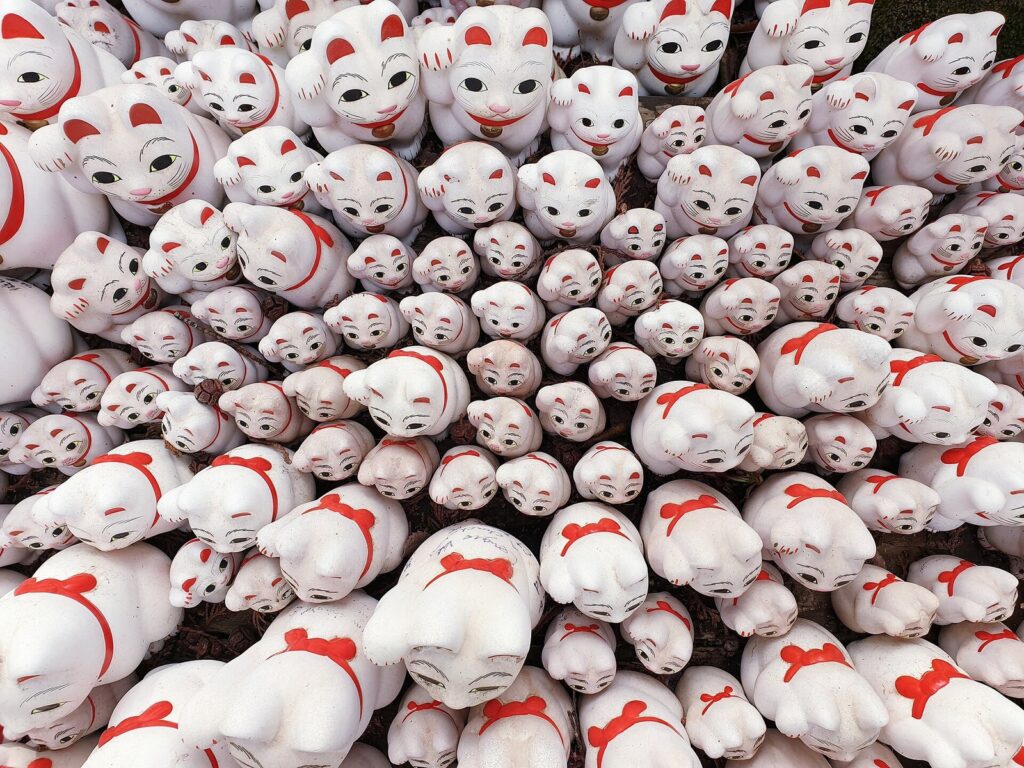
If you want to see what the legend built, Gotokuji in Setagaya is the place. The temple grounds hold a dedicated shrine area where visitors who feel their wish came true bring back a maneki-neko figurine as thanks — which is why there are now thousands of them, stacked shoulder to shoulder on open-air shelves, all facing the same direction, all raising the same paw. It is genuinely strange and a little moving in person, and it photographs like nothing else in Tokyo.
Getting there: take the Odakyu Line from Shinjuku Station to Gotokuji Station (about 15 minutes), then walk roughly 10 minutes to the temple. The more charming route is the tiny Tokyu Setagaya Line tram — change onto it at Sangen-jaya from the Den-en-toshi Line out of Shibuya, and get off at Miyanosaka Station, a 5-minute walk from the gate. Keep an eye out for the lucky-cat-painted tram car, which runs on this line from time to time. The temple is free to enter and is a working Buddhist temple, so dress and behave as you would at any other — this is a nice detour to pair with a day exploring Things to Do in Tokyo beyond the usual Shibuya-Asakusa loop.
If you are staying closer to Asakusa, Imado Shrine makes a shorter stop — about a 15-minute walk from Asakusa Station — and lets you compare both origin stories on the same trip, east side and west side, in a single day.
FAQ
Is maneki-neko the same as Hello Kitty? No, though they are often confused by first-time visitors. Hello Kitty is a 1970s Sanrio character with no cat-beckoning backstory. Maneki-neko is centuries older and has a specific religious and commercial history.
Can I buy one to take home? Yes — they are sold at souvenir shops, temples, and 100-yen stores all over Japan, in every size from keychain to shelf statue. Gotokuji and Imado both sell their own small versions on-site, which make a more specific souvenir than an airport gift-shop one.
Why is the paw raised and not the whole hand waving? Because in Japan, beckoning someone over is traditionally done palm-down with the fingers curling in, not palm-up like a Western wave. The cat’s gesture is copying that beckoning motion, not waving goodbye.
Is it rude to bring one as a gift? Not at all — it is a common, cheerful gift, especially for someone opening a shop or business. Pairing the right paw and color to the occasion (gold and right paw for a new business, for example) is a nice touch but not required.
Do real cats actually do this gesture? Yes, informally — cats do sometimes sit with a paw raised while grooming or stretching, and most historians agree that is likely where the whole idea started before any temple legend attached itself to it.
The verdict
Maneki-neko looks like a trinket until you learn that its paw and its color were never random — they are a centuries-old shorthand for a specific wish, argued over by two temples on opposite sides of Tokyo who still have not agreed on whose cat it really was. You do not need to resolve that argument to enjoy it. Go stand in front of the wall of cats at Gotokuji, or the quieter version at Imado, and you will never look at the one by your hotel’s front desk the same way again.
Written from Japan by the Wayfarer Japan team. Prices and details are approximate and change — always confirm before you book.
Featured image: “Gotokuji Temple Beckoning Cats” by Emma Brick, CC BY-SA 4.0, via Wikimedia Commons