There is an old line here that everyone quotes: a wise person climbs Mt. Fuji once, and only a fool climbs it twice. I have used it myself, usually on friends who have just asked whether the hike is “a nice walk.”
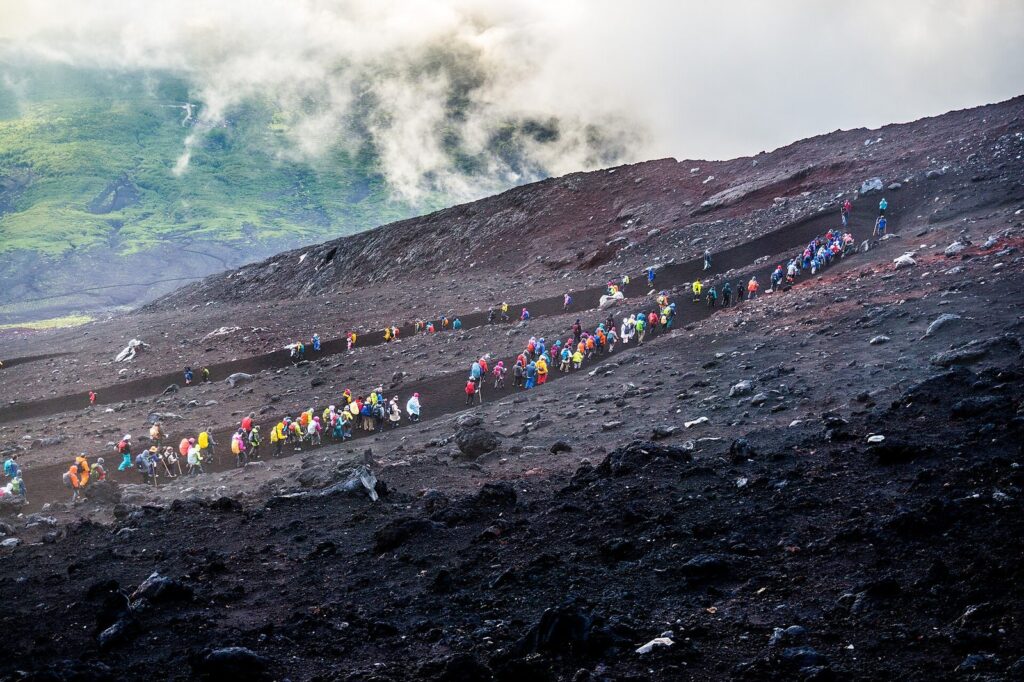
It is not a nice walk. It is a nine-to-eleven-hour slog up a volcanic cinder cone with no shade, no trees above the treeline, and air thin enough at the top to give a fit person a headache. It is also one of the few things in Japan that people remember for the rest of their lives.
What has changed is the paperwork. Since 2025 both prefectures that share the mountain have run a permit system, and 2026 is the second full season under it. Work from a guide written before that and you will be turned around at the trailhead. Here is how it actually works now.
The quick answer
- Season: Yoshida and Subashiri open 1 July 2026, Fujinomiya and Gotemba 10 July, all four close around 10 September. Outside those dates the huts, toilets and rescue cover are gone.
- Permit: ¥4,000 per person per climb on all four trails, reserved and paid online in advance. You get a QR code, scanned at the trailhead for a wristband, and a short safety module you cannot skip.
- The 2pm gate rule: no passing the trailhead gate between 14:00 and 03:00 without a mountain hut reservation for that night.
- Yoshida is capped at 4,000 climbers a day (roughly 3,000 advance, 1,000 same-day). The Shizuoka trails have no cap.
- Book the hut first, everything else second. Huts sell out months before permits do.
- Realistic budget: ¥4,000 permit + ¥14,000–¥17,000 hut + ¥9,600 return bus from Shinjuku — roughly ¥30,000 before gear and food.
👉 Klook
The 2026 rules, in plain English
The mountain is split between Yamanashi Prefecture, which owns the Yoshida trail, and Shizuoka, which owns the other three. They charge the same ¥4,000 but do not share a booking system, and this trips people up constantly.
For Yoshida, reserve through Yamanashi’s official online system, linked from the prefecture’s English climbing site (fujisan-climb.jp); registration opens in late spring. For Subashiri, Gotemba and Fujinomiya, register through Shizuoka’s FUJI NAVI app on your phone. Same fee, separate booking.
Both make you work through a short safety and etiquette module before payment goes through — altitude sickness, weather, why you should not take a rock home. It takes a few minutes and is worth actually reading.
At the gate, staff check three things: proper hiking footwear, two-piece rain gear (jacket and trousers, not a poncho), and warm layers. Trainers and a windbreaker get you turned back. This is not theatre — people have died of exposure on a mountain that was 30°C at the bottom.
The permit does not include a hut, and no travel platform sells the permit itself. A site advertising “Mt. Fuji entry tickets” is really selling a guided tour that handles registration for you — a legitimate product, but a different thing.
The four trails, compared
| Trail | Start | Up / down | Huts | Character |
|---|---|---|---|---|
| Yoshida (Yamanashi) | 2,300m | 5–7h / 3–5h | Many | The default. Direct buses from Tokyo, huts every hour or so, sunrise visible from the trail itself |
| Subashiri (Shizuoka) | 2,000m | 5–8h / 3–5h | A few | Forested lower half, quiet, merges with Yoshida near the top. Famous sand-run descent |
| Fujinomiya (Shizuoka) | 2,400m | 4–7h / 2–4h | Several | Shortest and steepest, rocky, best if you are coming from Kansai or Nagoya |
| Gotemba (Shizuoka) | 1,450m | 7–10h / 3–6h | Very few | Longest and emptiest. For experienced hikers only |
For a first climb from Tokyo, take Yoshida. More than half of all climbers do, and the density of huts is the safety net that makes the whole thing manageable. The catch is that it is also the only trail with a hard daily ceiling: August weekends, and especially the Obon week in the middle of the month covered in Japan in Summer: Surviving the Heat, Festivals and Obon, fill first.
Mountain huts: the part people leave too late
Huts on Yoshida run roughly ¥14,000–¥17,000 per person with dinner, usually curry, and a simple breakfast to carry. Weekends and Obon add ¥1,000–¥2,000. You get a space in a shared bunk, not a room, and the person next to you will be about forty centimetres away.
Reservations open in late April and the popular 8th-station huts lose their August weekend dates within days. Most take bookings only through their own sites or the Japanese hut systems, though several Yoshida huts have English pages. There is nowhere else to sleep at 3,400 metres, so turning up hopefully is not an option.
Break the climb over two days: leave Tokyo in the morning, start walking from the 5th station around noon, reach the hut in the late afternoon, sleep from about 19:00, wake at 01:00 and climb the last stretch in the dark for a sunrise around 04:40 in early August.
The alternative — dangan tozan, “bullet climbing,” going straight up overnight without sleeping — is exactly what the 2pm gate rule exists to stop, and it is how most rescues start.
If assembling the hut, permit and buses separately sounds like more admin than you want on a holiday, a two-day guided climb from Tokyo bundles the coach from Shinjuku, an English-speaking guide, the hut and the registration into one booking. For a first-timer with no mountain experience, that is money well spent.
👉 Klook Mt Fuji 2-Day Climbing Tour
Getting there from Tokyo
Direct highway buses run from Busta Shinjuku to the Fuji Subaru Line 5th Station in about 2.5 hours for roughly ¥4,800 each way, seats reserved. In peak season there are only a handful of departures, with the last arrival around lunchtime. The road is closed to private cars for most of the season — roughly 3 July to 10 September 2026 — so drivers park at Fuji-Hokuroku and shuttle up.
The more flexible option is to base yourself at Lake Kawaguchiko or Fujiyoshida the night before, take a local bus up in the morning, and have a room waiting when you stagger down. A bath afterwards is not a luxury.
Prices and timetables are approximate and shift every season. Confirm before you pay.
What to bring, and what you can buy here
Genuinely essential: hiking boots with ankle support, rain jacket and trousers, a warm mid-layer, gloves, a headtorch for the pre-dawn section, at least 1.5 litres of water, ¥1,000–¥2,000 in ¥100 coins for the toilets, and a bag for your rubbish — there are no bins on the mountain. The summit is around 5°C at dawn and colder in wind while the 5th station may be 20°C warmer, and that gap is the most underestimated thing about this climb.
If you arrive under-equipped, do not panic and do not overspend in Tokyo. Rental sets — boots, jacket, trousers, pack, headtorch — are widely available in Kawaguchiko and near the 5th station, which beats buying boots you will wear once. Montbell and Kojitusanso stock the real thing in most cities. A ¥110 convenience-store poncho is a fine extra layer but will not pass the gate check on its own. Japan Packing List: 15 Things You’ll Actually Need covers the rest of the trip.
Be honest with yourself: should you climb?
Plenty of people would have a better time not climbing. If you want the photograph of the mountain, you cannot take it from the summit — Fuji from the top is grey rock and a crater. The famous cone is best from Kawaguchiko, Chureito Pagoda, Hakone or the Shinkansen window on a clear morning, and Mt. Fuji Tours from Tokyo: Which One to Book in 2026 covers those in full.
Skip the climb if you have a heart or lung condition, are travelling with children under about ten, have never walked eight hours in a day, or if your only free date is late in the season when the weather turns.
FAQ
Can I climb outside the official season? Legally yes, practically no. The huts, toilets, first aid and staffed gates are closed, both prefectures require advance notification of your route, and conditions are alpine. People die there every October and May.
Do I need the permit if I only go to the 5th station? No. The 5th station is a shopping-and-viewpoint stop reachable by bus, and thousands visit without going a step higher. The fee and gate apply only above it.
Is the sunrise better from the summit or the trail? Honestly, from a hut balcony at the 8th station, with a coffee and no crowd. Summit sunrise means a cold, slow queue in the dark for the last hour.
How fit do I need to be? Not athletic, but able to walk uphill for six hours. Altitude is the real filter, not fitness, and it does not respect training — above 3,000m, headache and nausea are common, and descending is the only cure.
Can I do it as a day trip from Tokyo? You can, and you should not. The gate rule blocks afternoon starts without a hut booking, and a dawn-to-dark return leaves no margin for weather.
The verdict
Climbing Mt. Fuji in 2026 comes down to four bookings in the right order: a mountain hut in late April, the ¥4,000 permit online, bus seats, and a room at the bottom for the night after. Get the hut and the rest falls into place; miss it and you are down to a bullet climb the gate will not let you start.
Take Yoshida, split it over two days, sleep at the 8th station, and treat the equipment check as advice rather than bureaucracy. And if the appeal has quietly drained away while reading this — that is a perfectly good outcome too. The mountain looks better from Kawaguchiko anyway, and the wise person only climbs it once.
Written from Japan by the Wayfarer Japan team. Some links are affiliate links that support the site at no extra cost to you.
Featured image: “Mt. Fuji descent” by Flittergreeze, CC BY-SA 4.0, via Wikimedia Commons