I live in Japan, and every August the television schedule quietly fills up with ghosts. Late-night storytelling specials, reruns of horror films, a shrine festival with a tent where children pay a few hundred yen to be frightened by a teenager in makeup. It is the hottest, stickiest month of the year, and the country responds by telling each other scary stories on purpose.
That habit is one visible edge of something much larger: yokai, the enormous, disorganised, several-centuries-deep catalogue of Japanese spirits, monsters and inexplicable things. You will bump into them constantly as a visitor without knowing it — the fox statues at a shrine gate, the raccoon dog with the huge belly outside a restaurant, the long-nosed red mask in a souvenir shop. This is the field guide I wish someone had handed me.
The quick answer
- Yokai (妖怪) is a catch-all term, not a species. It covers monsters, animal shapeshifters, mischievous household spirits and unexplained noises in a dark corridor.
- They are not the same as yurei (ghosts of specific dead people, the pale woman with long black hair) or kami (Shinto deities) — though the borders leak in every direction.
- Most were explanations before they were entertainment. A drowning, a landslide, a strange sound in the mountains: something did that, and it had a name.
- Summer is ghost season in Japan, not autumn. Halloween exists here as a costume party; the genuinely old tradition is telling ghost stories in August heat.
- You can visit them. Sakaiminato in Tottori, Chofu in western Tokyo, Miyoshi in Hiroshima and Tono in Iwate are all built around yokai, and several are genuinely worth the trip.
What a yokai actually is
The word is usually translated as “monster,” which sets up the wrong expectation. A better rough translation is “the weird” — the residue of things people could not otherwise account for.
Japanese folk belief has never drawn a hard line between the divine and the sinister. A mountain spirit that is honoured with offerings and a mountain spirit that leads walkers off a cliff can be the same being in a different mood. That elasticity comes straight out of the Shinto worldview, where the sacred is local, plural and not especially concerned with morality — I go through that in Shinto vs Buddhism: Japan’s Two Religions Explained and Shrines, Shinto and Japanese Mythology: A First-Timer’s Guide.
Two distinctions worth carrying around. A yurei is the ghost of a named dead person with unfinished business: the woman in the white burial kimono in every Japanese horror film. A yokai does not need to have been human, or alive, or anything at all. An old umbrella can become one.
That last case has its own word: tsukumogami, the belief that a tool which reaches a hundred years of age wakes up. Sandals, lanterns, tea kettles — the one-eyed hopping umbrella you see on merchandise is kasa-obake, a household object that got bored. The idea that things accumulate spirit through use sits close to the aesthetic I describe in Wabi-Sabi: The Japanese Art of Beauty in Imperfection.
The cast you will actually meet
A handful of yokai appear so often in signage, food packaging and shop displays that recognising them changes what you see on the street.
| Yokai | What it is | Where you will see it |
|---|---|---|
| Kappa | River imp, green, beaked, with a dish of water on its head that must not spill. Pulls people and horses into rivers. Loves cucumbers. | Riverbank warning signs, cucumber sushi rolls (kappamaki) |
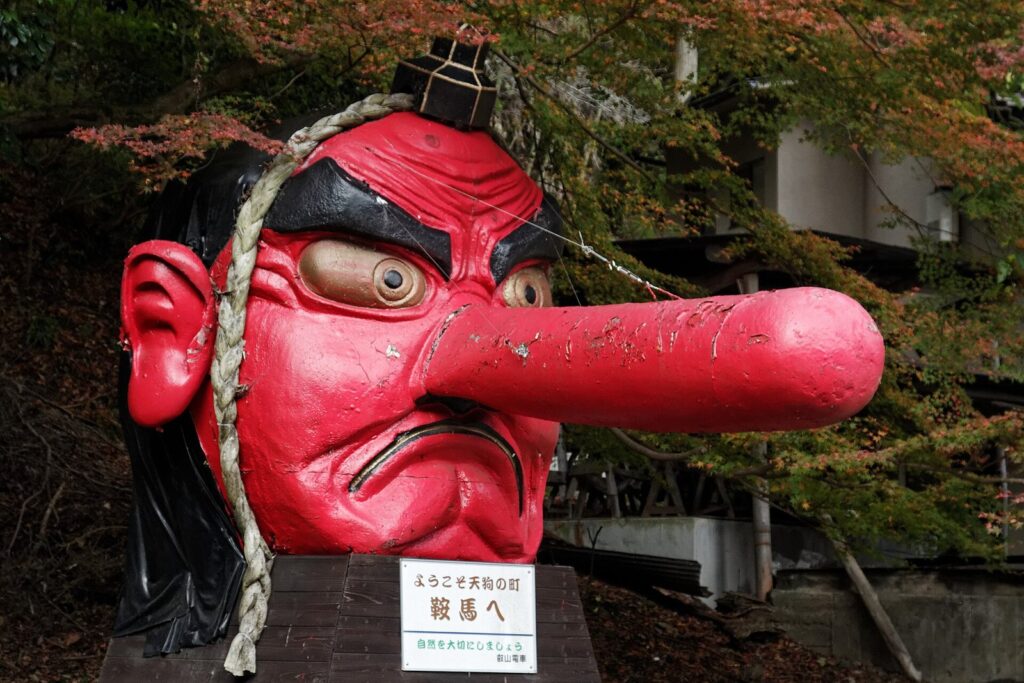
| Tengu | Mountain spirit with a long red nose or a bird’s beak. Arrogant, formidable, a master swordsman in some tales. | Masks in souvenir shops, mountain shrines |
| Kitsune | Fox. Messenger of Inari, god of rice and business; also a shapeshifter who takes the form of a woman. Grows extra tails with age. | Every Inari shrine in the country |
| Tanuki | Raccoon dog. Cheerful trickster with a straw hat, a sake flask and a comically exaggerated anatomy. | Ceramic statues outside restaurants |
| Oni | Horned ogre, club in hand, tiger-skin loincloth. Thrown out of houses with roasted soybeans each February. | Setsubun festivals, temple guardian imagery |
| Yuki-onna | The snow woman. Beautiful, freezing, appears in blizzards in the north. | Winter folklore, Tohoku souvenirs |
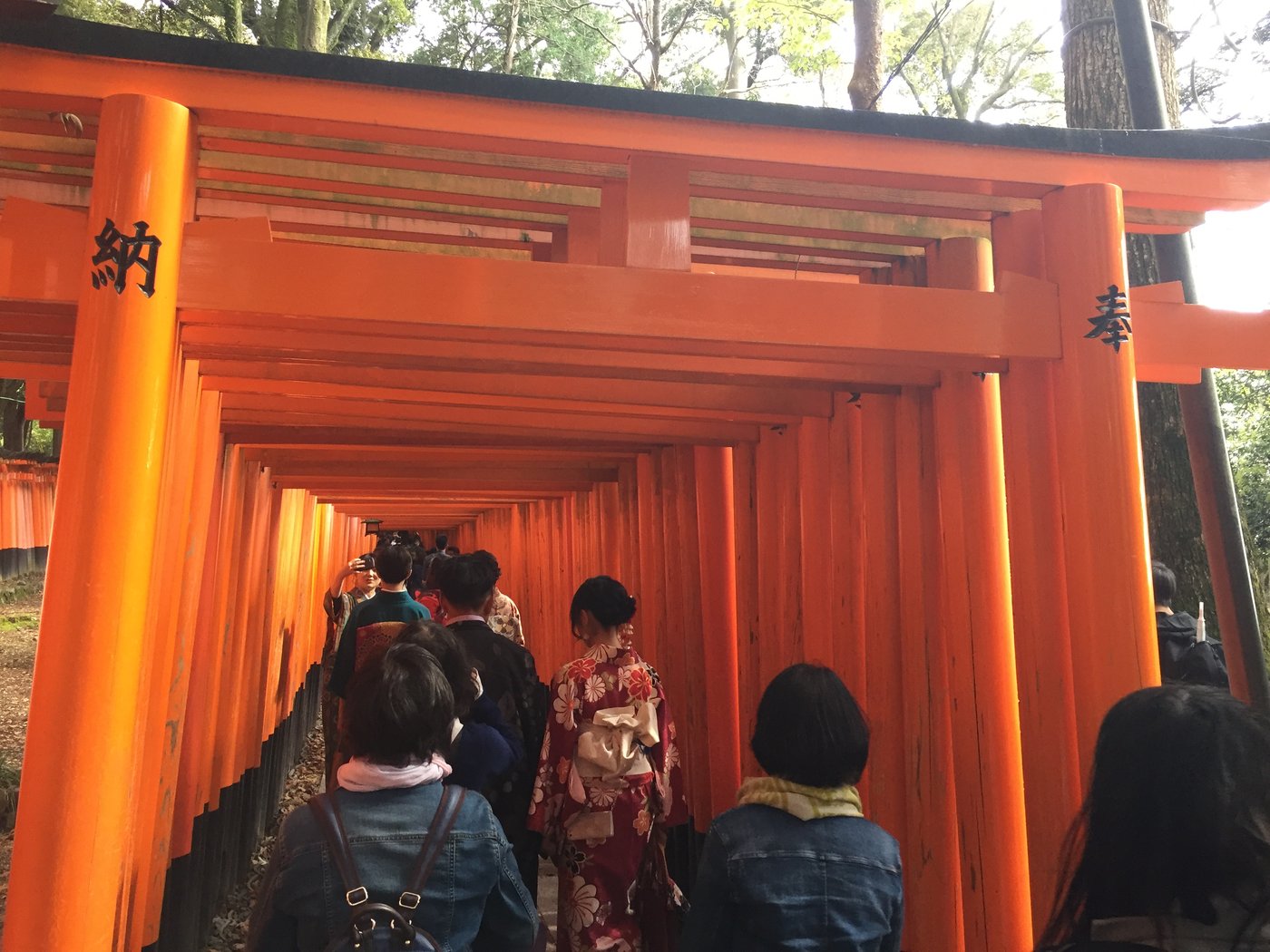
The foxes are the easiest to test yourself on. Walk up through Fushimi Inari in Kyoto and count the stone kitsune holding keys and jewels in their mouths. They are not decoration; they are staff.
How a folk belief became a catalogue
Yokai went through three moments that turned scattered village stories into a national encyclopedia.
The scrolls (medieval). The Hyakki Yagyo, the “Night Parade of One Hundred Demons,” is the image of a procession of monsters pouring through the streets after dark. Surviving painted handscrolls from the Muromachi period show them as a chaotic, slightly comic carnival — animated household objects, grinning oni, a parade you did not want to meet.
The artist who wrote the field guide (1776). Toriyama Sekien published Gazu Hyakki Yagyo, an illustrated bestiary that fixed the appearance of dozens of yokai for good. It was a print-era hit in an Edo full of ghost-story publishing. Sekien also, by most accounts, invented a number of yokai himself and slipped them in — which means part of the “ancient tradition” is a joke by an 18th-century artist that everyone took seriously.
The folklorist and the manga artist. In 1910 Kunio Yanagita published The Legends of Tono, recording the oral tales of a remote valley in Iwate and effectively founding Japanese folklore studies. Then Shigeru Mizuki (1922–2015), a manga artist who lost his left arm in the Pacific War, created GeGeGe no Kitaro and made yokai a permanent part of postwar childhood. Almost every yokai character a Japanese person under 70 can name passed through Mizuki’s pen. The warrior era that shaped much of this material is its own story — see Samurai and Bushido: The Warriors Who Shaped Japan.
Why summer is ghost season
If you visit in July or August, the ghost content is not a coincidence. Two threads combine.
One is practical and old: chilling stories were a form of air conditioning. Kaidan storytelling gatherings, and the game of hyakumonogatari — a hundred candles, a hundred tales, extinguish one candle per story and see what arrives when the last goes out — belong to the hot months. Kabuki theatres traditionally staged their great ghost play, Yotsuya Kaidan, in summer for the same reason.
The other is Obon in mid-August, when ancestral spirits are believed to return home. Families clean graves, light small fires to guide the dead in and out, and dance at neighbourhood bon odori. It is warm and communal rather than frightening, but the season’s underlying premise is explicitly that the dead are nearby. I cover the travel practicalities of that period, which is one of the busiest of the year, in Japan in Summer: Surviving the Heat, Festivals and Obon.
Yokai are still being made
This is the part that surprises visitors. The catalogue is open.
Postwar Japan produced Kuchisake-onna, the slit-mouthed woman who asks if you think she is pretty, and Hanako-san, the girl who answers if you knock on the third stall of a school toilet. Both spread through schoolyards in the late 20th century exactly the way village tales once spread.
The clearest modern case is Amabie, an obscure mermaid-like creature from a single 1846 broadsheet, which supposedly said that drawing its image would ward off epidemic disease. In early 2020 it went viral, appeared in public health graphics, and became sweets, stickers and shrine amulets within weeks. That is the mechanism working normally.
Where to actually go
Chofu, western Tokyo. Mizuki lived here. Around Jindaiji, one of Tokyo’s oldest temples, there are yokai statues, soba restaurants and Kitaro Chaya, a small themed cafe and goods shop (roughly 10:00–17:00, usually closed Mondays). Chofu is about 20 minutes from Shinjuku on the Keio line, then a short bus — the easiest yokai day out from the capital, and a good addition to Best Day Trips from Tokyo You Can Book Online.
Sakaiminato, Tottori. Mizuki’s hometown, and the real pilgrimage. Mizuki Shigeru Road runs from the station with around 170 bronze yokai statues set into the pavement, and the Mizuki Shigeru Museum at the end costs about ¥1,000 for adults, open roughly 9:30–18:00. Remote, but the town has committed completely.
Miyoshi, Hiroshima. The Yumoto Koichi Memorial Japan Yokai Museum, built around a collection of some 5,000 yokai artefacts. Admission runs roughly ¥600–1,000 depending on the exhibition, and it works as a detour if you are already heading to Hiroshima and Miyajima.
Tono, Iwate. The valley Yanagita wrote about. Visit Kappabuchi, the pool by Joken-ji temple where the kappa are said to live, and buy a novelty “kappa capture permit” for a couple of hundred yen so you can fish for one with a cucumber. The folklore museums nearby are ¥200–400 each.
Kyoto. Ichijo-dori in Kamigyo-ku markets itself as Yokai Street, with monster figures outside the shops and an occasional free Hyakki Yagyo costume parade — dates have moved around in recent years, so check locally. The former Toei Kyoto Studio Park, rebranded as Uzumasa Kyoto Village in March 2026, also runs a large yokai event in autumn; adult admission is about ¥2,800, or around ¥2,000 after 17:00. Kyoto is the natural home for this material, for reasons in The History of Kyoto: 1,000 Years as Japan’s Capital.
All prices are approximate and worth confirming before you travel.
FAQ
Do Japanese people believe in yokai? Almost nobody would say yes in those words. But plenty of people avoid whistling at night, will not point at a funeral car, and take a shrine amulet seriously. Belief here is less a yes-or-no question than a set of habits.
Is Halloween a yokai festival? No. Halloween arrived in Japan in the 1990s as a costume and retail event. The native ghost season is summer, and the closest thing to a domestic monster parade is Setsubun in February, when people throw beans at oni.
Are yokai evil? Mostly not. They are dangerous the way weather is dangerous. Many are simply strange, and a fair number are ridiculous.
Where can I see the old paintings? Museum rotations vary, but the Miyoshi museum is the most reliable dedicated collection. Major museums in Tokyo and Kyoto also run yokai exhibitions, most often in summer.
Is any of it good for kids? Very much so. GeGeGe no Kitaro is children’s material, and Sakaiminato and Chofu are family days out rather than horror attractions.
The verdict
Yokai are the record of a country that decided the unexplained deserved a name, a face and, eventually, a merchandise line. They are not a solemn tradition being preserved behind glass. They are still in circulation, still being invented, and still doing the original job of making the dark a bit more manageable.
The practical version for a traveler is small. Look at the fox statues properly at the next Inari shrine. Notice the tanuki outside the restaurant. If you are here in August and a shrine festival has a haunted house tent, pay the few hundred yen. You will be participating in something considerably older than the tent.
Written from Japan by the Wayfarer Japan team.
Featured image: “Welcoming Tengu (6911079352)” by KimonBerlin, CC BY-SA 2.0, via Wikimedia Commons