I live in Japan, and wabi-sabi is one of those words that means something noticeably different here than it does abroad. Overseas it has become a decorating style: beige linen, a chipped bowl on a bare shelf, a caption about embracing flaws. In Japan it is not a look you buy. It is closer to a way of noticing — and, awkwardly for anyone hoping for a tidy definition, most people here would struggle to explain it if you asked them at a bus stop.
That is not evasiveness. Wabi-sabi was never a philosophy anyone sat down and wrote out. It was assembled over centuries by poets, tea masters and monks who mostly used other words, and the compound “wabi-sabi” only became a fixed phrase relatively recently. Which makes it more interesting, not less: it is a genuine national instinct about beauty that predates anyone naming it.
The quick answer
- Wabi originally meant poverty, loneliness, the misery of being out in the cold — and was deliberately flipped into a virtue.
- Sabi meant desolation and withering, and came to mean the beauty an object gains from age and use — rust, patina, worn wood.
- The two words were rarely paired historically. Tea masters spoke of wabi-cha; poets spoke of sabi. “Wabi-sabi” as one term is largely a modern convenience.
- It is not minimalism. Minimalism removes things to achieve control. Wabi-sabi accepts that nothing is finished, permanent or perfect — including the room you are standing in.
- You can see it directly in Kyoto, most cheaply at Ryoan-ji (¥600) and Tenryu-ji’s garden (¥500), and most completely at Ginkaku-ji, the temple built to be quietly plain on purpose.
Two sad words that changed jobs
Wabi (侘) comes from a verb meaning to pine, to be distressed, to be at a loss. In the Heian court it was not a compliment. Sabi (寂) is written with a character meaning lonely or still, and shares a sound with sabi (錆), rust — a coincidence Japanese has never quite let go of.
The turn happened when medieval poets and monks began arguing that these were not conditions to escape but conditions to see clearly. A hut with a leaking roof is cold; it is also quiet, and you notice the rain. The 13th-century essay Hojoki, written by a man who moved into a three-metre-square hut outside Kyoto after watching the capital burn, is essentially a book about this: everything you own is on loan, so live light and pay attention.
Underneath sits the Buddhist idea of mujo, impermanence — the same idea that makes cherry blossom season so heavily freighted here. Japanese cherry blossoms are not especially fragrant and the trees are unremarkable for fifty weeks a year. They are loved because they fall. If you have wondered why the whole country times its calendar around a week of flowers, that is the answer, and it is the same instinct as wabi-sabi. Buddhism’s role in all this is worth understanding on its own terms — I go through it in Shinto vs Buddhism: Japan’s Two Religions Explained.
The tea room did the real work
The person who turned a mood into a practice was Sen no Rikyu (1522–1591), tea master to the two most powerful men in Japan.
Tea gatherings in his era had drifted toward display: imported Chinese porcelain, big rooms, expensive things arranged so guests could be impressed. Rikyu went the other way. He shrank the room to four and a half tatami mats and then smaller. He put in a nijiriguchi, a crawl-through entrance about 66cm high, so that everyone — including sword-carrying warriors, who had to leave the blades outside — entered on their knees. He used local raw-clay bowls made by a roof-tile maker rather than flawless Chinese ware. He used bamboo for a scoop where ivory was expected.
None of this was thrift. It was expensive austerity, arranged with total precision. That is the part the overseas version of wabi-sabi usually misses: a wabi tea room is not casual. Every element is chosen, and the roughness is deliberate.
The stories that survive make the point sharper than any definition. Rikyu is said to have had a garden path swept spotless, then shaken a tree so a few leaves fell across it — because perfectly clean read as anxious, not calm. In another, he filled his garden with morning glories, then cut every one before a visit from the warlord Hideyoshi, leaving a single bloom in the alcove of the tea room. Hideyoshi later ordered him to commit seppuku, in 1591, for reasons still debated. The aesthetic of humility was operating at the highest level of politics, and it was not safe there. The warrior world that surrounded it is its own story — see Samurai and Bushido: The Warriors Who Shaped Japan.
Sabi, kintsugi and the honest repair
Sabi is the easier half to see. It is the darkened cedar pillar in an old inn, the stone step worn into a shallow dish by four hundred years of feet, the moss that a temple gardener maintains rather than removes.
The clearest object lesson is kintsugi, repairing broken pottery with lacquer dusted with gold. The repair is not hidden. It is drawn in a line of gold precisely where the damage was, and the bowl is understood to be worth more afterwards, because it now has a history you can see. Kintsugi is genuinely old — the practice is usually dated to the 15th–16th centuries — and genuinely Japanese, but it has become such a popular metaphor abroad that visitors sometimes arrive expecting it everywhere. In practice you will see it in museums, in tea utensil shops and in workshops that will repair a piece for you over several weeks, not on the shelves of an average home.
A useful related word: shibui, meaning an understated, slightly austere good taste. A charcoal-grey kimono lining. A restrained lacquer box. If a Japanese friend calls something shibui, that is high praise for the same family of reasons.
Where to actually stand in it
Wabi-sabi is not evenly distributed. Kyoto has most of it, because Kyoto is where it was invented — the background to that is in The History of Kyoto: 1,000 Years as Japan’s Capital.
Ginkaku-ji, the Silver Pavilion. Built in 1482 by a shogun who lost his war and retired to make things beautiful instead. It has no silver, and that is the point: unlacquered dark wood, a moss garden, a raked sand cone. Note the price change — admission rose to ¥1,000 for adults from 1 April 2026 (previously ¥500), so check before you assume the older figures you find online.
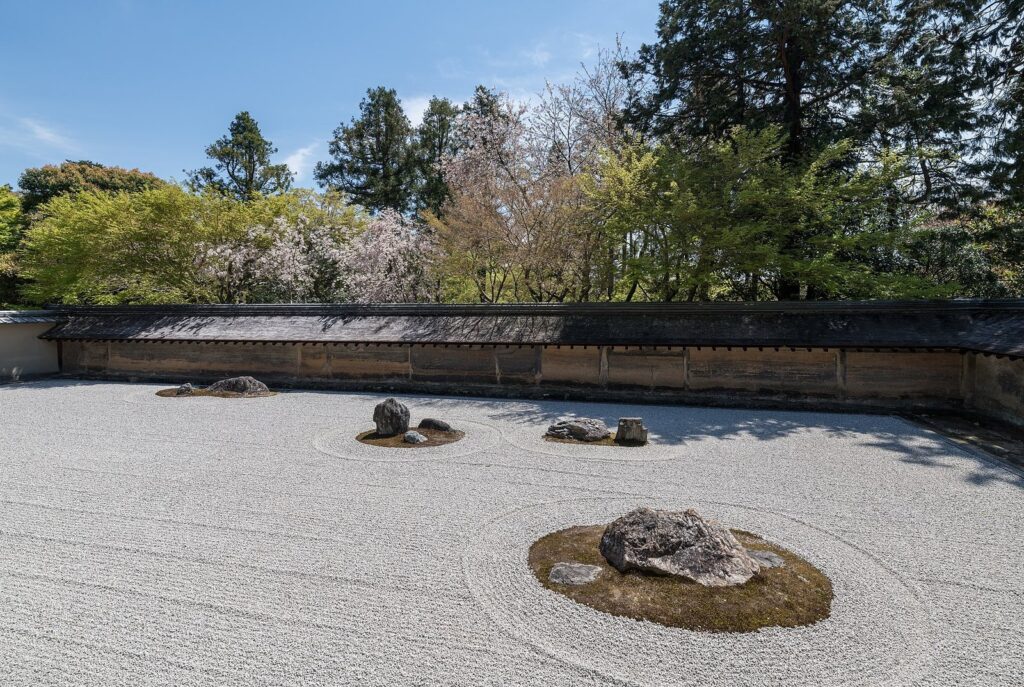
Ryoan-ji. Fifteen rocks in white gravel, walled in by an oil-stained earthen wall that is itself half the beauty. Around ¥600. Go at opening or in rain; the rain is better.
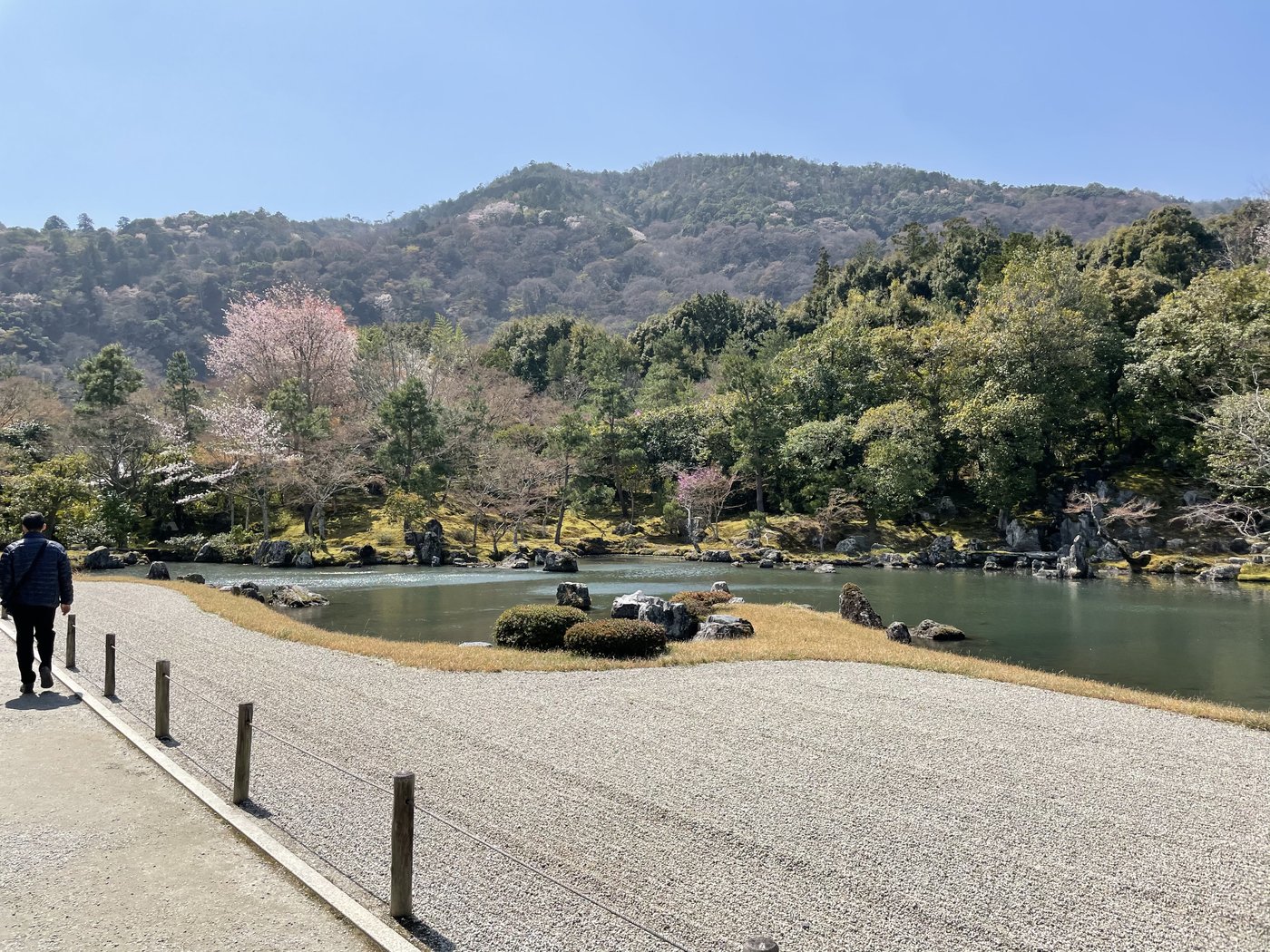
Tenryu-ji, Arashiyama. A 14th-century garden designed to borrow the mountains behind it. Garden entry around ¥500, with roughly ¥300 more for the buildings.
A ryokan. Honestly the most complete way to spend a night inside the aesthetic — worn wood, one scroll in the alcove, a window framing exactly one thing. If you are weighing that against a hotel, I compare them in Hotel vs Ryokan: Which Should You Book in Japan?.
All figures here are approximate and worth confirming before you go; temple admissions in Kyoto have been revised upward repeatedly in the last two years. For fitting these into a route, see Best Things to Do in Kyoto: Temples, Gardens and More.
FAQ
Is wabi-sabi a religion or a philosophy? Neither, formally. It is an aesthetic sensibility with Zen Buddhist roots. No one is initiated into it and no temple teaches it as doctrine.
Do Japanese people actually use the word? Rarely in conversation, and almost never about their own homes. You will meet shibui, sabi and mujo far more often. The compound is more common in writing and in explanations aimed at foreigners.
Is a messy room wabi-sabi? No. Neglect is not the same as accepted imperfection. Rikyu’s tea room was swept obsessively; the imperfection was placed, not left.
Is minimalism the same thing? No. Minimalism tends toward the new, the clean and the controlled. Wabi-sabi tolerates asymmetry, decay and things that are visibly old.
Where can I buy something wabi-sabi? Look for regional pottery — Hagi, Bizen, Shigaraki, Karatsu — in a department store craft floor or a local kiln town, not a souvenir aisle. Prices run from a few thousand yen to a great deal more.
The verdict
Wabi-sabi is not a style you can install. It is permission to find something beautiful while it is still unfinished, already worn, or about to end. That reframing is why it survives: it is a workable answer to the fact that nothing keeps.
The practical version for a traveler is small. Sit on the veranda at Ryoan-ji for twenty minutes instead of five. Notice that the temple wall is more interesting than the rocks. Pick the cup at the pottery shop that is slightly off-round, because your hand will find it in the dark. That is closer to the real thing than any amount of beige linen.
Written from Japan by the Wayfarer Japan team.
Featured image: “Kare-sansui zen garden, Ryōan-ji, Kyoto 20190416 1” by DXR, CC BY-SA 4.0, via Wikimedia Commons