I take the Shinkansen often enough that I don’t think twice about where my bag goes, but I still remember being confused the first time a conductor stopped at my row and pointed at the suitcase wedged next to me. Japan quietly tightened its bullet train luggage rules a few years ago, and it still catches a lot of visitors off guard, because nothing about it is obvious until you’re standing on the platform with a 28-inch suitcase and nowhere obvious to put it. The good news is that the fix costs nothing if you plan ahead, and the entire system exists for a very practical reason: Shinkansen carriages simply don’t have the overhead bin space that long-haul flights do.
The quick answer
- If your suitcase’s three dimensions (height + width + depth, including wheels and handles) add up to 160cm or less, you don’t need to do anything. Use the overhead rack or the gap in front of your seat.
- If they add up to more than 160cm and up to 250cm, you must reserve a seat in the “oversized baggage area” (特大荷物スペースつき座席) section, and it costs nothing extra on top of your normal reserved-seat fare.
- This rule only applies on the Tokaido, Sanyo, Kyushu and Nishi-Kyushu Shinkansen — the line that runs Tokyo–Nagoya–Kyoto–Osaka–Hiroshima–Fukuoka–Kagoshima and the Nagasaki spur. The Tohoku, Joetsu, Hokuriku, Yamagata and Akita Shinkansen (JR East’s network heading north) don’t enforce it.
- Skip the reservation and bring an oversized bag anyway, and staff can charge a ¥1,000 handling fee and move it to whatever space they can find — not guaranteed to be near your seat.
- Anything over 250cm total isn’t allowed on board at all; ship it ahead with takkyubin instead.
- Strollers, wheelchairs, musical instruments and sports equipment are exempt from the size rule regardless of dimensions.
Why this rule exists
Shinkansen cars were designed decades ago for domestic business travelers who mostly carried briefcases, not travelers with large hard-shell suitcases. As inbound tourism grew, the overhead racks and the gaps between seat rows started overflowing, and standard suitcases were ending up in aisles and doorways. JR Central, JR West and JR Kyushu responded in 2020 by converting the last row of seats in certain reserved cars into a walled-off space designed to hold big luggage, and made reserving that space compulsory if your bag exceeds the size threshold. It’s a fairly elegant solution: nobody has to guess, and the person with the biggest suitcase always has a guaranteed spot for it, right behind their own seat.
How to measure your bag
Add up the length, width and height of your suitcase in centimeters, including the wheels and any handle that sticks out. Airlines often quote a slightly different combined-dimension number, so don’t assume your bag’s checked-baggage allowance translates directly — measure it yourself if you’re close to the line. As a rough guide:
- A typical carry-on (about 55 x 40 x 25cm) adds up to around 120cm — no reservation needed.
- A medium check-in suitcase (roughly 65 x 45 x 27cm, about 60-70 liters) usually lands right around 135–140cm — still fine without a reservation, but check yours.
- A large check-in suitcase (around 75 x 50 x 30cm or bigger, 90L and up) typically clears 160cm and needs the reservation.
If you’re traveling with a large suitcase for a longer trip, this is one more reason to read Japan Packing List before you leave home — the less you’re hauling, the fewer of these logistics you have to think about.
How to book the oversized baggage seat
- Booking online (Smart EX or the JR Central/JR West apps): when you select your seat, there’s an option to choose “seat with oversized baggage space.” It’s usually in the last row of specific cars, so availability can be limited on popular departures — book as early as you can once your schedule is fixed.
- At a ticket machine or ticket window: if you’re buying your ticket in person, tell the staff you have oversized luggage and ask for a seat with the baggage space. This works even if the self-service option is confusing in a language you don’t read well.
- With the Japan Rail Pass: exchange your voucher and reserve seats at a JR ticket office (みどりの窓口), and mention the oversized baggage when you do. If you’re still deciding whether the pass makes sense for your trip, Japan Rail Pass 2026: Is It Still Worth It? walks through the current math.
- There’s no extra fee for choosing this seat type — it costs exactly the same as any other reserved seat on the same train.
The catch is that these seats are limited in number per train, and they can’t be booked from every possible seat inventory at every fare tier, so build in a little flexibility on train times if you’re traveling with a big bag during a busy season.
What happens if you don’t reserve
If you board with an oversized bag and no reservation, a conductor may ask about it during the trip. As of 2026, the enforced penalty is a ¥1,000 handling fee, and staff will place your bag in whatever storage space is actually available on that train, which might not be anywhere near your seat. It’s not a huge fine, but it does mean you lose control over where your luggage ends up, which is stressful if it holds anything you’d rather keep an eye on. It’s a small hassle that’s completely avoidable with a two-minute booking step.
What’s exempt, and what’s not allowed at all
Strollers, wheelchairs, musical instruments in cases, and sports equipment like ski bags or golf bags are treated separately from the general size rule and don’t require the oversized baggage reservation, even if they’re bulky. On the other end, anything with combined dimensions over 250cm, or weighing more than 30kg, isn’t permitted in the passenger cabin at all. If you’re moving something that large between cities — extra suitcases before a long onward flight, sports gear, or seasonal shopping — the better option is takkyubin courier delivery, which many hotels and convenience stores can arrange for next-day delivery to your next stop. What to Do With Your Luggage in Japan covers how that service works in more detail.
Does this affect other trains?
No — this specific reservation rule is unique to the Tokaido, Sanyo, Kyushu and Nishi-Kyushu Shinkansen network. If your trip mostly uses the Tohoku Shinkansen up toward Sendai or Aomori, the Hokuriku Shinkansen toward Kanazawa, or local and limited express trains anywhere in the country, the general Japan Rail baggage limit (two bags per passenger, 250cm and 30kg each) applies without a special seat reservation. It only becomes relevant on routes like Tokyo to Kyoto, Tokyo to Osaka, or a Hiroshima and Miyajima trip that runs through Shin-Osaka or Hakata.
FAQ
Does this apply to the Nozomi, Hikari and Kodama services? Yes, the rule applies across all reserved-car services on the Tokaido/Sanyo/Kyushu/Nishi-Kyushu network, since it’s tied to the specific baggage-space seats in certain cars, not the train name.
Can I still use the overhead rack for a medium suitcase? Yes — anything under the 160cm threshold is fine in the overhead rack or the space in front of your seat, no reservation required.
What if the oversized baggage seats are sold out for my train? Try an earlier or later departure, or check a different car class. If nothing is available and you can’t reschedule, consider shipping the bag ahead by takkyubin and traveling with a smaller daypack instead.
Do backpacks count toward this rule? Only if their combined dimensions exceed 160cm, which is unusual for most travel backpacks. Measure it if you’re unsure, especially if it’s a large external-frame hiking pack.
Is this the same rule on the Shinkansen from Kansai Airport? If your onward Shinkansen connection runs through Shin-Osaka on the Tokaido/Sanyo line, yes. Check Kansai Airport to Kyoto and Osaka for how that connection works.
The verdict
This is one of those Japan travel rules that sounds bureaucratic but is genuinely easy to handle once you know it exists: measure your suitcase once, reserve the right seat for free if you’re over 160cm, and you’ll never think about it again for the rest of your trip. Skipping it doesn’t ruin your trip, but it does mean surrendering control over where your bag ends up for a few hours, and a ¥1,000 fee on top. Two minutes at checkout when you book your seat is the whole fix.
Written from Japan by the Wayfarer Japan team — practical, no-nonsense travel guides from people who actually live here.
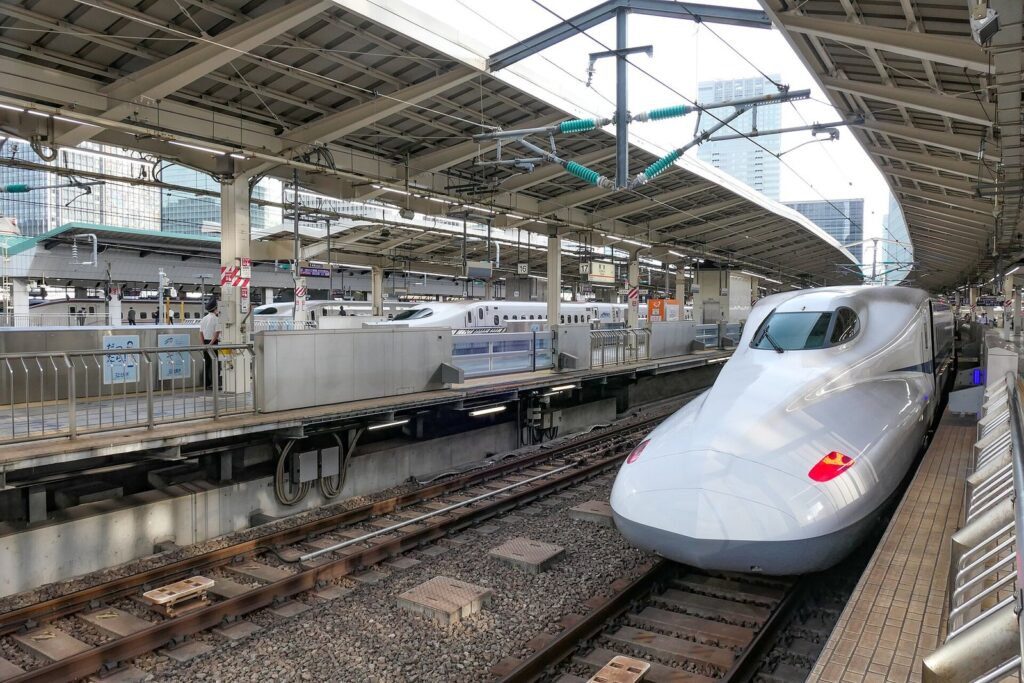
Featured image: “JR-Central-Tokyo-STA Shinkansen-Home N700” by MaedaAkihiko, CC BY-SA 4.0, via Wikimedia Commons