I live in Japan, and the question I get asked most about capsule hotels isn’t “are they safe?” — it’s “will I fit?” The honest answer is: probably, but not with the suitcase you’re picturing. A capsule is built around one specific promise, a clean, private place to sleep for a fraction of a hotel room’s price, and it keeps that promise well. What it doesn’t do is give you anywhere to put a 28-inch checked bag. Get that part right before you book, and the rest of the experience is one of the more interesting, comfortable ways to spend a night in Japan.
Capsule hotels started in Osaka in 1979, built for salarymen who’d missed the last train home. The category has since split into two very different things: the old-school, budget, mostly-men version that inspired the stereotype, and a newer wave of design-forward “poshtels” with proper lounges, saunas and women-only floors that wouldn’t look out of place in a lifestyle magazine. Both still exist side by side, sometimes in the same building.
The quick answer
- Price: roughly ¥3,500–¥6,500 a night for a standard pod in central Tokyo or Osaka; ¥2,000–¥4,000 in smaller cities; ¥7,000–¥10,000+ at design-led chains like First Cabin or Nine Hours on weekends.
- What you get: a sealed or curtained pod (roughly the footprint of a single bed, just tall enough to sit up in), shared bathrooms and showers, a locker for your belongings, and usually a communal bath, sauna or lounge.
- Luggage: lockers fit a carry-on or backpack. A large suitcase generally does not fit in the room or the locker — check the hotel’s own size limit before booking.
- Who it suits: solo travellers, one-night stopovers near an airport or station, budget-conscious trips, and anyone curious about a genuinely Japanese way to sleep.
- Who should skip it: couples or families wanting to stay together in one space, anyone with a large checked bag and no way to forward it, and light sleepers bothered by shared spaces.
What a capsule actually is
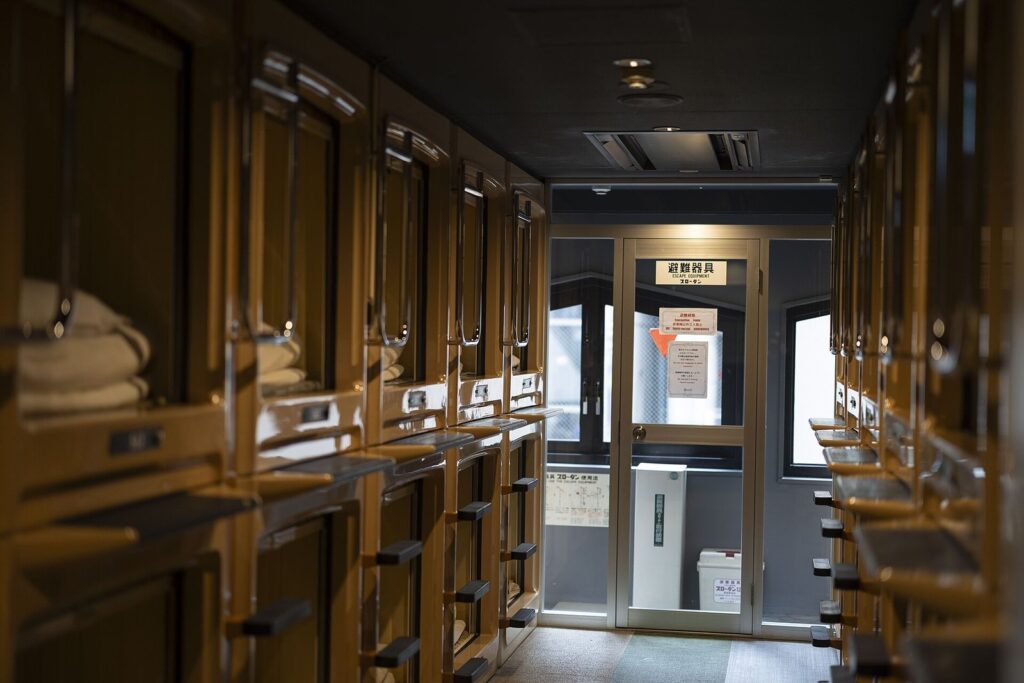
Picture a stack of plastic or wood-panelled pods, two rows high, lined up like a wall of dresser drawers you climb into. Each capsule has a thin mattress, a light, a power outlet, sometimes a small TV or tablet built into the wall, and a curtain or roll-down screen instead of a locking door — this is a privacy barrier, not a security one, which is why valuables go in your locker, not your pod. A capsule is not sealed in the way older Western media sometimes implies; you can sit up, and most modern ones pipe in a little airflow and ambient light so it doesn’t feel like a box.
Nine Hours, the chain that popularized the minimalist white-pod look, names itself after the stay formula: one hour to shower, seven hours to sleep, one hour to get ready — check-in to check-out. First Cabin sits at the other end, with taller “cabins” modelled loosely on business-class aircraft, starting around ¥5,000–7,000 and pushing toward ¥9,500 at well-located branches like the one near Haneda Airport. In between are hundreds of independent capsule hotels, many attached to a sauna or public bath (sento), a holdover from the format’s roots as an extension of the bathhouse.
The part everyone gets wrong: your luggage
This is the detail that catches people out more than anything else. Capsule hotel lockers are built for a daypack, a backpack, or at most a carry-on — not a large suitcase. Some properties have a small overflow storage room for bigger bags, but plenty simply don’t have anywhere to put one, and staff will tell you so at check-in, sometimes after you’ve already paid.
If your route includes a capsule-hotel night mid-trip, the easiest fix is the one residents actually use: send your suitcase ahead by takkyubin courier to your next hotel for about ¥2,000–¥2,500, and travel that one night with a small bag. What to Do With Your Luggage in Japan covers exactly how that system works, including the coin-locker and booked-storage alternatives if you only need somewhere for the day. Whatever you do, check the specific capsule hotel’s stated size limit on its own site or booking page before you commit — it varies a lot between properties, and it’s the one detail online reviews rarely mention.
Booking, check-in and etiquette
Most capsule hotels catering to tourists now take passport ID without issue and list in English on major booking sites — 👉 Booking.com Tokyo and 👉 Agoda both carry a wide range, from bare-bones Nine Hours branches to design hotels with a rooftop bath. Check-in is standard hotel-style: you’re handed a key or wristband for your locker, sometimes a set of loungewear and a towel, and shown to your floor.
A few things are close to universal:
- Shoes off at the entrance. Slippers are provided.
- Gender-separated floors or buildings are the norm, not the exception. Mixed-gender lobbies and lounges exist, but sleeping floors are split.
- Most capsule hotels don’t accept children, and a meaningful number set a minimum age around 15 or 18. Families should look at a business hotel or ryokan instead — see Best Ryokan Near Tokyo with a Private Onsen or Where to Stay in Tokyo for alternatives.
- Quiet hours apply. Talking, phone calls and even loud phone screens inside the pod area are discouraged after a set time, usually 10pm or 11pm.
- Tattoos can still be an issue at the communal bath or sauna, though the rules have loosened considerably; some places offer cover stickers, others simply don’t check. If a shared bath is the main draw for you, it’s worth a quick check of that property’s specific policy — the general etiquette in Japan Etiquette holds here too.
- No eating in the pod, and often no food in the sleeping area at all — there’s usually a lounge or vending machine area for that.
Comparing your options
| Type | Typical price | Best for | Watch out for |
|---|---|---|---|
| Budget chain (Nine Hours-style) | ¥3,500–5,500 | Solo travellers, airport stopovers | Minimal storage, strict quiet hours |
| Design “poshtel” with sauna/bath | ¥5,500–9,000+ | First-time curious travellers, a treat night | Books out early on weekends |
| Independent, sento-attached | ¥2,500–4,500 | Budget travel outside major cities | English support varies |
| Premium cabin (First Cabin-style) | ¥6,000–9,500 | Those who want more space, less “capsule” feel | Still not built for large luggage |
FAQ
Is a capsule hotel actually comfortable? For one or two nights, most travellers find it surprisingly fine — the mattress and bedding are usually better than the tiny footprint suggests, and modern pods have decent airflow and lighting controls. It’s the shared bathroom and lack of privacy for calls or video, not the sleeping itself, that takes adjusting to.
Can couples stay in the same capsule hotel? You’ll typically be on separate, gender-split floors and won’t share a pod, even if you book together. A handful of hotels have “twin capsule” or connecting-pod options, but they’re the exception. If sharing a room matters to you, a business hotel is the simpler choice.
Do I need to speak Japanese to check in? No. Any capsule hotel that shows up on Booking.com or Agoda in English is used to foreign guests and will have English signage, at minimum a translated check-in sheet, and usually staff who can manage the basics.
Is it safe to leave my belongings? Yes, for the standards most travellers are used to. Your locker is where your valuables go — passport, wallet, electronics — and Japan’s low theft rate applies here as everywhere else. The curtain on your pod is for privacy, not security, so don’t leave anything valuable inside it.
The verdict
A capsule hotel is one of the better one-night, low-cost options in Japan if you’re travelling solo or as part of a longer, mixed-accommodation trip — not because it’s a novelty, but because it genuinely does the job of a clean, cheap, well-located bed better than a lot of budget hotels do. The catch is entirely logistical: sort out where your big suitcase is going before you arrive, not after. Do that, and a capsule stay is a good night, not a story about the night you couldn’t fit your luggage anywhere.
Written from Japan by the Wayfarer Japan team — practical, first-hand travel advice for visitors to Japan.
Featured image: “Booth Netcafe & Capsule Hotel, Shinjuku, Tokyo, Japan Feb 21 2025” by GoToVan, CC BY 2.0, via Wikimedia Commons