I live in Japan, and every time a friend visits for the first time, I get some version of the same 20 questions before they land. Most have short, reassuring answers — Japan is one of the easier “hard” countries to visit for the first time. Here they are, answered straight, with links to deeper guides where you need more detail.
The quick answer
- Visa: most Western passport holders don’t need one for short tourist stays — just a valid passport.
- Money: Japan is more cash-friendly than people expect, but cards and IC cards work almost everywhere in cities now.
- Language: you’ll be fine with English in tourist areas, a translation app, and a little patience.
- Safety: Japan is one of the safest countries in the world to travel in.
- Cost: a realistic mid-range trip runs $150–250/day per person, all-in (see How Much Does a Trip to Japan Cost? for the full breakdown).
Do I need a visa to visit Japan?
If you hold a passport from the US, Canada, UK, EU, Australia, or most other Western countries, you can enter Japan visa-free for short tourist stays (typically up to 90 days) — you just need a valid passport. Fill out the Visit Japan Web form before you fly to speed up immigration and customs. Note: Japan passed a law in 2026 to introduce a new pre-travel authorization system called JESTA, similar to the US ESTA, but it isn’t required until fiscal 2028 at the earliest — for 2026 and 2027 trips, a passport is still all you need.
Is Japan cash-only, or can I use cards?
Neither, really. Convenience stores, chain restaurants, department stores, and most hotels take cards and contactless payment everywhere in cities now. But small restaurants, temples, some markets, and rural areas can still be cash-only. Carry some yen and get comfortable using ATMs (7-Eleven ATMs reliably accept foreign cards). Full breakdown: Cash or Card in Japan?
Do I need an IC card like Suica?
Yes — get one on your phone or as a physical card. It taps onto virtually every train, subway, and bus, and works at convenience stores and vending machines too. It’s the single biggest quality-of-life upgrade for getting around. See How to Use a Suica Card in Japan and Suica vs PASMO vs Welcome Suica.
Is the Japan Rail Pass worth buying?
Depends on your itinerary. The 7-day nationwide pass costs roughly ¥50,000 (about $330) as of 2026, rising to about ¥53,000 from October 2026. It only pays off if you’re taking multiple long-distance shinkansen trips (e.g., Tokyo–Kyoto–Hiroshima) within the validity window. If you’re mostly staying in one region, point-to-point tickets or a regional pass are usually cheaper. See Japan Rail Pass 2026: Is It Still Worth It? for the real math.
Do I need an eSIM or pocket WiFi?
You’ll want data from the moment you land — for maps, translation, and train apps. An eSIM installed before you fly is the easiest option for most visitors; a physical SIM or pocket WiFi are the alternatives if your phone doesn’t support eSIM or you’re traveling as a group. 👉 Airalo has easy Japan eSIM plans you can activate the moment you land. See Best eSIM for Japan for a full comparison.
Will people speak English?
In Tokyo, Kyoto, Osaka, and other tourist hubs — enough to get by. Station signage, ticket machines, and menus increasingly have English. Outside the big cities it thins out fast. A translation app (Google Translate’s camera mode is excellent for menus and signs) and a few polite Japanese phrases go a long way. Don’t let language anxiety stop you from booking the trip.
Is Japan safe?
Yes — consistently ranked among the safest countries in the world. Violent crime is rare, and it’s completely normal to see unattended bags holding a table at a cafe. Standard travel precautions still apply (watch belongings in crowded areas like Shibuya), but you don’t need to be on edge here the way you might elsewhere.
Do people tip in Japan?
No. Tipping isn’t part of the culture and can actually cause confusion — service staff may chase you down to return money you “forgot.” Good service is simply the standard, already reflected in the price. Full etiquette rundown: Japan Etiquette: 15 Dos and Don’ts.
What should I pack?
Less than you think, and don’t stress about forgetting things — Japan has excellent shops for anything you’re missing. Forgot an umbrella? Any convenience store sells one for a few hundred yen. Need a jacket? Uniqlo and GU are everywhere. Dead phone battery? ChargeSPOT rental stations and electronics stores are all over the cities. See Japan Packing List: 15 Things You’ll Actually Need.
How much does a trip to Japan cost?
For a realistic mid-range trip, budget $150–250 per person per day, covering accommodation, food, local transport, and some activities — more in Tokyo, less if you’re careful with dining. Long-distance transport (shinkansen, flights) and any Japan Rail Pass are extra. Full cost breakdown by category: How Much Does a Trip to Japan Cost?
When is the best time to visit?
October–November for crisp weather and autumn leaves, or late March–early April for cherry blossoms (book months ahead — it’s the busiest season). Avoid the peak of summer humidity if you can, and check whether your dates overlap Golden Week or Obon, when domestic travel spikes prices. Details: Best Time to Visit Japan.
How many days do I need?
7 days is enough for a solid first look at Tokyo and Kyoto (see The Perfect 7-Day Japan Itinerary). 10–14 days lets you add Osaka, Hiroshima, or Hakone without rushing (10-Day Japan Itinerary). Anything less than 5 days means picking one city and going deep rather than trying to see everything.
Is Tokyo or Kyoto better to start in?
Most itineraries do both — they’re about 2.5 hours apart by shinkansen. Tokyo for scale, food, and modern culture; Kyoto for temples and old Japan. If you can only pick one, Tokyo fills a few days more easily without day trips.
What airport should I fly into?
For Tokyo: Narita or Haneda — Haneda is closer to the city center and generally more convenient (see Haneda vs Narita). For the Kansai region (Kyoto/Osaka): Kansai International Airport (KIX).
Do I need to book restaurants in advance?
For popular or high-end spots, yes, especially in Tokyo. Casual ramen shops, izakaya, and conveyor-belt sushi are usually walk-in, though you may queue at peak times. Book anything specific as soon as your dates are fixed.
Can I drink the tap water, and what’s the deal with shoes?
Tap water is safe to drink throughout Japan. You’ll remove your shoes entering homes, many ryokan, some restaurants (look for a shoe rack or raised floor at the entrance), and temple interiors — slip-on shoes make this easier. When in doubt, watch what locals do at the entrance.
Is tax-free shopping worth it?
For big purchases, yes. Foreign visitors can get the 10% consumption tax refunded on qualifying purchases over ¥5,000 at participating stores (bring your passport). Note that Japan is changing this to a refund-based system starting November 1, 2026 — you’ll pay full price and claim the refund before departure rather than getting it deducted at checkout. Ask at the store or check signage for current procedure.
What if I get sick or need a doctor?
Pharmacies (green cross sign) handle minor issues, and pharmacists often speak some English in cities. For anything serious, call 119 for ambulance/fire and 110 for police. Travel insurance is strongly recommended — Japanese hospital care is excellent but not free for visitors.
What’s one thing that surprises first-timers most?
How quiet and orderly it is — trains run silently and on time, people queue unprompted, and public spaces are spotless despite almost no public trash cans. It takes a day to recalibrate, and most visitors wish they could bring some of it home.
FAQ
Do I need to speak Japanese to travel here?
No. English signage, translation apps, and pointing at menus will get you through comfortably, especially in cities.
Is Japan expensive compared to other destinations?
It’s mid-range overall — often cheaper than Western Europe for food and local transport, with accommodation and long-distance rail as the main variable costs.
Can I use my home country’s driver’s license?
Generally no — you need an International Driving Permit alongside your home license to drive in Japan, and most first-timers won’t need to drive at all given the train network.
What’s the biggest mistake first-timers make?
Over-packing the itinerary. Japan rewards slowing down — fewer cities, more time in each, with room for the unplanned discovery.
The verdict
Japan is far less intimidating for first-timers than it looks from the outside: visa-free entry for most Western travelers, safe streets, an IC card that solves transport, and shops that will bail you out if you forget something. The details that trip people up — the Rail Pass math, tipping, tax-free shopping changes — are all things you can sort out in ten minutes before you fly. Book Visit Japan Web, grab a Suica, and go.
Written from Japan by the Wayfarer Japan team.
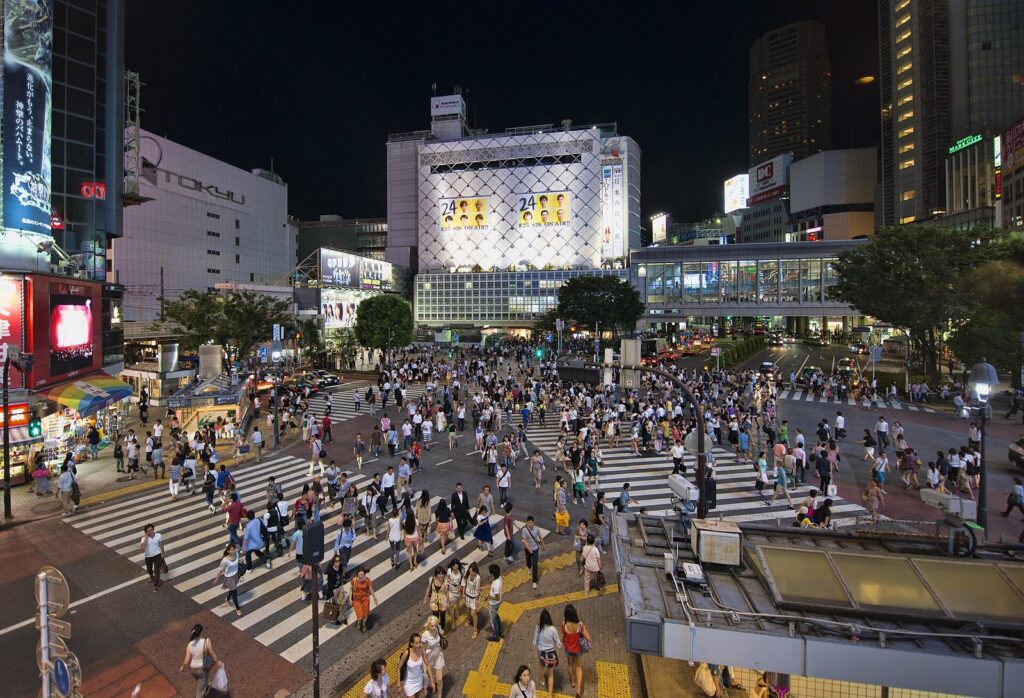
Featured image: “1 shibuya crossing 2012” by chensiyuan, CC BY-SA 4.0, via Wikimedia Commons