Most visitors never make it to the Kii Peninsula, and that is exactly why it is worth the detour. I live in Japan, and the Kumano Kodo region south of Osaka and Kyoto is one of the few places I still recommend to friends precisely because it is quiet. There are no queues, no crowd-control staff with megaphones, just mountain trails that pilgrims have walked for over a thousand years, a waterfall that drops 133 meters past a vermilion pagoda, and onsen towns that feel barely touched by the 21st century.
The Kumano Kodo is a network of ancient pilgrimage routes through the Kii Mountain Range, leading to three grand shrines collectively known as the Kumano Sanzan. Along with Spain’s Camino de Santiago, it is one of only two pilgrimage routes recognized as a UNESCO World Heritage Site. You do not need to be religious, or even particularly fit, to get something out of it — a short walk between two shrines, a soak in a 2,000-year-old hot spring, and a look at Nachi Falls is enough to feel like you have found a different Japan.
The quick answer
- What it is: A UNESCO-listed pilgrimage trail network in Wakayama Prefecture connecting three grand shrines (Kumano Hongu Taisha, Kumano Hayatama Taisha, Kumano Nachi Taisha), plus Nachi Falls, Japan’s tallest single-drop waterfall at 133 meters.
- Gateway stations: Kii-Tanabe (western routes, Nakahechi trailheads), Kii-Katsuura and Shingu (Nachi Falls, eastern shrines).
- From Shin-Osaka or Kyoto: A limited express train runs roughly 4–4.5 hours to Kii-Katsuura; it is not covered by the standard Japan Rail Pass (commonly called the JR Pass) for the fastest sections in some seasons, so check the route when you book.
- Best for a day trip: Kii-Katsuura Station, then the local bus toward Nachi-no-Taki-mae, Nachi Taisha shrine, Seiganto-ji’s pagoda, and the falls viewpoint.
- Best for an overnight or two: Add a night at Yunomine Onsen, one of Japan’s oldest hot springs and the only one inside the UNESCO-listed route.
- Season: Spring and autumn are most comfortable for walking; autumn foliage along the trail is a quieter alternative to the famous momijigari spots near Kyoto.
Why this corner of Japan is different
The Kii Peninsula juts out south of the Kansai region, and its interior is thick, steep, forested mountain — the kind of terrain that kept this area isolated enough to preserve routes that have barely changed in character since the Heian period. Emperors, aristocrats and ordinary pilgrims all walked these same paths to pay respects at the Kumano Sanzan, a set of three shrines that blend Shinto and Buddhist practice in a way that is distinct from most shrines you will see in Tokyo or Kyoto.
If you have already read our first-timer’s guide, Shrines, Shinto and Japanese Mythology, Kumano is the advanced course: a place where the lines between mountain worship, Shinto kami and Buddhist deities blur on purpose, because for centuries that is exactly how it was practiced here.
Getting there from Osaka or Kyoto
There is no bullet train directly into this region — part of what keeps it peaceful. The standard approach:
- From Shin-Osaka: Take a JR limited express (the Kuroshio) down the Kisei Line. Kii-Tanabe is about 2 hours 20 minutes away; continuing to Kii-Katsuura or Shingu takes closer to 4 hours.
- From Kyoto: Similar total journey time, around 4–4.5 hours, usually via Shin-Osaka or Tennoji to join the same limited express line.
- Which station to use: Kii-Tanabe is the trailhead for the western Nakahechi route (Takijiri-oji and the start of the classic multi-day walk). Kii-Katsuura is the gateway for Nachi Falls and Nachi Taisha. Shingu serves Kumano Hayatama Taisha and is a common exit point if you are walking the trail west to east.
👉 Klook JR Ise-Kumano-Wakayama Area Pass
For getting to Nachi Falls specifically, there is no train directly to the falls — you take the limited express to Kii-Katsuura, then the local No. 31 bus toward Nachi-no-Taki-mae, which takes about 25–30 minutes. Regional day passes, such as the Nachi Area World Heritage Free Pass, cover the bus loop between the station, the shrine complex and the falls and are worth checking at the local tourist information counter, since bus schedules here are infrequent compared to Tokyo or Kyoto.
Walking even a short piece of the Kumano Kodo
You do not need five days to say you have walked the Kumano Kodo. The full Nakahechi route, from Takijiri-oji through Hongu to Nachi, takes a determined walker about five days through forest, rural villages and mountain passes. Most visitors on a first trip do a single, well-marked section instead:
- Daimonzaka to Nachi Taisha: A short, steep, beautiful stretch of stone steps lined by cedar trees, ending at Nachi Taisha and the view of the falls past Seiganto-ji’s three-story pagoda. This is the single most rewarding short walk in the region and takes most people 30–45 minutes uphill.
- Short Hongu-area loops: If you are based near Hongu Taisha, several short forest sections let you walk an hour or two of genuine pilgrim trail without committing to a multi-day itinerary.
The trail is well maintained and signposted in English, but mountain weather changes fast — bring layers and proper shoes. And if you forget rain gear or a hiking pole, do not panic: convenience stores near the main stations carry basic ponchos, and outdoor shops in Tanabe and Shingu rent proper equipment.
Nachi Falls and the shrine complex
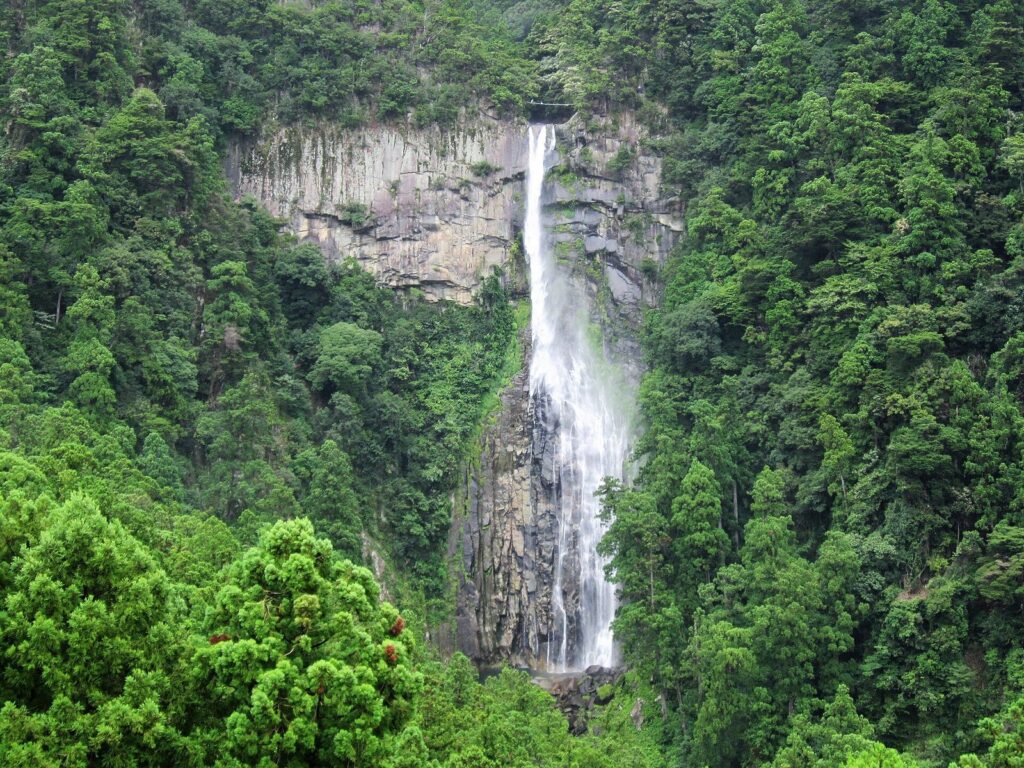
Nachi Falls drops 133 meters in a single sheet, making it Japan’s tallest waterfall with a single uninterrupted drop, and it has been an object of worship for over a thousand years — the waterfall itself is the shintai, the sacred body, of the deity enshrined at Hirou-jinja at its base. The classic photograph, with the vermilion three-story pagoda of Seiganto-ji framed against the falls, is one of the most recognizable images of the Kii Peninsula.
Kumano Nachi Taisha sits further up the hill, a short walk (or a ride on the slope car for those who prefer not to climb) past Seiganto-ji. The two sites — one Shinto shrine, one Buddhist temple — stand side by side, which is unusual in modern Japan but was the historical norm before Shinto and Buddhism were formally separated in the Meiji era. It is one of the clearest places in the country to see what Japanese religious practice looked like before that split.
Where to stay: Yunomine Onsen
If you can manage one overnight, stay at Yunomine Onsen rather than doing the whole trip as a day trip from Osaka or Kyoto. It is a tiny valley town built around hot springs that have been in continuous use for close to 2,000 years, and it is the only onsen located directly inside the UNESCO-listed pilgrimage route. The Tsuboyu bath, a single small bathhouse over the stream, is a UNESCO World Heritage component in its own right — bookable in short private slots, so arrive early or ask your ryokan to help reserve a time.
Ryokan here are small and family-run rather than resort-scale, and most include a kaiseki dinner featuring local river fish and mountain vegetables. Book ahead, especially in autumn and around Japanese holiday weeks, since there are far fewer rooms here than in Hakone or Kyoto.
Combining Kumano with the rest of a Kansai trip
Most travelers pair this region with a broader Kansai itinerary. If you are coming from Kyoto or Osaka and have already planned where to sleep in the cities, it is easy to treat Kumano as a 2–3 day loop in the middle of a longer trip — out to Kii-Tanabe or Kii-Katsuura, one or two nights in the mountains, and back to the same base. If your main stop afterward is Kyoto, it is worth confirming your Japan Rail Pass: Is It Still Worth It? math first, since the fastest long-distance legs on this trip may not be covered the same way regular Shinkansen travel is, and a regional pass or point-to-point ticket can work out better.
Mobile coverage along the trail itself is patchy in the deeper mountain sections, which is honestly part of the appeal, but it is worth setting up your Best eSIM for Japan before you leave the cities so you have a working map and translation app for bus schedules once you are out here.
FAQ
Do I need to speak Japanese to visit? No. Trail signage on the main Nakahechi sections is in English, and the main train stations and tourist information centers in Tanabe, Kii-Katsuura and Shingu have English-speaking staff or printed English materials. Buses are less consistently signed, so download an offline map before you go.
Is the Japan Rail Pass worth buying just for this trip? Usually not on its own. The pass is best value when combined with Shinkansen travel elsewhere in your itinerary; the regional Kisei Line limited express covers most of the route to Kumano, but check current coverage and seat-reservation rules before relying on it for this leg alone.
How much walking do I actually need to do? None, if you just want to see Nachi Falls and the shrine — the bus brings you within a short walk of both. A single hour-long walk (Daimonzaka to Nachi Taisha) gives you a genuine taste of the pilgrimage trail without a major hike.
What is the best season to visit? Spring (April–May) and autumn (October–November) are the most comfortable for walking, with mild temperatures and good visibility. Summer is hot and humid in the valleys; winter can be cold in the higher mountain sections but is quiet and atmospheric.
Can I visit as a day trip from Osaka or Kyoto? Yes, to see Nachi Falls and Nachi Taisha specifically, though it makes for a long day — roughly 8 hours of travel for a few hours on site. An overnight in the region, ideally at Yunomine Onsen, is a much better way to experience it.
The verdict
Kumano Kodo and Nachi Falls will not suit a traveler trying to pack in as many sights as possible — it rewards slowing down. But if you have already done Tokyo, Kyoto and Osaka, or simply want one stretch of a trip that feels genuinely removed from the usual circuit, this is one of the most rewarding regions in the country, and most visitors to Japan never see it.
Written from Japan by the Wayfarer Japan team — we live here, and we test and research everything we recommend so you can plan with confidence.
Featured image: “Nachi Falls 201908-1” by Suikotei, CC BY-SA 4.0, via Wikimedia Commons