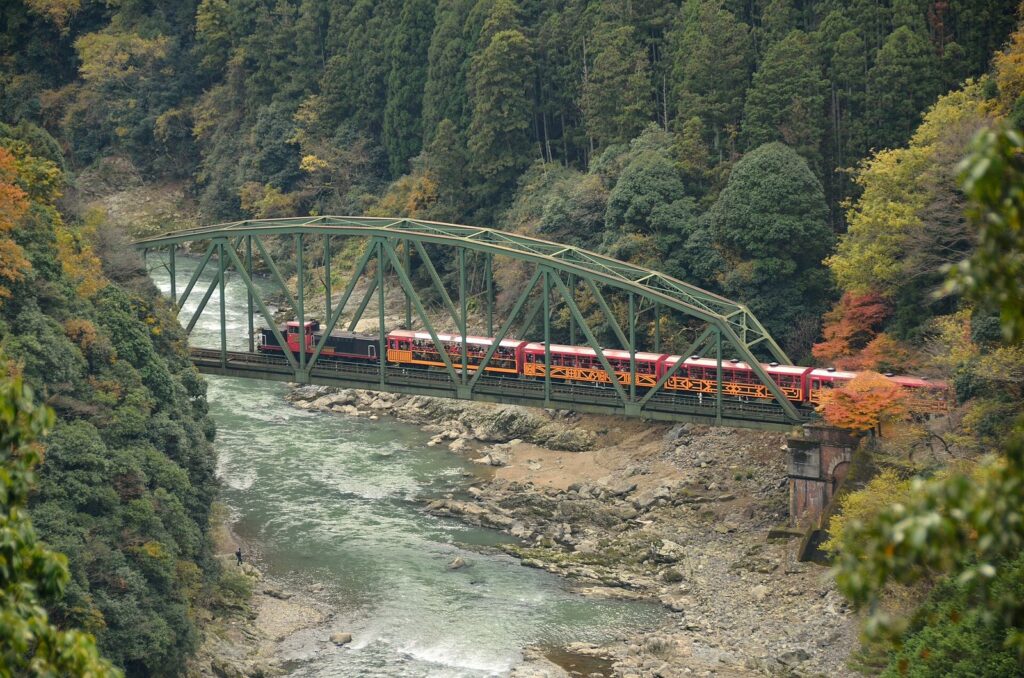
I live in Japan, and every November my phone fills up with the same photo from friends visiting: a half-open trolley car, orange and red leaves sliding past the window, someone’s coffee going cold because they forgot to drink it. Japan has koyo (紅葉, autumn foliage) spots everywhere, but the ones that stick with people are usually the ones you get to by a train that is part of the experience, not just transport to it.
Below are five rides that are genuinely worth building a day around in autumn 2026 — not quick ropeway rides, but actual railways where the journey is the point. None of them are covered by the Japan Rail Pass, so budget for separate tickets.
The quick answer
- Sagano Romantic Train (Kyoto) — open-sided trolley through the Hozugawa gorge in Arashiyama; reserved seats sell out fast in autumn, book exactly one month ahead.
- Kurobe Gorge Railway (Toyama) — a narrow-gauge mountain trolley through a dramatic ravine; closes for the season on November 30.
- Watarase Keikoku Railway (Gunma/Tochigi) — a quieter countryside trolley along a river valley, popular as a Nikko-area add-on.
- Hakone Tozan Railway (Kanagawa) — the easiest one to fold into a normal Tokyo trip; ride past the Hayakawa Bridge for the best color.
- Chichibu Railway’s Paleo Express (Saitama) — a real steam locomotive on weekends and holidays, about 90 minutes from Tokyo.
Why ride for the leaves, not just see them
Most “best autumn leaves” lists (including our own Best Autumn Leaves Spots in Japan) are about where to stand and look. These trains are different: you’re moving through the color for 20 minutes to over an hour, often through valleys and gorges that aren’t easy to reach any other way. They’re also a nice way to avoid the worst of the crowding you get at famous temple gardens in peak koyo week — you still have to book ahead, but you’re not shuffling through a packed garden path.
Sagano Romantic Train, Kyoto — the classic
This is the one most visitors have seen a photo of without knowing its name: the open-sided torokko (trolley) train that runs along the Hozugawa River between Torokko Saga and Torokko Kameoka stations, right through Arashiyama.
For 2026, a special autumn light-up runs from October 24 to December 29, with evening departures from around 16:30 until the last train (no service December 16). Regular daytime trains run roughly hourly from 9am to 4pm, with an extra evening run added in peak season. Adult fare is ¥880, children ¥440 — cheap for what you get.
Every seat is reserved, and in autumn this train sells out. Tickets go on sale online at midnight Japan time exactly one month before your travel date — if your dates are fixed, set an alarm. If you miss the online release, a limited number of same-day tickets go on sale at the station windows (around 8:35am at Torokko Saga, 8:50am at Torokko Arashiyama), but don’t count on it during peak weeks in late November.
If you’re staying in the city the night before to catch an early departure, 👉 Booking.com Kyoto is worth checking for places near Kyoto Station or Arashiyama itself.
Kurobe Gorge Railway, Toyama — the dramatic one
This is the most physically dramatic ride on this list: a narrow-gauge trolley that climbs through the Kurobe Gorge on the way to Keyakidaira, with tunnels, bridges, and drop-offs that make the valley floor feel a long way down. It’s less convenient to reach than the others — you’re coming through Toyama, which also makes it a natural stop if you’re already doing the Kanazawa Guide route through the Hokuriku region.
The full line (Unazuki to Keyakidaira) reopened for the season on October 1 and runs through November 30, 2026. Peak color is forecast for late October into mid-November, with the midpoint of the line turning first around early November. One-way adult fare is ¥2,480 (child ¥1,240); an enclosed “relax car” with proper seatbacks and openable windows costs ¥600 more per person and is worth it on a cold day. Book ahead for weekends and peak-color weekdays — this one fills up.
Watarase Keikoku Railway, Gunma/Tochigi — the quiet countryside ride
Less famous than the other four, which is part of its appeal. The Watarase Keikoku Railway runs between Kiryu (Gunma) and Mato (Tochigi), tracing the Watarase river valley, and pairs naturally with a Nikko trip if you want something slower-paced than Toshogu’s crowds.
There are two sightseeing cars: an open-view “Torokko Watarase Gorge” pulled by a diesel locomotive, and a self-propelled “Torokko Wasshi.” The end-to-end fare is around ¥1,130 one way, plus a ¥520 add-on for the open-view trolley car. The special trolley trains run on selected dates, mostly weekends, through autumn — the exact 2026 autumn calendar is usually posted on the operator’s site only a month or two ahead, so check close to your travel dates rather than planning this one far in advance.
If you’d rather have the logistics handled, both 👉 Klook and 👉 KKday list guided day tours from Tokyo that build a full day around the Watarase Keikoku Railway, usually combined with Nikko’s Takatsudokyo gorge or Ashikaga Flower Park — a reasonable option if you don’t want to piece together local transfers yourself.
Hakone Tozan Railway, Kanagawa — the easy add-on near Tokyo
If you’re already doing Hakone — and most first-time visitors are, since it’s one of the easiest overnight trips from Tokyo — the Tozan Railway itself is worth riding for more than just getting to your ryokan. The stretch between Hakone-Yumoto and Gora includes a switchback climb and crosses the Hayakawa Bridge, which turns into one of the better foliage views in the area in November.
One thing worth correcting: there’s no special autumn night-illumination train on this line — the Tozan Railway’s famous night train is the Hydrangea Train, which runs in June, not autumn. For leaves, just ride during daylight; a window seat on the left side heading up from Hakone-Yumoto gives the better view. If you’re building a Hakone itinerary, our Hakone Guide covers onsen and Mt. Fuji viewpoints to pair it with.
Chichibu Railway’s Paleo Express, Saitama — the steam train near Tokyo
This is the only real steam locomotive on this list, and the closest one to central Tokyo — about 90 minutes by train. The Paleo Express runs between Kumagaya and Mitsumineguchi, stopping at Nagatoro, which has its own autumn color along the Arakawa River gorge.
It only runs on weekends, holidays, and some additional dates, generally through early December in 2026 — check the Chichibu Railway site for the exact autumn calendar. You need the base train fare plus a separate SL seat reservation ticket, which costs ¥1,000 if bought online in advance or ¥1,100 at the station counter; the same price applies to adults and children. Book the seat reservation ahead if you can — same-day seats are limited.
Do these count toward your Japan Rail Pass?
No — and this trips up a lot of first-time visitors. All five of these railways are privately operated (or run as separate scenic services with their own ticketing, in Sagano’s case), so a Japan Rail Pass (commonly called the JR Pass) doesn’t cover any of them. If you’re deciding whether a Pass is worth buying for your trip at all, our Japan Rail Pass 2026: Is It Still Worth It? guide walks through where it does and doesn’t pay off — these scenic lines are a good example of where it doesn’t.
How to book
Reserved seating is standard on all of these in autumn, and “I’ll just show up” is a real risk during peak koyo weeks (typically early-to-mid November inland, late November to early December around Kyoto). Where online booking opens exactly one month ahead, as with the Sagano Romantic Train, set a reminder — seats for Saturday departures in peak week can go in minutes. For the others, book as early as the operator’s site allows, and have a backup day in mind in case your first choice sells out.
Foliage timing is also a forecast, not a guarantee — color moves earlier or later by a week or two depending on the year’s weather, so treat the dates above as estimates and check the operator’s site or a koyo forecast closer to your trip.
FAQ
Do I need to reserve a seat on all of these? Yes, functionally. Sagano and Kurobe Gorge sell every seat as reserved in autumn. Watarase and Chichibu require an add-on ticket for the open-view or SL car specifically, which is also limited.
Which one is best if I only have one day near Tokyo? Hakone Tozan Railway or Chichibu’s Paleo Express — both are under two hours from central Tokyo and can be a full day trip without an overnight stay.
Can I combine more than one of these in a single trip? Realistically, pick one or two unless you have a longer, multi-region itinerary. Kurobe Gorge is a detour even from Kanazawa; Sagano is Kyoto-specific; the others cluster around Tokyo.
Is the Japan Rail Pass worth buying just to reach these? No — since none of the scenic lines themselves are covered, buy the Pass (if at all) based on your longer-distance shinkansen travel, not these rides.
What if I can’t get a reserved seat? Check for same-day window sales (Sagano, Chichibu) or simply ride the regular, non-reserved cars on lines that have them — you lose the open-air trolley experience but still get the view through a window.
The verdict
If you only have time for one, make it the Sagano Romantic Train in Kyoto or the Kurobe Gorge Railway in Toyama — they’re the two where the ride itself, not just the destination, is the reason to go. The others are worth building into a trip you’re already taking nearby rather than a special journey on their own. Book earlier than feels necessary; autumn reserved seats on all five of these go fast.
Written from Japan by the Wayfarer Japan team — we live here and ride these trains ourselves most autumns.
Featured image: “Autumn foliage 2012 (8252583379)” by Takeshi Kuboki from Amagasaki, Japan, CC BY 2.0, via Wikimedia Commons