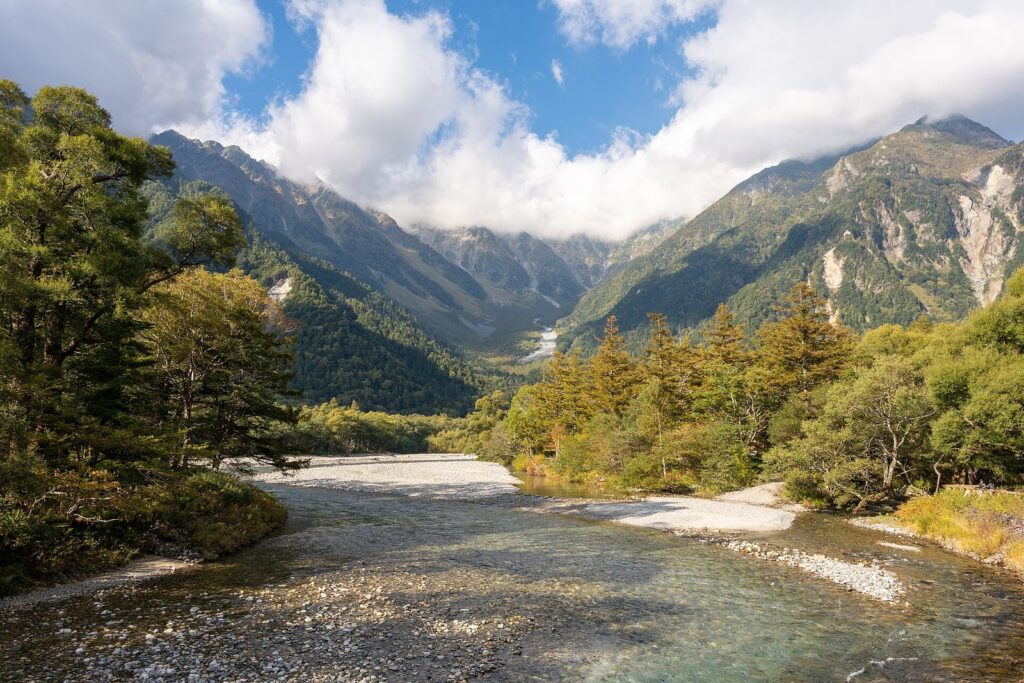
I live in Japan, and Kamikochi is one of the few places here that genuinely surprises people who think they already know what Japanese scenery looks like. It’s a flat-bottomed alpine valley at about 1,500 meters in Nagano Prefecture, hemmed in by the jagged peaks of the Hotaka range, with a clear, pale-blue river running down the middle. No cars have been allowed in since 1975, so the only sounds are the river, birds, and other hikers. It feels closer to the Dolomites than to the Tokyo most visitors have just left.
It’s also a half-day trip from Matsumoto, which makes it a realistic add-on if you’re already doing a Japan Alps loop, and a genuinely worthwhile detour even if you weren’t planning one.
The quick answer
- Kamikochi is closed to all private vehicles — you reach it only by bus or taxi from a gateway town.
- The valley is only open mid-April to mid-November; in 2026 it opens April 17 and closes November 15.
- From Matsumoto: train to Shin-Shimashima (¥710), then a bus into the valley (around ¥3,100 one-way), or a direct bus from Matsumoto Bus Terminal (around ¥4,600 one-way).
- The easiest walk is the flat 2–3 hour loop from Taisho Pond to Kappa Bridge to Myojin Pond — no hiking experience needed.
- Peak autumn color in 2026 is expected roughly October 5–20 at higher elevations, moving down to the valley floor through late October.
Why this isn’t just another mountain view
Japan has no shortage of famous mountain scenery, but most of it you look at from a cable car, a ropeway platform, or a road pullout. Kamikochi is different because the valley floor itself is the destination — you walk along it, at river level, with peaks rising straight up on both sides. The car ban, in place since 1975, long before “car-free tourism” was a marketing phrase, is why it still feels this way: no exhaust, no traffic noise, no parking lots inside the valley.
It also closes completely for winter: the road in runs through the Kama Tunnel, sealed off once snow makes it impassable, so for roughly five months a year the valley is simply inaccessible. That’s part of why it doesn’t come up in the same breath as Hakone or Nikko for first-time visitors — but if your trip falls between mid-April and mid-November, it’s worth knowing about.
Getting there: the bus-only part is not optional
You cannot drive into Kamikochi under any circumstances, even with a rental car. The access points are Sawando on the Matsumoto side (about 2,000 parking spaces, roughly ¥800/day) and Hirayu or Akandana on the Takayama side (around 850 spaces, roughly ¥600/24 hours). From either, you park and transfer to a shuttle bus or a fixed-rate taxi for the final stretch into the valley.
If you’re doing a Japan Alps itinerary by train, the routes in are:
- From Matsumoto Station: take the Matsumoto Electric Railway to Shin-Shimashima (about 30 minutes, ¥710), then transfer to an Alpico bus into Kamikochi (around ¥3,100 one-way, about an hour). This combination is the standard route and is not covered by the Japan Rail Pass.
- Direct bus from Matsumoto Bus Terminal: a more straightforward single bus, roughly ¥4,600 one-way for the standard departures (a couple of early-morning services run slightly higher, around ¥5,000).
- From the Takayama side: buses run from Hirayu Onsen into Kamikochi as well, which is the natural approach if you’re coming from Takayama or Gifu rather than Nagano.
Buses only run during the open season, and the last bus out leaves in the afternoon — check the current timetable before you go, since missing it with nowhere to stay is a genuine problem this far from anywhere else.
What to actually do once you’re there
The easiest and most popular route is the gentle, mostly flat walk from Taisho Pond to Kappa Bridge and on to Myojin Pond. It takes two to three hours round trip at an easy pace, requires no hiking gear beyond decent shoes, and passes the two most photographed spots in the valley:
- Taisho Pond — a marshy pond formed when a 1915 volcanic eruption of nearby Mount Yake dammed the river; dead tree trunks still stand in the shallow water, with the Hotaka peaks reflected behind them on a clear morning.
- Kappa Bridge (Kappa-bashi) — the small wooden suspension bridge that’s the unofficial center of the valley, with the best straight-on view of the Hotaka range. Most day-trippers end up here at some point whether they planned to or not.
From Kappa Bridge, it’s roughly an hour’s walk further up-valley to Myojin Pond, quieter and less crowded, inside the grounds of a small shrine. Trails continue from there toward the base of the Hotaka peaks for anyone with real hiking or climbing plans — a different trip from the valley-floor walk, needing proper gear, since the terrain turns alpine fast.
If you forgot a rain jacket or decent socks, don’t panic — Matsumoto has outdoor shops near the station, and there are small shops inside Kamikochi itself selling basics, though at a premium given how remote it is.
When to go: autumn colors versus summer crowds
Kamikochi is beautiful in summer too, but it’s also when it’s busiest and the valley can feel more like a trailhead queue than a quiet walk. Autumn is the draw for most visitors, and the colors move in a particular order that’s worth planning around:
- Early October: the high slopes and ridgelines above roughly 2,000 meters start turning first.
- Mid-to-late October: color drops down to the valley floor itself, where most visitors are walking — forecasts for 2026 put the peak window around October 5–20, with color continuing to shift through the rest of the month.
- Through late October: the larch forests turn a deep gold, which is the color most people picture when they think of Kamikochi in autumn, often with the first dusting of snow already visible on the summits behind them.
Whatever your dates, the valley closes completely on November 15 and every bus stops running that day — there’s no visiting outside the season, so build it into a trip between mid-April and mid-November, with October for the colors.
Where to sleep if you want more than a day trip
Most visitors treat Kamikochi as a day trip, but a handful of lodges and a hotel sit inside the valley itself, letting you catch the quiet hour right after sunrise before the day-trip buses arrive — genuinely a different experience from the valley at midday. Rooms are limited and book out early for peak autumn weekends, so decide early if that appeals to you.
For a base the night before or after, Matsumoto itself is a pleasant small city with its own castle and is worth at least a few hours regardless — checking 👉 Booking.com Matsumoto for something near the station makes the early bus connection easier.
If you’d rather not plan the bus connections yourself, day tours from Matsumoto or Takayama that bundle transport are available through 👉 Klook, which can be worth it on a tight schedule or during peak autumn weekends when seats on the public buses are harder to count on.
FAQ
Can I drive to Kamikochi myself? No. Private cars are banned from the valley year-round; you park at Sawando (Matsumoto side) or Hirayu/Akandana (Takayama side) and take a shuttle bus or taxi the rest of the way.
Is the Japan Rail Pass any use for this trip? Only for the train portion to Matsumoto itself if that’s on a JR line you’re using the pass for. The local electric railway to Shin-Shimashima and every bus into the valley are not covered and need separate tickets.
How long do I need in Kamikochi? A half to full day covers the main Taisho Pond–Kappa Bridge–Myojin Pond walk comfortably. Staying overnight inside the valley lets you see it at dawn before the day-trip buses arrive, which is worth it if your schedule allows.
Is it open in winter? No. The road in through the Kama Tunnel closes once snow makes it impassable, and the whole valley, including all bus service, shuts down between mid-November and mid-April.
Is this doable as a side trip from a Tokyo or Kyoto-based itinerary? Yes, if you’re already routing through Matsumoto as part of a wider Japan Alps leg — pairing it with the Kanazawa Guide or a Takayama stop makes more sense than a dedicated round trip from Tokyo, which eats most of a day just in transit.
The verdict
Kamikochi rewards people willing to deal with a slightly inconvenient, bus-only approach: no cars, a hard seasonal close, and a transfer or two to get there. In exchange you get a genuinely quiet alpine valley, a flat and easy walk with real mountain scenery on both sides, and — if you time it for early-to-mid October — some of the best autumn color in the Japan Alps before the lower valley even turns. If you’re building a Nagano or Japan Alps leg into your trip, it’s worth the half day.
Written from Japan by the Wayfarer Japan team — practical, no-nonsense travel advice from people who actually live here.
Featured image: “Kamikochi (52488638383)” by Raita Futo from Tokyo, Japan, CC BY 2.0, via Wikimedia Commons