I live in Japan, and bunraku is the one classical art form I had to be talked into twice. The first time a friend mentioned it, I pictured something like a children’s puppet show and politely changed the subject. The second time, she told me the plot of the play we’d be seeing — a doomed love affair ending in a double suicide pact, narrated by a single chanter doing every voice in a near-scream — and I realized I had it backwards. Bunraku is not for kids. It is some of the most serious, emotionally brutal storytelling Japan has ever produced, and it happens to be performed by puppets roughly a meter tall, worked by three black-clad puppeteers standing right there on stage in full view of the audience.
That last part is what throws people. Unlike a Western puppet show, bunraku never hides its mechanics. You can see exactly who is moving the puppet’s head, who is working its left hand, who is crouched below controlling its feet. The strange thing is how fast that stops mattering.
The quick answer
- Bunraku (文楽) is Japan’s traditional puppet theater, developed in Osaka in the late 1600s and still performed in essentially its original form.
- Each puppet is operated by three visible puppeteers: one controls the head and right arm, one the left arm, one the feet (female puppets have no feet — the hem of the kimono is worked by hand instead).
- A narrator called the tayu chants and voices every character alone, accompanied by a thick-necked shamisen whose low tone drives the emotional pacing.
- UNESCO recognized bunraku as Intangible Cultural Heritage in 2008.
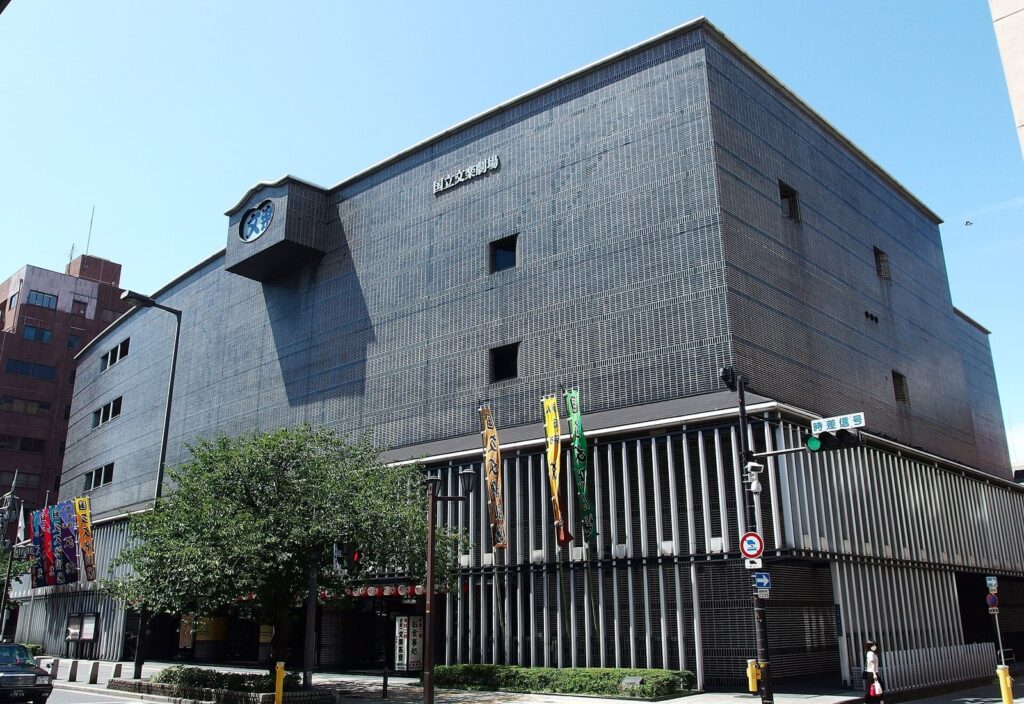
- The main home is the National Bunraku Theatre in Osaka; Tokyo performances currently rotate between substitute venues because the National Theatre has been closed for reconstruction since 2023.
Three puppeteers, one puppet, no attempt to hide it
A bunraku puppet is a serious piece of engineering, built from wood and roughly three-quarters human size, with a head that can shift its eyebrows, roll its eyes, and open its mouth through strings and levers hidden inside. Operating one takes three people working in close coordination.
The lead puppeteer, the omozukai, controls the head and the right arm and is the only one of the three who performs bare-faced, often a senior performer whose name appears in the program. The hidarizukai works the left arm from just behind, and the ashizukai — traditionally the most junior role, something performers can spend a decade training for before being trusted with it — operates the legs, but only on male puppets. Female puppets in bunraku have no legs at all; the kimono simply falls to the floor, and the ashizukai’s job becomes shaping the fabric to suggest a knee bending or a body collapsing in grief.
The two assistant puppeteers wear black hoods and robes, a costume called kuroko that is theater shorthand for “please don’t look at me.” For the first ten minutes of any bunraku show, you absolutely do look at them — it’s impossible not to. Then, almost on schedule, your eye adjusts and stops registering them as people. What’s left is a puppet that seems to breathe.
The chanter and the shamisen carry everything else
A bunraku stage has no dialogue in the way a play does. Instead, a single performer called the tayu sits to one side and chants the entire text alone — narration, and every character’s lines, male and female, young and old, shifting voice and pitch for each one without changing costume or position. It is closer to opera than to conventional theater, and a skilled tayu can hold a packed house through twenty minutes of a single escalating speech with nothing but voice.
Next to the tayu sits a shamisen player using a futozao, a thicker-necked, lower-toned shamisen than the one used in folk or pop music, built specifically for bunraku’s dramatic weight. The music doesn’t illustrate the story so much as push it forward — a few notes can compress a scene change, or stretch out the silence before a character makes a decision they can’t take back.
Where the name — and the stories — actually came from
What’s performed today as “bunraku” was originally called ningyo joruri, puppet performances of joruri, a style of dramatic chanting that had existed in various forms since the medieval period. It took on its modern shape in Osaka in the late 17th century, when the chanter Takemoto Gidayu teamed up with the playwright Chikamatsu Monzaemon — a partnership still treated as the single most important collaboration in Japanese theater history. Chikamatsu, sometimes called the Shakespeare of Japan, wrote historical epics and, more famously, contemporary tragedies about ordinary Osaka merchants and the women they loved and ruined themselves over. His 1703 play “The Love Suicides at Sonezaki,” based on an actual double suicide that had happened weeks earlier, was such a sensation that it reportedly inspired copycat suicides across the city.
The name “bunraku” itself is younger than the art form — it comes from the Bunraku-za, a theater opened in Osaka in the early 1800s by an impresario named Uemura Bunrakuken, whose venue eventually became so dominant that its name replaced the older term for the whole tradition.
Bunraku’s odd relationship with kabuki and Noh
If you’ve already read our guides to Kabuki Explained or Noh Theater Explained, bunraku is the piece that makes the other two make more sense. Noh came first, built for 14th-century aristocrats and deliberately slow and masked. Kabuki arrived two or three centuries later as loud, popular entertainment for Edo-period city crowds. Bunraku sits in an unusual middle position: it has kabuki’s working-class Osaka audience and emotional extremity, but it tells its stories with the same literary seriousness that Noh brings — just through puppets instead of masked actors.
The relationship is closer than most visitors realize. A striking number of now-famous kabuki plays, especially the big historical “jidaimono” epics, were written first for bunraku and only adapted for live actors afterward. When you watch a kabuki actor hold an unnaturally long, frozen pose at a dramatic peak — a technique called mie — you are watching a human actor imitating the stillness of a puppet, not the other way around.
How to actually see one in 2026
The National Bunraku Theatre, a short walk from Nipponbashi Station in Osaka, is the art form’s year-round home and the most reliable place to see a full production with English support — printed synopses and an English audio guide are available for most programs. Osaka’s autumn program runs from October 31 through November 23, 2026, split into three daily parts; tickets run roughly ¥6,500 per part for adults (¥4,600 for students), or about ¥18,000 for all three parts in one day. As with kabuki’s single-act tickets, you don’t have to commit to the whole day — one part is a complete, satisfying chunk of story.
Tokyo is more complicated right now. The National Theatre near Hanzomon, bunraku’s traditional Tokyo home, has been closed since October 2023 for a full rebuild, and as of 2026 a reopening date still isn’t confirmed after the redevelopment project failed to attract a winning construction bid on repeated attempts — the original 2029 target now looks optimistic. In the meantime, Tokyo performances move between substitute venues each season: Theatre 1010 in Kita-Senju hosted a run in May 2026, Koto Cultural Centre ran a beginner-oriented program in September, and Tokyo Metropolitan Theatre’s Playhouse is staging the December 2026 performance. If you’re hoping to catch bunraku in Tokyo, check the current season’s venue rather than assuming a fixed address — it changes.
Prices, schedules, and English-support details shift season to season, so confirm on the official National Theatre booking site before you plan a trip around it.
FAQ
Is bunraku appropriate for kids? Not really, no. Plots center on love suicides, revenge, and family tragedy pitched at an adult emotional register. It’s puppetry in form only — the content is closer to classical tragedy.
Can you really stop noticing the puppeteers? Most first-time visitors say yes, usually within the first act. It helps that the lead puppeteer’s visible concentration becomes part of the performance rather than a distraction from it.
How long does a performance run? Each of the day’s three parts runs roughly two to two and a half hours including an intermission. Buying a single part is normal and common for visitors.
Do I need to understand Japanese? No. The National Bunraku Theatre in Osaka provides English program synopses and an audio guide. The classical language being chanted is dense even for native Japanese speakers, and most of the audience is following along with a program too.
Is bunraku connected to kabuki? Yes, more than most visitors expect — many of kabuki’s most famous historical plays were originally written for bunraku puppets and adapted for human actors afterward.
The verdict
Bunraku rarely makes a first-time visitor’s itinerary, and that’s exactly why it’s worth the detour if you’ve already seen kabuki or a sumo tournament and want something Tokyo and Kyoto tour buses mostly skip. Buy a single-part ticket at the National Bunraku Theatre if you’re building a trip around Osaka — it pairs naturally with a day covering the rest of our Best Things to Do in Osaka guide — and go in knowing the puppeteers are supposed to be visible. Give it twenty minutes before deciding whether it works for you. For most people, it does.
Written from Japan by the Wayfarer Japan team — real experience, checked facts, no fluff.
Featured image: “National Bunraku Theatre in 201408” by Mc681, CC BY-SA 4.0, via Wikimedia Commons