The first thing that confuses visitors about sumo is that the tournament itself — 15 days, six times a year — is almost the smallest part of a wrestler’s life. For the other ten months, sumo happens inside a heya, a stable, which is part gym, part monastery and part family business, usually tucked into an ordinary residential street in Tokyo’s Ryogoku district with nothing but a nameplate to mark it.
I live in Japan, and I have walked past these buildings more times than I can count without realising what they were — low, quiet, nondescript, until you hear the thud of bodies hitting clay at six in the morning. What goes on inside is one of the strictest hierarchies left in modern Japan, built entirely around rank, and it explains almost everything strange about how sumo wrestlers actually live. Here is how it works, and where you can see it.
The quick answer
- A heya (部屋, “room”) is both a training facility and a home. Around 40 stables exist today, nearly all of them clustered in Tokyo’s Ryogoku and Sumida neighbourhoods, each run by a retired wrestler who has taken the title of oyakata.
- Rank decides everything. Lower-ranked wrestlers rise first, clean, cook and serve; only sekitori — wrestlers in the top two divisions, makuuchi and juryo — get a private room, a salary, and the right to live outside the stable if married.
- Practice comes before food, not after. Keiko starts around 5–6 am on an empty stomach; the first meal of the day, a protein-heavy stew called chankonabe, is eaten only once training ends, around noon.
- A few stables let the public watch morning practice, usually through a licensed tour guide, under strict rules of silence and stillness.
- Most wrestlers never reach the salaried ranks. Below juryo, sumo is training, not a paying job, and the allowance is small.
What a stable actually is
A heya is not a gym you join. It is closer to an apprenticeship that absorbs your whole life. New recruits, often teenagers recruited straight out of junior high school, move in and stay — eating, sleeping, training and cleaning under one roof, under one master, for as long as their career lasts. Japan’s governing body, the Nihon Sumo Kyokai, currently licenses roughly 40 of these stables, and the overwhelming majority sit within a few train stops of each other in Ryogoku, home to the Kokugikan arena where the three Tokyo tournaments are held. We cover the tournaments themselves, and how the sport got this strange, in The History of Sumo: Japan’s Ancient Sport.
Each stable is named after its master and run as his personal responsibility: he recruits wrestlers, houses them, trains them, and answers for their conduct. Lose your oyakata’s trust and your career in that stable is effectively over, since wrestlers cannot simply switch stables the way athletes change teams.
A day with no breakfast
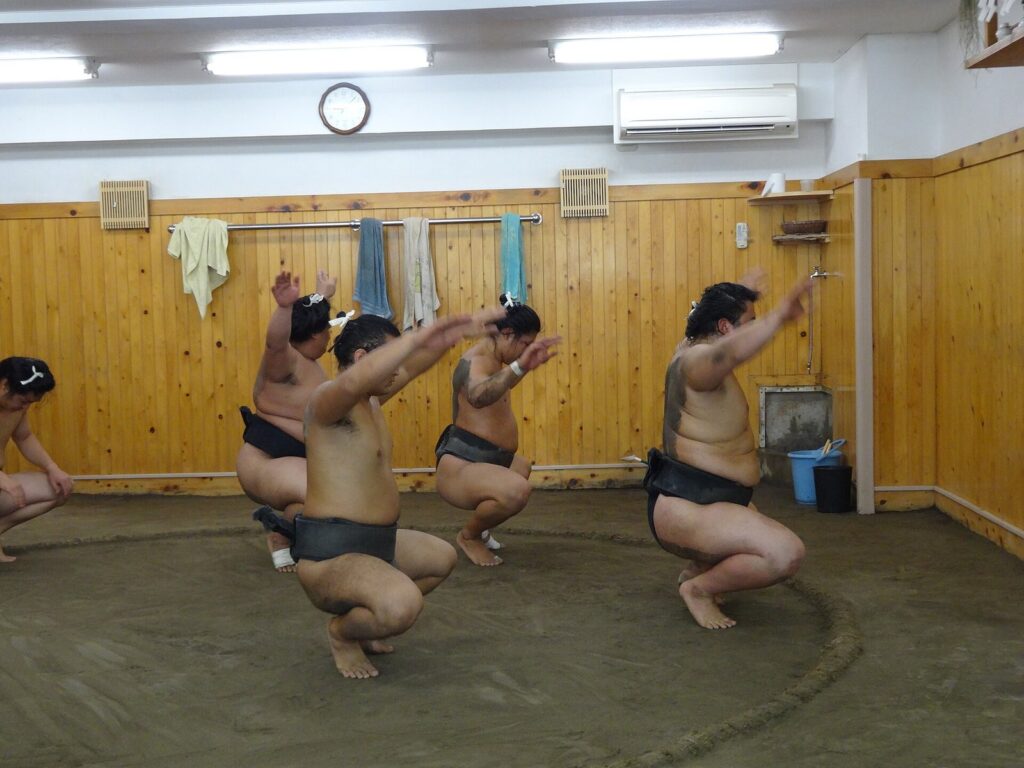
The sumo daily schedule is built around one rule that surprises almost everyone: wrestlers do not eat before training. Keiko begins at dawn, often 5 or 6 am, and runs for several hours of repetitive, punishing drills — the same leg stomps and pushing exercises for hours, long before any bout technique is practised. Junior wrestlers arrive first and practise longest; the most senior wrestlers in the room may not step into the ring until the final half hour.
Training ends, and only then does the day’s first meal happen: chankonabe, a stew of chicken, fish, tofu and vegetables in broth, eaten in enormous quantities over large bowls of rice, sometimes followed by a long nap — a deliberate combination that builds the bulk the sport demands. A stable’s chanko recipe is often one of its few points of individual pride, and several retired wrestlers run chankonabe restaurants around Ryogoku today, serving the same stew they once lived on.
Rank is the whole hierarchy
Nothing in a stable happens outside the rank order. Junior wrestlers rise earliest, do the cooking and cleaning, scrub the practice ring, and serve the senior ranks before they are allowed to eat themselves. Everyone below the makushita division sleeps in shared communal rooms; only wrestlers who reach sekitori status — the makuuchi and juryo divisions, roughly the top 70 wrestlers in the entire sport — are given a private room, a salary, their own attendants, and permission to live outside the stable if married. Below that line, wrestlers receive only a small living allowance, not a wage, no matter how many years they have trained.
It is a genuinely steep pyramid. A new recruit can expect years of cooking rice and scrubbing another man’s back before even a chance at sekitori rank, and most never get there at all.
| Rank group | Status |
|---|---|
| Makuuchi / Juryo (sekitori) | Salaried, private room, own attendants, may live outside the stable if married |
| Makushita and below | Unpaid apprentice status, shared rooms, cooking and cleaning duties, small allowance |
Retirement, and becoming an oyakata
A wrestling career ends relatively young, usually in the mid-30s at the latest, and what happens next is almost as regulated as life inside the ring. To stay in the sumo world as a coach, a retired wrestler needs to acquire one of a strictly limited number of toshiyori (elder) names, essentially a licence to run or help run a stable — a system that keeps the total number of stables roughly fixed and turns names into something close to inherited property within the sport. Without one, a career wrestler, however accomplished, simply leaves the sumo world for good.
Can visitors actually see this?
Yes, with real limits. A handful of stables around Ryogoku allow outside visitors to watch morning practice, but almost never by walking up and knocking — access is normally arranged through a licensed guide or tour operator, with the group kept small, silent, and seated the entire time. Flash photography, talking and moving around mid-practice are not tolerated; this is a working training session, not a show staged for tourists. Capacity is tiny, often twenty to thirty people, so these visits need to be arranged well ahead of your trip rather than decided on the day.
Outside of practice hours, Ryogoku rewards a slower visit anyway: the Sumo Museum inside the Kokugikan is free to enter when no tournament is running, the streets are dotted with chankonabe restaurants, many run by retired wrestlers, and the banners outside each heya list the current roster by rank — the same hierarchy described above, printed in black and white for anyone to read. If you are planning tournament days into a Tokyo trip, How to Get Sumo Tournament Tickets (2026) and 15 Best Things to Do in Tokyo You Can Book Ahead cover the logistics around it, and ordinary visitor manners — Japan Etiquette: 15 Dos and Don’ts for Visitors — apply doubly inside a stable.
FAQ
Can anyone just walk into a sumo stable? No. Stables are private residences and working training facilities, not public attractions. Visits need to be arranged in advance, almost always through a licensed guide.
Do all sumo wrestlers get paid? No. Only sekitori — wrestlers in the makuuchi and juryo divisions — receive a salary. Everyone else receives a small allowance while training.
Why don’t wrestlers eat breakfast? Training on an empty stomach, followed by a large, calorie-dense meal and rest, is believed to help wrestlers add and retain mass more effectively than eating before exercise would.
How many sumo stables are there? Roughly 40, almost all concentrated in Tokyo, mainly around Ryogoku and the wider Sumida area.
Do foreign wrestlers live the same way? Yes, with one restriction: each stable may have only one foreign-born wrestler at a time, which limits how many train in the sport overall.
The verdict
A sumo stable looks, from the street, like nothing at all — a quiet building with a nameplate, easy to walk past without a second glance. Inside, it runs on a hierarchy stricter than almost anything else left in Japan: rank decides who eats, who sleeps where, who scrubs the ring and who simply stands in it. The tournaments are the visible ten percent. The stable, with its 5 am practice and its no-breakfast rule, is where sumo actually happens.
Written from Japan by the Wayfarer Japan team.
Featured image: “Sumo squats training at Arashio Stable Tokyo Japan (14657643137)” by amanderson2, CC BY 2.0, via Wikimedia Commons