The quick answer
- Japan’s consumption tax is 10% on most goods, 8% on food and non-alcoholic drinks. Visitors on a temporary visa can get this refunded on purchases over ¥5,000 (before tax) at participating stores.
- Right now (through October 31, 2026): you show your passport at the register, the tax is removed on the spot, and you leave with your receipt stapled into your passport.
- From November 1, 2026: this changes completely. You pay the full tax-included price at checkout, then claim the refund yourself at the airport before you fly home.
- Keep every receipt. Under the new system, losing them means losing the refund.
- Build in an extra 45-60 minutes at the airport if you’re claiming refunds, especially during busy travel weeks.
I live in Japan, and even I had to re-read this one twice
I don’t use the tax-free counter myself — residents don’t qualify — but readers ask me about it constantly, usually after getting confused in a department store line. The truth is, the system has been a minor headache for years because of fraud: resellers were buying “tax-free” electronics and cosmetics in bulk, never actually taking them out of the country, and reselling them domestically. Japan’s answer, after a lot of back and forth, is to flip the whole process around starting November 1, 2026.
If your trip lands before that date, you’ll use the old system. If it lands after, you’ll use the new one. If your trip straddles the date, pay attention to which stores have switched over, since the rollout is a hard cutover rather than a gradual one.
How the current system works (until October 31, 2026)
- Shop at a store with a “Tax-Free” or “免税” sign — not every shop participates, and convenience stores and most restaurants don’t.
- Spend at least ¥5,000 (before tax) at that store on that day. You can usually combine receipts from different departments in the same shop.
- Show your passport at the tax-free counter (sometimes a separate counter from the regular register).
- The clerk deducts the consumption tax immediately. You pay the discounted price and get a receipt stapled or printed into your passport.
- Consumables (food, cosmetics, medicine) get sealed in a special bag that you’re not supposed to open until you leave Japan, and until recently were capped at ¥500,000 total. General goods (electronics, clothing, bags) have no sealed-bag requirement.
This is the system most guidebooks and older blog posts still describe. It’s accurate until the end of October 2026.
What changes on November 1, 2026
The new system is “pay first, refund later,” closer to how tax refunds work in parts of Europe:
- No more in-store exemption. You pay the full, tax-included price at checkout, just like a resident would.
- No more sealed bags. The distinction between “general goods” and “consumables” disappears, and so does the ¥500,000 cap on consumables and the requirement to keep food and cosmetics sealed until departure. You can actually use or eat what you bought during your trip.
- The ¥5,000 minimum purchase stays the same, per shop, per day, before tax.
- The refund happens at the airport, not in the store. Before you check in for your flight, you go to a tax refund kiosk in the international departures area (at Narita, Haneda, Kansai and other major airports), scan your passport, and the system pulls up your registered purchases.
- Many stores will ask you to register your purchase details — sometimes through an app or website — at the time of purchase, so the airport kiosk has your records ready. Ask the clerk what they need from you; the exact process still varies a bit by retailer as everyone adjusts.
- A customs officer may ask to see the items you bought, so don’t bury your tax-free purchases at the bottom of your checked luggage. Keep them accessible until after you’ve been through the refund process.
- The refund is usually issued back to a credit card or through a designated payment method rather than handed over as cash on the spot, though this can vary by airport and by how you registered.
Practical tips from someone who deals with Japanese bureaucracy daily
- Always keep physical and digital copies of your receipts. Even with digital registration, a lost receipt is the single biggest reason people miss out on a refund.
- Don’t leave the airport refund process for your last 20 minutes. Airports are explicitly telling travelers to add 45-60 minutes to their normal check-in time for this, more during spring and autumn peak season. If you’re also returning a pocket Wi-Fi router or dealing with oversized luggage, budget even more.
- “Tax-free” and “duty-free” are not the same thing. Tax-free shops are ordinary stores in town (department stores, electronics retailers, some souvenir shops) where you get the consumption tax removed or refunded. Duty-free shops are only in the airport departure area past security, and sell at prices with no consumption tax or import duty baked in at all. You don’t need a passport scan for duty-free airport shopping the same way.
- Alcohol and tobacco have separate, smaller allowances tied to customs limits in your home country, not to Japan’s tax-free system, so check your own country’s duty-free allowance before loading up on sake as gifts.
- This only applies to goods you’re taking out of the country, not to hotel stays, train tickets, restaurant meals or other services, which are taxed normally with no refund available to anyone.
If you’re trying to work out your overall trip budget alongside this, our guide How Much Does a Trip to Japan Cost? walks through typical daily spending, and Cash or Card in Japan? covers how to actually pay for things once you’re here. For the bigger picture of what else is different this year, see What Changed for Travelers in Japan in 2026.
FAQ
Is the ¥5,000 minimum before or after tax?
Before tax. It’s calculated on the pre-tax subtotal, and this doesn’t change under the new system.
Can I combine purchases from different stores to hit ¥5,000?
No. The minimum applies per store, per calendar day, not across your whole shopping trip.
Do I need to show my passport every time I shop tax-free?
Yes, under both the current and new systems. Bring the physical passport, not just a photo of it — most registers scan the actual document.
What happens if I lose a receipt under the new system?
You likely won’t be able to claim the refund for that purchase, since the airport kiosk process relies on matching your registered records to your receipts. Keep them somewhere safe, like a dedicated envelope or zip pocket, from the moment you get them.
Will prices in stores look different after November 1, 2026?
Price tags should already show the tax-included price, since that’s standard in Japan for most retail. What changes is whether tax is removed at checkout (old system) or refunded later (new system) — not the sticker price itself.
Does this affect residents of Japan?
No. The tax-free system has only ever applied to visitors on a temporary visitor visa, and that doesn’t change.
The verdict
If you’re visiting Japan before November 1, 2026, tax-free shopping works the way it always has: show your passport, get the discount instantly, done. If you’re visiting after that date, expect to pay full price in the store and handle the refund yourself at the airport — which means keeping every receipt and giving yourself real time before your flight. Either way, the ¥5,000 per-store minimum and the 10% (or 8% for food) tax rate are the numbers to remember. The process around them is what’s in flux, so it’s worth a quick check closer to your travel dates in case the rollout details shift again.
Written from Japan by the Wayfarer Japan team, who deal with Japanese paperwork so you don’t have to.
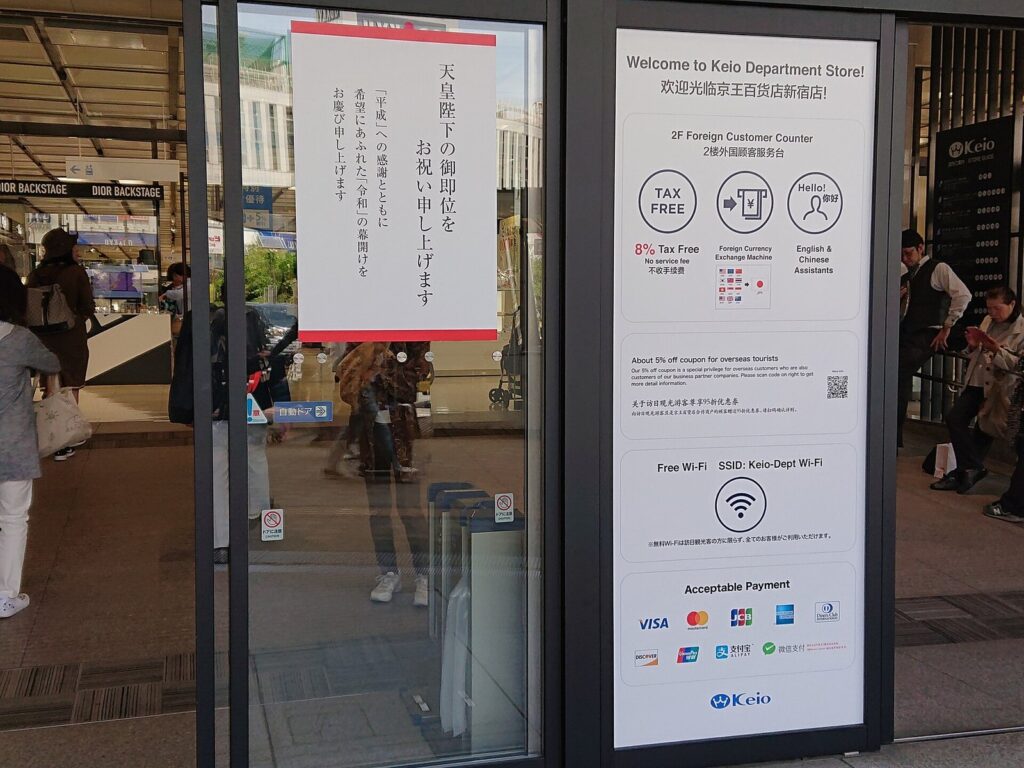
Featured image: “Keio Department Store Shinjuku Store (2019-05-01)” by Lombroso, CC BY-SA 4.0, via Wikimedia Commons