Matcha is having the strangest year of its long life. Tencha, the shaded leaf that gets ground into matcha powder, went for around ¥10,800 per kilogram at auction this year — roughly double 2025, and the price has fed straight through to the shelves. Through the spring, tea shops in Tokyo and Kyoto were limiting customers to one tin each. A green powder that a Zen monk once prescribed as medicine is now a global commodity with a supply problem.
I live in Japan, and what strikes me about the boom is how far the latte is from the thing it came from. The ceremony that made matcha matter is not a drink order. It is closer to a four-hour performance in which nobody performs, built around a bowl of bitter tea that takes ninety seconds to drink.
Here is where it came from, what the rules are actually for, and how to meet it as a visitor without pretending to be a scholar.
The quick answer
- The tea ceremony is called chanoyu or sado — literally “hot water for tea” and “the way of tea.” Almost nobody calls it “the tea ceremony” in Japanese.
- Tea arrived twice. It came in the 800s, died out, and returned in 1191 with the Zen monk Eisai, who brought seeds and a health treatise.
- Sen no Rikyu (1522–1591) shaped what we have now, turning a display of imported Chinese luxury into an art of small rooms, rough bowls and deliberate restraint. His patron later ordered him to kill himself.
- The rules are not etiquette for its own sake. Every movement is designed to be efficient, quiet and repeatable, so the host can stop thinking about it and pay attention to the guests.
- You do not need a booked experience to try matcha properly. Many temples and gardens serve a bowl with a sweet for roughly ¥500–1,000, and that is what people here actually do.
Tea came to Japan twice, and only the second attempt stuck
Tea first reached the Japanese court in the early 800s, carried back by monks who had studied in Tang China. Emperor Saga liked it enough to order plantations. Then relations with China cooled, the fashion faded, and tea effectively vanished from Japanese life for three hundred years.
The second arrival was the one that mattered. In 1191 the monk Eisai — who also brought Rinzai Zen to Japan — returned from China with seeds and a new method: powdered green tea, whisked into hot water rather than boiled in chunks. In 1211 he wrote Kissa Yojoki, “Drinking Tea for Health,” which is part pharmacology, part sermon. Tea, he argued, was medicine for the heart and a cure for the hangover of a warrior class that drank too much sake.
Zen temples adopted it as a stimulant for long meditation. From the temples it spread to the warriors who patronised them, and by the 1400s the shogun’s circle was holding lavish tea gatherings in gilded rooms, judging one another on their collections of Chinese ceramics. Tea had become a status contest. If you have read The History of Kyoto, this is the Kyoto of the Ashikaga shoguns — refined, competitive, and about to burn down in civil war.
Rikyu: the man who made poverty expensive
The correction came from merchants, not lords. Murata Juko in the late 1400s, and then Takeno Joo, began holding tea in tiny rooms with plain Japanese and Korean utensils instead of prized Chinese ones. This became wabi-cha — tea in the spirit of wabi, a word for the beauty of the plain, weathered and incomplete. It is the same aesthetic instinct we unpack in Wabi-Sabi: The Japanese Art of Beauty in Imperfection.
Joo’s student, Sen no Rikyu, took it to its logical end. Rikyu was a merchant’s son from Sakai, the port near Osaka, and he served as tea master to the two men who unified Japan: Oda Nobunaga, then Toyotomi Hideyoshi. In an age of warlords, being the person who decided what was beautiful was real political power.
His choices still define the form:
| Rikyu’s move | What it replaced |
|---|---|
| A two-mat room barely large enough for host and guests | Large reception halls |
| Rough, hand-shaped black raku bowls by a local tile-maker | Flawless imported Chinese celadon |
| A crawl-through door about 66 cm square (nijiriguchi) | A normal doorway |
| Unpainted wood, mud walls, a single flower | Gold leaf and displayed collections |
The crawl-through door is the sharpest idea in the whole tradition. You cannot enter standing, and a samurai could not enter armed — swords went on a rack outside. Inside, rank was suspended. A warlord and a merchant knelt on the same mats.
The contradiction is that this humility was theatre for the most powerful men alive, and it made Rikyu enormously influential. In 1587 Hideyoshi staged the Grand Kitano Tea Gathering at Kitano Tenmangu shrine in Kyoto, open to anyone who brought a kettle — while also owning a portable tea room lined entirely in gold. Rikyu served in both.
In 1591, at nearly seventy, Rikyu was ordered by Hideyoshi to commit seppuku. Historians still argue about why: a wooden statue of Rikyu placed above a temple gate Hideyoshi walked under, accusations of profiteering on utensils, or simply a ruler who could no longer tolerate a subject with independent authority over taste. He performed one last tea gathering, gave away his utensils, and died.
What actually happens
There are two very different things people call a tea ceremony.
A chakai is the short, informal version: thin tea (usucha), a sweet, perhaps an hour. This is what a visitor will normally see. A chaji is the full formal gathering — four hours or more, with a light kaiseki meal, a charcoal-laying sequence, thick tea (koicha) shared from one bowl, and thin tea to finish. Most Japanese people have never attended a chaji. I certainly have not.
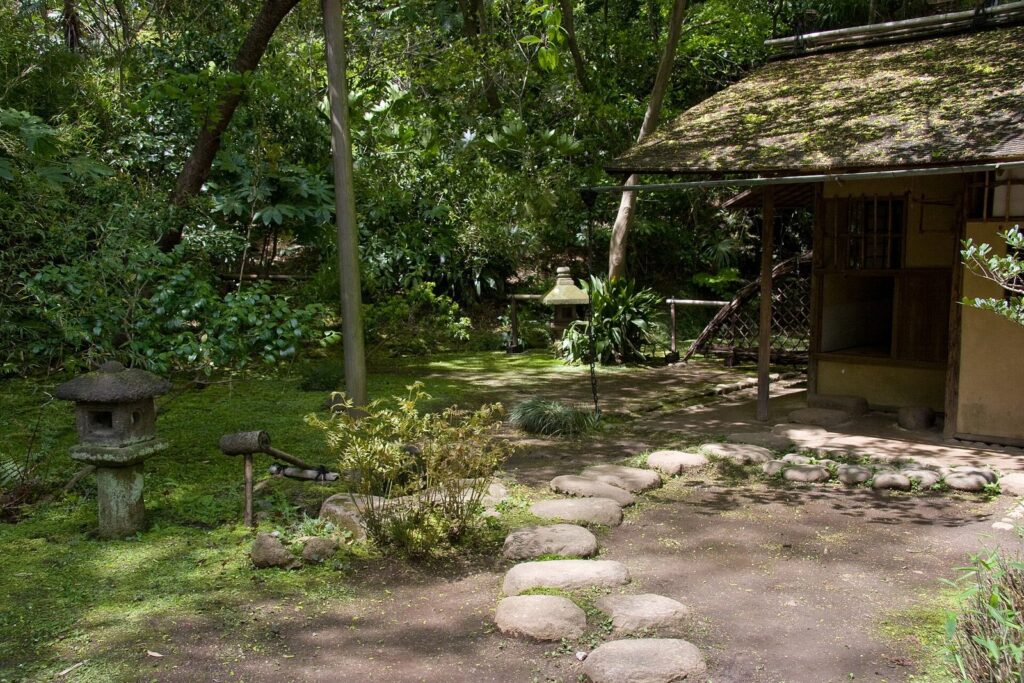
The shape of a short gathering: guests wait in a garden shelter, rinse hands and mouth at a stone basin, and enter through the low door. You look at the scroll and flower in the alcove first — they set the theme of the day. Sweets come before tea, because matcha is bitter and the sugar is meant to still be on your tongue. The host cleans each utensil in front of you, ladles hot water, whisks, and sets the bowl down with its “front” — the best-looking side — turned toward you.
Then the famous part: you turn the bowl. Two small clockwise turns, roughly, so you do not drink from the decorated front. Drink in a few mouthfuls, finish audibly, wipe the rim, turn it back, and set it down. That is it. The turning is not mysticism; it is a courtesy loop, host and guest each declining to take the good side.
Two seasonal details worth knowing: from November to April the kettle sits in a sunken hearth (ro) near the guests for warmth; from May to October it moves to a portable brazier (furo) set further away, so the fire feels distant in summer. Almost every whisk you will ever see, meanwhile, is split by hand from a single piece of bamboo in Takayama, a district of Nara that has made them for five hundred years.
The idea underneath: ichigo ichie
Rikyu is credited with four principles — harmony, respect, purity, tranquility — but the phrase that carries the tradition is ichigo ichie, “one time, one meeting.” It was set down in the 1850s by Ii Naosuke, a tea practitioner who was also one of the last shogunate’s chief ministers, and who was assassinated at a castle gate in the snow. The meaning: this exact gathering, these guests, this weather, this bowl, will never occur again, so treat it as unrepeatable.
Rikyu’s own instructions are almost deflating in their plainness. Make tea that is good to drink. Lay the charcoal so the water boils. Arrange flowers as they are in the field. Be cool in summer and warm in winter. Be ready ahead of time. Prepare for rain. Attend to the guests you are with. Someone reportedly told him that this was obvious, and he replied that if you could actually do it, he would become your student.
That is the honest content of the art: extreme attention to ordinary hospitality. The same instinct shows up in the way a restaurant hands you a hot towel, and in the way a shop assistant walks your bag to the door — the background courtesy we describe in Japan Etiquette: 15 Dos and Don’ts for Visitors.
How to encounter it as a visitor
Booked tourist ceremonies in Kyoto exist and are generally well run — expect roughly ¥3,000–6,000 per person for a shared 45-minute session, more for a private one, though prices move and should be checked before you book. They are simplified and explained in English, which is a fair trade for a first encounter.
But the cheaper option is often the better one. Many temples and gardens have a tea house where anyone can sit down for a bowl of matcha and a seasonal sweet for around ¥500–1,000 — no reservation, no instruction, no group. Kyoto temple gardens, Kenroku-en in Kanazawa, Hama-rikyu in Tokyo. You sit on the tatami, look at the garden, drink your tea, and leave. There is no test. If you are building a Kyoto day around temples, it slots in easily alongside the stops in Best Things to Do in Kyoto.
And if you only want to taste good matcha, buy a tin from an old Kyoto or Uji tea house and take it home. Just expect to pay more than last year, and to find some shelves empty.
FAQ
Do I need to sit in seiza?
No. Say so, and you will be offered a stool or told to sit however is comfortable. Nobody wants a guest in pain.
Is it religious?
It grew out of Zen Buddhism and keeps its vocabulary and pacing, but attending is not a religious act. For the wider picture, see Shinto vs Buddhism: Japan’s Two Religions Explained.
Will the tea be very bitter?
Thin tea is bright and grassy rather than harsh, and the sweet beforehand is there to balance it. Thick tea is another matter — closer to warm paint, and an acquired taste.
Do Japanese people do this regularly?
Most do not. It is a lifelong study for a dedicated minority, a school club for some teenagers, and an occasional garden outing for everyone else.
What should I wear?
Anything tidy. Slip-on shoes help, since you will remove them, and avoid strong perfume — it competes with the tea and the charcoal.
The verdict
The tea ceremony is not a performance of Old Japan for visitors. It is a four-hundred-year-old argument that attention is the highest form of hospitality, made by a merchant who was killed for having too much authority over beauty. You can meet it for the price of a coffee in a temple garden, and that is the version I would recommend first: no host explaining, no group photo, just an unreasonably careful bowl of green tea and a view of some raked gravel.
Written from Japan by the Wayfarer Japan team. Prices and details are approximate and change — always confirm before you book.
Featured image: “Shunsoro” by Kimon Berlin, Gribeco, CC BY-SA 3.0, via Wikimedia Commons