I live in Japan, and Centrair is the airport I use whenever I am flying somewhere out of central Honshu — it is small, calm, and refreshingly free of the crowds you get at Narita or Kansai. The one thing first-time visitors never expect is that there is no JR line out of it at all. Every train into the city runs on the private Meitetsu network, and the fare you pay depends entirely on which of its trains you choose to board.
That choice boils down to one decision: pay a bit more for a guaranteed seat and the fastest possible ride, or save the difference and accept a slightly longer, standing-room-possible trip. Here is how the options actually compare, plus the bus and taxi alternatives for when the trains do not fit.
The quick answer
- In a hurry or landed exhausted after a long flight? Take the Meitetsu μSKY (Mu-Sky) limited express: 28 minutes to Meitetsu Nagoya Station, ¥1,430 (¥980 base fare + ¥450 reserved-seat μticket). Every seat on every car is reserved — there is no standing-room option on this train.
- Travelling light and don’t mind a few extra minutes? The regular Meitetsu express or rapid express covers the same route in about 40–50 minutes for ¥980, no reservation needed, tap in with any IC card.
- Missed the last train, or travelling as a group of three or four? A taxi runs about 50 minutes and ¥15,000–16,000, plus highway tolls, with a 20% late-night surcharge between 22:00 and 05:00.
- Prefer a bus? A limited bus service runs to Nagoya Station’s west exit for around ¥1,500 and 55 minutes, mainly scheduled around the first and last flights of the day — most daytime airport buses now head to Sakae and Fushimi instead, not the station.
- Prices and schedules are 2026 figures and approximate — always confirm the current timetable before you travel, since Meitetsu adjusts μSKY departures a few times a year.
The options at a glance
| μSKY Limited Express | Regular train | Bus | Taxi | |
|---|---|---|---|---|
| Time to Nagoya | 28 min | 40–50 min | ~55 min | ~50 min |
| Cost (one way) | ¥1,430 | ¥980 | ~¥1,500 | ~¥15,000–16,000 |
| Reservation | Required (all-reserved) | None | None | None |
| Luggage | With you, overhead racks | With you, can be tight | In the hold | Boot |
| Best for | Speed, guaranteed seat | Budget, light luggage | Groups near first/last flights to the station side | Very late arrivals, 3–4 people splitting the fare |
Where Centrair actually sits
Chubu Centrair International Airport sits on an artificial island in Ise Bay, about 35 kilometers south of downtown Nagoya. The airport’s own railway station is built directly into the terminal — follow the signs for “Railway Station” past arrivals, down one level, and you are at the platform without stepping outside. There is no need to find a connecting shuttle first, which is a nicer start than a lot of Japan’s airports manage.
Every train from that platform belongs to Meitetsu (Nagoya Railroad), a private line, not Japan Railways. If you are holding a Japan Rail Pass, it does not cover this route at all — one more reason the μSKY-versus-regular-train decision matters, since neither one is “free” the way a JR local train inside a pass region would be.
Option 1: The μSKY (Mu-Sky) — the fastest, most comfortable way in
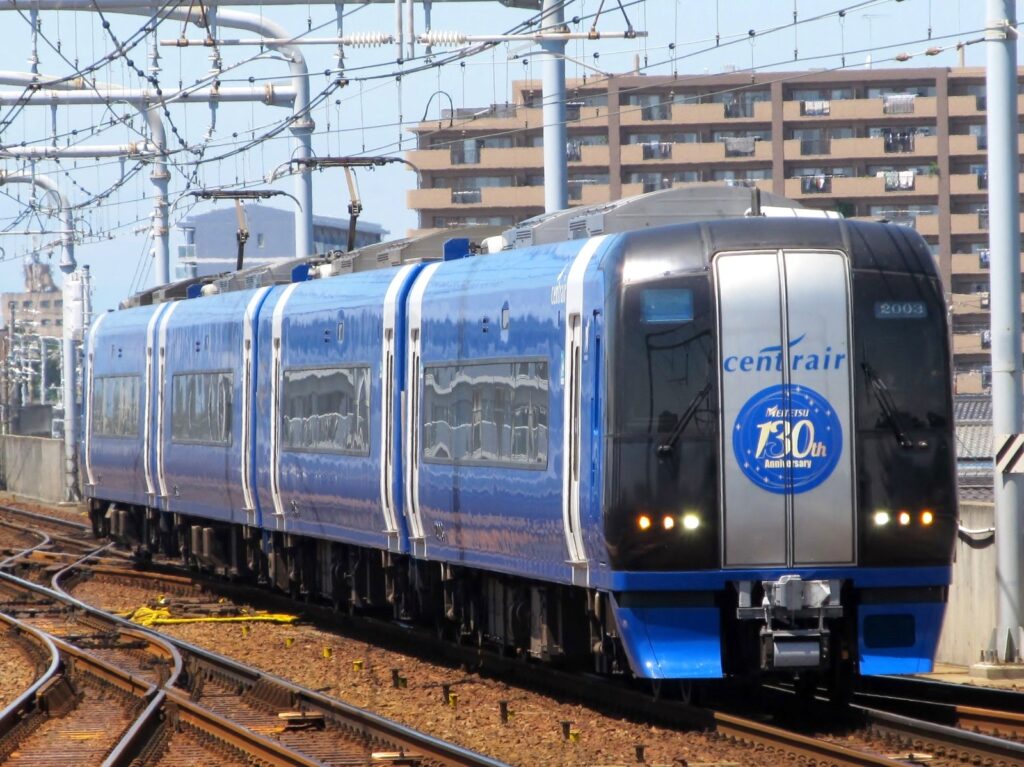
The μSKY is Meitetsu’s flagship airport limited express, instantly recognizable by its white-and-orange livery and the panoramic front seats above the driver’s cab. It runs roughly every 30 minutes through most of the day, stopping at only a couple of stations before terminating at Meitetsu Nagoya Station, which sits directly underneath the same building complex as JR Nagoya Station — so if you are connecting onward to a Shinkansen, you walk, you do not taxi.
The catch, and it trips up a few travelers every year, is that every car on the μSKY is reserved seating. You need two things to board: the regular fare (¥980) and a separate μticket (¥450) for your specific seat. An IC card alone will not get you through the gate for this train — you still need the paper or app-based μticket on top of it. Buy both from the ticket machines just past the station gates, from the staffed counter, or in advance through Meitetsu’s ticketless reservation app.
👉 Klook Chubu Centrair Airport Meitetsu ticket
For context on how Japan separates a base fare from a premium-train surcharge like this, our guide How Japan’s Train Fares Work breaks down the same logic behind JR’s limited express tickets — Meitetsu’s μticket is the private-railway equivalent.
Option 2: The regular express — the one I actually take
Meitetsu also runs ordinary express and rapid express trains over the exact same track, stopping at more stations and taking 40 to 50 minutes depending on the service. These cost a flat ¥980, require no reservation, and you simply tap an IC card or buy a paper ticket at the gate like any other train in the country.
As a resident, this is the train I take most often — the time difference rarely matters once you factor in that I am usually not racing for a connection, and the fare is roughly a third cheaper. The only downside is that these trains can have standing passengers during busier periods, which is worth avoiding if you are wrestling with large check-in luggage. If that is you, the extra ¥450 for a guaranteed μSKY seat earns its keep.
Our guide Japan’s Trains Explained covers how private railways like Meitetsu fit alongside JR and the subway system more broadly, if the whole network still feels confusing at this point in your trip.
Option 3: Bus
Meitetsu and Nagoya’s airport limousine buses mostly serve Sakae and Fushimi these days rather than Nagoya Station directly, which catches out travelers expecting a simple airport-to-station bus. A separate, more limited bus service does run to Nagoya Station’s west exit, scheduled mainly around the day’s first and last flights, for about ¥1,500 and roughly 55 minutes. Check the current timetable at the airport bus counter on arrival, since this schedule is thinner than the trains and worth confirming rather than assuming.
For most travelers heading straight to the station, the regular train is simpler and faster than waiting for one of these buses.
Option 4: Taxi
A metered taxi from Centrair to Nagoya Station takes about 50 minutes and typically costs in the ¥15,000 to ¥16,000 range once you add the Centrair Bridge toll and other expressway charges — a late-night surcharge of roughly 20% applies between 22:00 and 05:00. That is a lot more than the train, but if you have landed after the last μSKY or regular service has stopped for the night, or you are a group of three or four splitting the cost, it stops being an unreasonable option.
Taxi ranks are clearly signed just outside the arrivals hall, and drivers accept cash or card without any fuss.
Settling in near Nagoya Station
Nagoya Station’s complex is enormous and genuinely walkable to a cluster of hotels, department stores and the Shinkansen platforms all under one roof, which makes it a sensible first-night base whether or not it is your final destination. From there, side trips to the castle, the Toyota-adjacent industrial heritage sites, and a bowl of miso katsu are all close by — our Nagoya Travel Guide covers what to do once you have arrived.
FAQ
Is there a JR line from Centrair to Nagoya?
No. Every rail option is operated by Meitetsu, a private railway. A Japan Rail Pass does not cover any part of this route.
Do I still need the μticket if I already have a Suica or other IC card?
Yes. An IC card covers the base fare but not the reserved seat. For the μSKY you need both the fare and a separate μticket; for regular trains, the IC card alone is enough.
Is Meitetsu Nagoya Station far from JR Nagoya Station or the Shinkansen?
No — they share the same station building. It’s a short walk through connected concourses, not a separate trip.
Is Chubu Centrair the same as “Nagoya Airport”?
Not quite. Nagoya also has a small airfield closer to the city (Nagoya Airfield, formerly Komaki), which now handles only a limited number of domestic flights on small turboprop aircraft. Nearly all international and most domestic flights use Centrair, further out on the bay.
Can I use my Suica, Pasmo or ICOCA here?
Yes. Nagoya’s local IC card is called manaca, but all ten major nationwide IC cards are mutually compatible across Meitetsu, the subway and buses.
I forgot to pack something — is that a problem landing at a smaller airport like this?
Not really. Centrair has convenience stores and a reasonable shopping concourse, and once you are in Nagoya proper there are the same Uniqlo branches, drugstores and ChargeSPOT rental stands as any other Japanese city, so a forgotten charger or umbrella is never a crisis.
The verdict
If you want the fastest, most comfortable start to your trip and do not mind the extra ¥450, take the μSKY — 28 minutes, a guaranteed seat, and a direct link into the same building as the Shinkansen. If you are watching the budget or traveling light, the regular Meitetsu express does the same job in under an hour for ¥980 less the reservation. Save the bus for the rare case it matches your flight time, and the taxi for when the trains have stopped running or you are splitting the fare four ways.
Written from Japan by the Wayfarer Japan team. Prices and times are 2026 figures and approximate — always confirm before booking.
Featured image: “2000 series BLUE μSKY 1” by ButuCC, CC BY-SA 4.0, via Wikimedia Commons