I live in Tokyo, and the first time a friend dragged me to the Kabukiza, I expected something like a museum piece — polite, slow, a little dusty. What I got instead was a man leaping across the stage on a hidden walkway through the audience, a quick-change costume trick that drew gasps, and a death scene so stylized and loud that the person next to me laughed out loud in delight. Kabuki was never meant to be respectable. It was meant to be a spectacle, and four centuries later it still is.
If you’re visiting Japan and wondering whether kabuki is worth your time, the short answer is yes — but you don’t need to understand a word of Japanese or sit through an entire program to get something out of it. Here’s what it actually is, why it looks the way it does, and the easiest way to see it for yourself.
The quick answer
- Kabuki is a stylized form of Japanese theater that began in 1603, combining dance, music, elaborate costumes and exaggerated acting.
- All roles, including female characters, are played by men — a rule that has held for about 370 years.
- The main venue is the Kabukiza Theatre in Ginza, Tokyo; Kyoto’s Minamiza and Osaka’s Shochikuza also stage productions.
- You don’t need to watch a full program: single-act tickets let you see one act for roughly ¥1,500–4,000, no reservation ahead of time required beyond the day before.
- English-language audio guides and subtitle devices are available for rent, so the lack of Japanese isn’t a barrier.
Where kabuki actually came from
Kabuki’s origin story is stranger than most people expect. It’s generally traced to 1603, when a shrine dancer named Izumo no Okuni began performing unconventional dances on a makeshift stage in Kyoto, blending sacred dance with popular entertainment and a fair amount of sex appeal. The word “kabuki” itself likely comes from the verb kabuku, meaning to lean or to be out of the ordinary — this was subversive, slightly scandalous street theater, not refined court art.
It caught on fast, and so did the imitators. Troupes of women performed kabuki through the early 1600s, and it became closely associated with the pleasure districts and their resident entertainers — which is a thread you’ll also find in our piece on the real story of the geisha, since the two worlds overlapped for a while. The Tokugawa shogunate, never comfortable with women performing in public, banned women from the kabuki stage in 1629, citing (official) concerns about public morals. Young men took over the female roles next, and when that was banned too for similar reasons in 1652, the shogunate settled on a rule that has defined kabuki ever since: only adult men could perform, in every role.
That rule produced one of kabuki’s most distinctive features — the onnagata, male actors who specialize in playing women. A great onnagata doesn’t impersonate a woman so much as perform an idealized, theatrical version of femininity, built from decades of training in movement, voice pitch and gesture. Some of the most celebrated kabuki actors in history have been onnagata specialists, and the skill is still passed down through specific acting families today, often from father to son.
What’s actually happening on stage
A full kabuki program can run three to five hours and typically covers two or three unrelated plays or dance pieces in one sitting — this is one reason locals rarely watch the whole thing in one go. The plays generally fall into a few broad categories: jidaimono (historical dramas about samurai and court intrigue), sewamono (domestic dramas about merchants and commoners), and dance-heavy pieces built around a single spectacular set piece.
A few things to watch for even if you don’t follow the dialogue:
- The hanamichi — a raised walkway that extends from the stage through the audience, used for dramatic entrances and exits. Sitting near it means an actor might make eye contact a few feet from your seat.
- Kumadori makeup — the bold red and black (or blue) face paint used in some historical plays, where each color and pattern signals a character’s personality, from heroic to villainous to supernatural.
- Mie poses — a sudden freeze-frame pose at a dramatic peak, often accompanied by crossed eyes, timed with wooden clappers (tsuke) struck against the stage floor.
- Keren — stage tricks, including actors flown on wires, rotating stage sections, and lightning-fast costume changes performed in full view or hidden behind a quick assist from stagehands dressed in black.
- The kakegoe — shouted calls from audience members at key moments, naming an actor’s stage name in approval. It’s not heckling; it’s closer to applause mid-scene, and part of the genuine audience participation that keeps kabuki feeling alive rather than museum-like.
The music comes from an onstage ensemble playing shamisen, drums and flute, often seated visibly at the side or back of the stage rather than hidden in a pit — part of the point is that you can see how the whole thing is constructed.
How to actually watch kabuki in Tokyo
The main stage is the Kabukiza Theatre in Ginza, rebuilt in 2013 and the most convenient option if you’re already working through a Tokyo travel guide for first-timers or our list of things to do in Tokyo. A handful of points worth knowing before you go:
Full tickets go on sale around two weeks before each program and can be bought online, by phone, or at the box office, with prices depending on seat class and show.
Single-act tickets are the easier option for a first visit and the one I’d actually recommend to a friend. Instead of committing to the whole program, you buy a ticket for just one act — usually in the fourth-floor gallery — at roughly ¥1,500 to ¥4,000 depending on the month and play. These seats go on sale from around noon the day before the performance through the official e-tix system, and you can usually still find same-day availability if you’re flexible. It’s the kabuki equivalent of watching one episode instead of the whole series, and honestly the better way to find out if the full thing is for you.
Language help is built in. English-language earphone guides explaining the plot and cultural context as it unfolds are available to rent at the theater for a few hundred yen, and English subtitle/caption devices can also be rented at the venue. You don’t need any Japanese to follow what’s happening.
Getting tickets without doing it yourself: if navigating a Japanese ticketing portal from abroad sounds like more effort than you want, Kabukiza admission is also sold as a bookable experience through 👉 GetYourGuide, which is a reasonable option if you’d rather lock in a seat before you land.
Outside Tokyo, Kyoto’s Minamiza theater — Japan’s oldest kabuki venue, with roots to the 1600s — stages a famous “kaomise” program each December, and Osaka’s Shochikuza hosts its own regular programs. If your trip includes a stop covered in our Kyoto travel guide, it’s worth checking the Minamiza schedule before you go, since programs don’t run year-round at every venue.
FAQ
Do I need to book weeks in advance? Not for single-act tickets — those go on sale the day before. Full seats for a popular run can sell out faster, so if you want a specific date for a full program, book as soon as tickets open.
Is kabuki appropriate for kids? Some programs are family-friendly and visually spectacular enough to hold a child’s attention even without understanding the dialogue; others are long, dialogue-heavy historical dramas. A single act is a much safer bet for a first try with children than a full program.
Why are there no women on stage? It’s a convention that dates to a 1629 ban on female performers, later extended to boy actors too, after which all-male casts became the fixed tradition — one that kabuki has kept intentionally ever since rather than ever reversing.
Is kabuki the same as Noh theater? No — Noh is older, slower and more austere, built around masks and minimalist staging, while kabuki is louder, more colorful and was originally popular entertainment rather than elite court art. They’re related but distinct traditions.
What should I wear? Nothing special — regular clothing is fine, and plenty of visitors come straight from a day of sightseeing.
The verdict
Kabuki rewards curiosity more than preparation. You don’t need to read up on four centuries of theatrical history before you go — though it helps to know that the elaborate makeup, the sudden freezes, and the man convincingly playing a noblewoman are all deliberate, centuries-old choices rather than things that will be explained to you on the way in. Start with a single act if you’re unsure, bring the English earphone guide, and let the hanamichi do the rest of the convincing.
Written from Japan by the Wayfarer Japan team — real residents sharing what we actually know about living and traveling here.
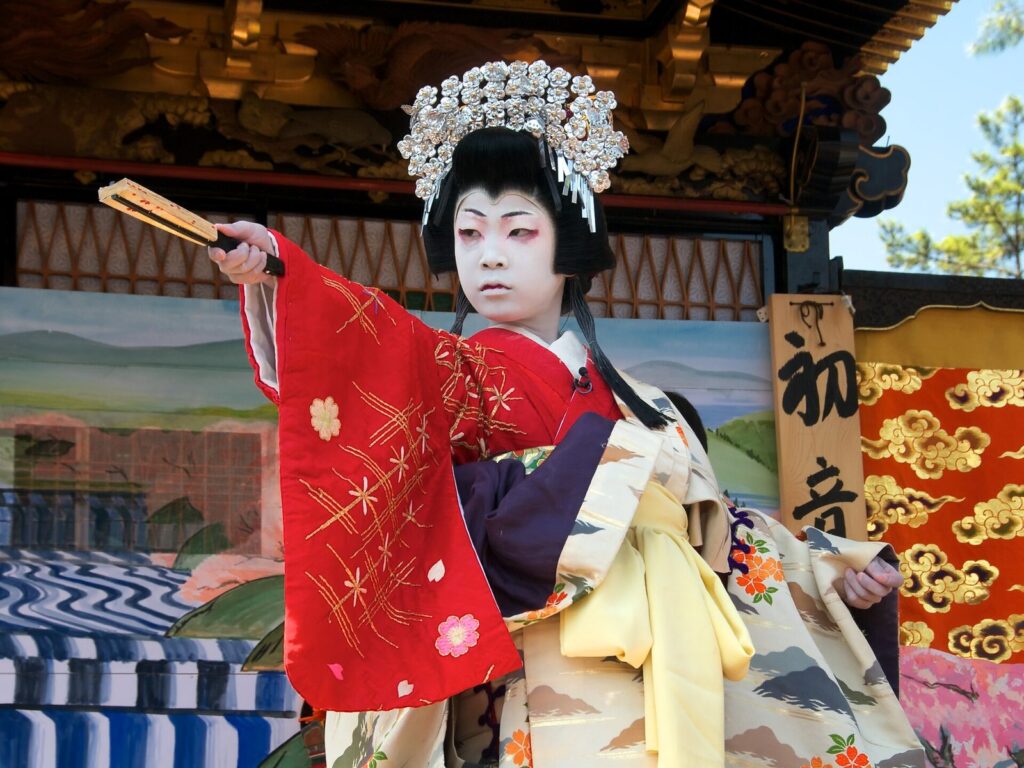
Featured image: “Children kabuki theater in Nagahama (lady Shizuka, 10 y.o.)” by lensonjapan, CC BY 2.0, via Wikimedia Commons