I have watched a lot of visiting friends freeze up over a bowl of ramen, chopsticks hovering, clearly running through a mental checklist of rules they read before the trip. Most of that checklist is unnecessary. Japanese dining etiquette has a handful of things that genuinely matter and a much longer list of internet myths that locals don’t actually enforce.
Here is what I’ve learned living here: nobody is grading you. Staff and fellow diners extend a lot of grace to visitors who are clearly trying. But a few habits do stand out as awkward or even distressing to the people around you, and those are worth getting right. The rest you can relax about. (This guide focuses on the table itself; for the wider picture — shoes, shrines, trains and more — our general Japan Etiquette: 15 Dos and Don’ts for Visitors covers the rest.)
The quick answer
- Never stick chopsticks upright in a bowl of rice — it echoes a funeral ritual and is the one rule locals really do notice.
- Don’t pass food chopstick-to-chopstick for the same reason.
- Slurping noodles is fine and even expected at a ramen or soba shop — it’s not rude.
- Tipping is not expected anywhere, including restaurants, taxis and hotels. Don’t leave cash on the table.
- Pour drinks for others at a shared table before pouring your own.
- Say “itadakimasu” before eating and “gochisosama deshita” when finished — small, appreciated gestures.
- Eating and drinking while walking down the street is considered a bit sloppy, though train-platform convenience-store snacking is increasingly normal.
The two rules that actually matter
Almost everything else in Japanese table manners is negotiable or regional, but these two are not, because they connect directly to funeral customs.
Don’t plant your chopsticks upright in a bowl of rice. At Buddhist funerals, a bowl of rice is placed with chopsticks standing straight up in it as an offering to the deceased. Doing the same thing at a dinner table, even by accident while you reach for something else, makes people flinch. If you need to set your chopsticks down, rest them on the little ceramic chopstick holder (hashi-oki) next to your plate, or balance them across the edge of your bowl.
Don’t pass food from your chopsticks to someone else’s chopsticks. This mirrors a specific part of the cremation ritual, where family members pass a loved one’s bones between chopsticks. If you want to share food, place it on a small plate and let the other person pick it up themselves, or use the opposite (butt) end of your chopsticks to serve.
Everything past these two is etiquette-as-courtesy, not etiquette-as-taboo, and Japanese people themselves break plenty of the “softer” rules without a second thought.
Chopsticks: the rest of the story
Beyond the two hard rules, a few habits are considered a bit uncouth but won’t actually offend anyone watching a visitor do them:
- Don’t point with your chopsticks or wave them around while talking. It reads as aggressive, the same way pointing a knife would elsewhere.
- Don’t spear food with a single chopstick like a skewer, even though it’s tempting with a slippery piece of tofu.
- Don’t rub disposable wooden chopsticks together like you’re trying to sand off splinters — it signals you think the restaurant gave you cheap chopsticks, which is a mild insult to a host.
- If a dish doesn’t come with chopsticks (steak, some Western-style cafes), don’t worry about it. Japan has plenty of cutlery for Western food, and switching utensils mid-meal is completely normal.
If you’re genuinely unsure how to hold chopsticks, nobody will mind if you ask, and restaurants that cater to visitors often have cutlery on standby anyway.
Slurping, sipping, and the sounds of eating
This is the rule that surprises first-time visitors the most: slurping noodles is not rude in Japan, it’s close to customary. At a soba or ramen counter — see our Types of Ramen guide if you want to know what you’re ordering — you’ll hear a chorus of slurping around you, genuinely believed to help cool the noodles and pull in aroma as you eat. There’s no minimum volume requirement, so don’t feel self-conscious about it either way.
The same relaxed attitude doesn’t extend to all sounds, though. Chewing with your mouth open or talking with food in your mouth land the same as they would most places — mildly rude, not uniquely Japanese.
Drinking customs: pour for others first
If you’re at an izakaya (Japanese pub) or any meal where drinks are shared, the custom is to pour for the people around you before filling your own glass, and to keep an eye on others’ glasses to top them up when they’re getting low. It’s customary to lift your glass slightly off the table while someone pours for you, as a small gesture of acknowledgment.
The toast is “kanpai,” said with glasses raised, and it’s common — though not mandatory — to hold off on the first sip until everyone has said it together.
Before and after: the two phrases worth learning
“Itadakimasu” (roughly “I humbly receive this”) is said just before eating, and “gochisosama deshita” (“thank you for the feast”) is said when you finish, whether you’re at home, in a restaurant, or even opening a convenience store bento alone at your desk. Neither is religious in any strict sense today — they’re closer to a reflexive expression of thanks toward the food, the cook, and the people who grew or caught it. Visitors who use these two phrases, even a little awkwardly, tend to get warm reactions from staff. It costs nothing and signals real effort.
What about tipping?
Short answer: don’t. Tipping is not part of Japanese service culture, in restaurants, taxis, hotels, or anywhere else, and leaving cash on the table is more likely to confuse staff than please them — some will chase you down to return it. Excellent service is simply the baseline, not something that needs to be rewarded separately. A sincere “arigatou gozaimashita” on your way out does more than a tip would.
Where you will see an added charge is at upscale restaurants and hotels, which may add a 10–15% service charge to the bill. This is a set fee built into the pricing, not a tip, and it should already be printed on the menu — you don’t add anything on top of it.
One small payment habit worth knowing: many counters have a small tray near the register for cash or card rather than handing it directly to the cashier.
What tourists worry about for nothing
A few “rules” that circulate online are either outdated, regional, or simply exaggerated:
- Finishing every grain of rice is appreciated but not enforced; nobody will say anything if you leave some.
- Eating while walking is considered a little sloppy in general, but grabbing something from a convenience store and eating it on the spot near the register, or snacking on a long train journey, is completely normal and not judged.
- Which hand holds chopsticks doesn’t matter; left-handed diners are not expected to switch.
- Blowing your nose at the table is genuinely considered impolite (step outside or to a restroom), but this is closer to universal table manners than a uniquely Japanese taboo.
FAQ
Is it rude to ask for a fork instead of chopsticks? No. Staff would rather you eat comfortably than struggle in silence, and many restaurants that see visitors regularly keep forks on hand without being asked.
Do I have to say itadakimasu out loud in a restaurant? Not loudly or formally — a quiet, almost murmured version is normal, even solo. It’s a personal habit more than a performance for others.
Is it okay to take photos of my food before eating? Yes, this is extremely common in Japan itself, not just among tourists. Just be mindful of flash and other diners nearby.
What if I accidentally break one of the “real” rules, like sticking chopsticks in rice? Nobody is going to scold a visitor over an honest mistake. Simply correct it, and the moment passes. These rules are about not causing people a small jolt of discomfort, not about punishment.
Is sharing dishes family-style normal? Very much so, especially at izakaya, where ordering several small dishes to share across the table is the default way of eating, not an exception.
The verdict
You only need to actually remember two rules — no chopsticks standing in rice, no chopstick-to-chopstick food passing — because those are the ones tied to funeral customs and the ones locals genuinely notice. Slurping noodles, sharing plates, and skipping the tip are all things you can do without a second thought. The best approach at a Japanese table isn’t memorizing a long list; it’s relaxing into the meal, saying your itadakimasu, and letting the rest take care of itself.
Written from Japan by the Wayfarer Japan team — we live here and write from daily experience at the table, not a guidebook.
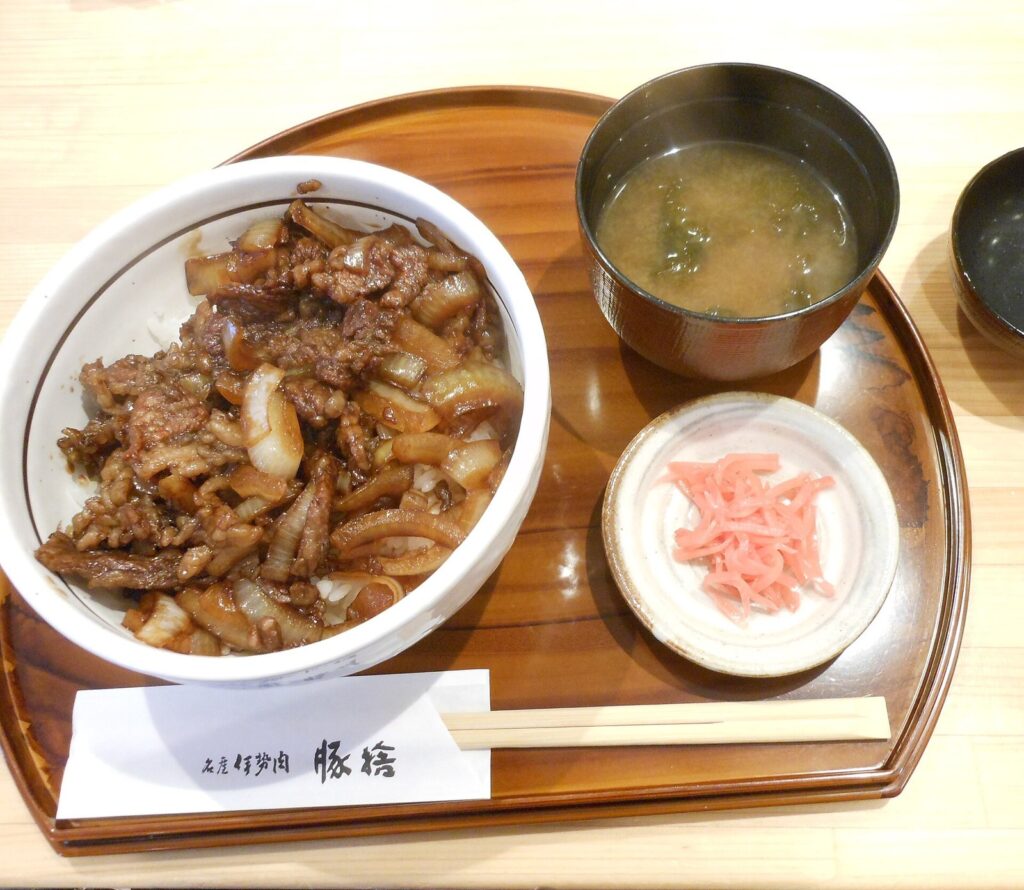
Featured image: “Butasute Gyudon” by Miyuki Meinaka, CC BY-SA 4.0, via Wikimedia Commons