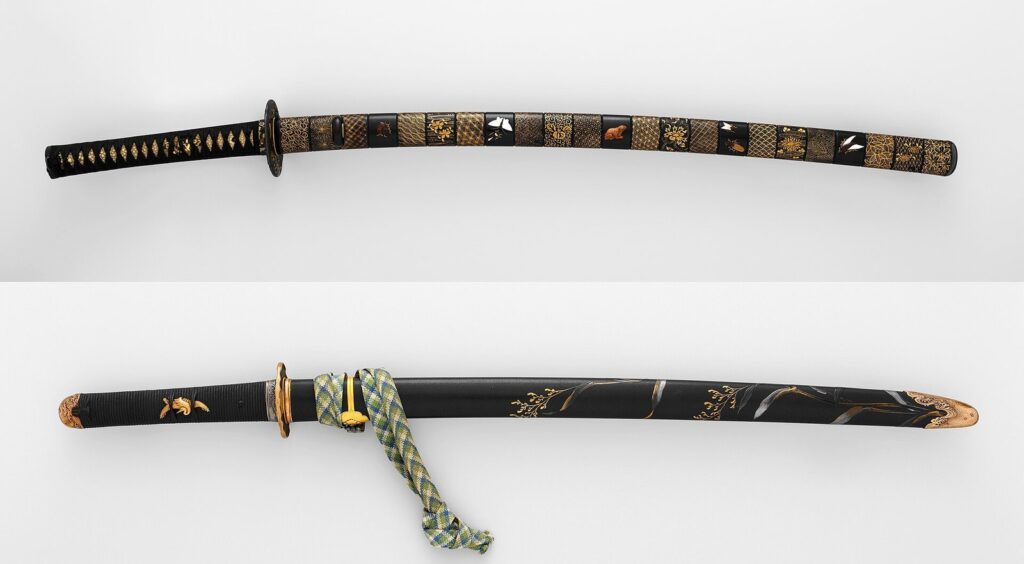
I live in Japan, and the first time I stood in front of a real katana in a museum case, what struck me was not the blade. It was the light moving along it — a faint, cloud-like pattern running the length of the edge that shifts as you walk past. That pattern is not etched on. It is baked into the steel itself, the fingerprint of a decision a swordsmith made about fire and water roughly six hundred years ago.
I am not a collector and do not own a sword — almost no resident does. But the katana shows up everywhere once you start looking: temple treasure halls, sumo tournament gifts, the small industrial city of Seki that still makes kitchen knives the way it once made blades. This is the history behind that curved shape, including the parts where the tradition nearly died.
The quick answer
- The katana is younger than most people assume. The long, deeply curved tachi worn by mounted Heian-era (roughly 10th century) warriors came first; the katana — worn edge-up through the belt for a fast draw — became dominant for foot combat only from the late Kamakura and Muromachi periods, roughly the 1300s–1500s.
- The steel is the real story. Swordsmiths fold and hammer tamahagane, steel smelted from iron sand in a traditional clay furnace called a tatara, combining a hard outer shell with a softer core so the blade holds an edge without snapping.
- The wavy temper line (hamon) is functional, not decorative. It comes from coating the blade in clay before quenching, so the edge cools and hardens faster than the spine — which is also what creates the curve.
- Swords were nearly wiped out twice: once by the 1876 Meiji-era ban on wearing them, and again after 1945, when occupation forces confiscated and destroyed enormous numbers as weapons before a 1953 law carved out an exception for swords made as traditional art.
- About 300 licensed swordsmiths still work in Japan today, and the law caps each one at two long swords a month — the craft survives, but deliberately in miniature.
- You cannot casually buy one and fly home with it. Exporting an authentic sword requires an Agency for Cultural Affairs certificate confirming it is not a protected cultural property.
Where the curve actually comes from
The earliest Japanese swords, from the Kofun period, were straight, double-edged blades modelled on Chinese designs. The curve that defines a “Japanese sword” in most people’s minds developed later, in the Heian period, alongside mounted cavalry warfare: a curved blade is easier to draw and swing cleanly from horseback, and easier to cut on the draw rather than the chop.
That earlier form is properly called a tachi, worn edge-down, slung from the belt on cords. The katana most people picture — worn edge-up, tucked directly through an obi sash for a single fast draw-and-cut — became the standard sidearm later, as warfare shifted toward infantry fighting in close, chaotic battles during the Sengoku period. Samurai culture and the code built around carrying one are their own subject, which I cover in Samurai and Bushido: The Warriors Who Shaped Japan.
By the peaceful Edo period, swords stopped being primarily weapons and became status objects. The paired daisho — a long katana and a shorter wakizashi worn together — was restricted by law to the samurai class, a visible marker of rank in a strictly ordered society.
The steel, the fold, and the line of light
A traditional blade starts as tamahagane, “jewel steel,” smelted from black iron sand in a tatara, a clay furnace fed by hand-pumped bellows over several days. The resulting bloom of steel is uneven — some chunks high in carbon and hard, others low in carbon and tough — and sorting it by hand is half the craft.
The smith folds and hammer-welds the steel repeatedly, building up thousands of microscopic layers, then wraps a harder, high-carbon shell (kawagane) around a softer, more flexible core (shingane). That combination is the actual engineering behind a Japanese sword: a blade that is entirely hard steel chips and snaps, while one that is entirely soft steel will not hold an edge.
The last and most theatrical step is differential hardening. Before the final quench, the smith coats the blade in a layer of clay, thicker along the spine and thinner along the edge, then heats it and plunges it into water. The thin-coated edge cools fast and becomes very hard; the thick-coated spine cools slowly and stays comparatively soft and flexible. The boundary between those two zones, visible as a cloudy white line, is the hamon — and the uneven cooling is also what pulls the blade into its final curve. Nothing about the shape is carved or forced; it happens in the water.
After the smith, the blade still passes through a separate specialist, the togishi (polisher), who can spend weeks bringing out the steel’s structure with a sequence of increasingly fine stones — plus makers for the fittings, scabbard and hilt wrap. A finished sword is the work of several craftspeople, not one.
Masamune, Muramasa, and swords with reputations
Two names come up constantly in sword lore. Goro Nyudo Masamune, working in the Soshu tradition in the early 1300s, is generally treated as the greatest smith who ever lived, credited with blades of extraordinary, almost serene balance. Sengo Muramasa, working slightly later, became attached to a very different reputation: a “cursed” or bloodthirsty blade, associated in Edo-period legend with misfortune in the Tokugawa family, supposedly to the point that owning one was dangerous.
Historians generally treat the virtuous-Masamune-versus-cursed-Muramasa story as a later invention, folklore built onto two real names. Worth knowing — and worth treating as a story.
How the tradition nearly ended twice
The 1876 Haitōrei Edict, part of the Meiji government’s rapid modernisation, banned wearing swords in public except for the military, police and certain formal occasions — effectively ending the samurai’s defining visible privilege and collapsing demand for new swords almost overnight.
A far larger break came after Japan’s surrender in 1945. Allied occupation authorities, treating swords as weapons rather than art, ordered mass confiscation, and huge numbers were destroyed or shipped abroad as war trophies. The craft survived only because collectors and smiths successfully argued, through the early 1950s, that a hand-forged nihonto is a cultural artefact, not a firearm. The 1953 result is the law still in force: licensed swordsmiths may keep working, strictly in the traditional method, capped at two long swords per smith per month. Roughly 300 people hold that license today, and only around 30 do it as a full-time living — a tradition kept deliberately scarce by statute, not by secrecy.
Where to actually see this today
The Nagoya Sword Museum (Touken World), one of Japan’s newest and largest, covers the forging and polishing process in detail alongside armour and blade displays (around ¥1,200 adult admission). The Bizen Osafune Sword Museum in Okayama, in a region famous for medieval sword production, runs public forging demonstrations on the second Sunday of most months for about ¥500. Tokyo National Museum’s permanent arms-and-armour gallery is a free-with-admission option if a day trip isn’t practical — a good add-on to Things to Do in Tokyo.
A few workshops around Kyoto also let visitors try a simplified version of the process under a working artisan, if you want something more hands-on than a display case.
FAQ
Can I just buy a real katana as a souvenir?
A reproduction or decorative blade, yes. An authentic antique or modern nihonto is a different matter: it must be registered, and taking a real one out of the country requires an export certificate from the Agency for Cultural Affairs confirming it is not a protected cultural property, which is not a same-day process.
Is a katana legal to own in Japan?
Yes, but every authentic sword must be registered with the prefectural Board of Education under the Firearms and Swords Control Law — residents register swords the way they would a car, not a weapon.
What’s the difference between a katana and a samurai sword in general?
“Samurai sword” is the casual umbrella term. Katana, tachi and wakizashi are specific shapes within that broader category, distinguished mainly by length, curvature and how they were worn.
Were swords ever used for anything other than combat?
Constantly, and increasingly so after the 1600s. A sword given as a gift, displayed in an alcove, or passed down a family line functioned as a status object and an art piece long before — and long after — it stopped seeing a battlefield.
The verdict
The katana survived because enough people, at the right moment, argued successfully that it was art rather than a weapon. That argument is the reason a six-hundred-year-old forging method is still legally practiced today, in tiny, regulated quantities, by a few dozen people who do almost nothing else. You do not need to buy one, or even understand metallurgy, to get something out of standing in front of a good blade. Just look for the cloudy line near the edge. It is not a flaw in the steel. It is the whole point.
Written from Japan by the Wayfarer Japan team.