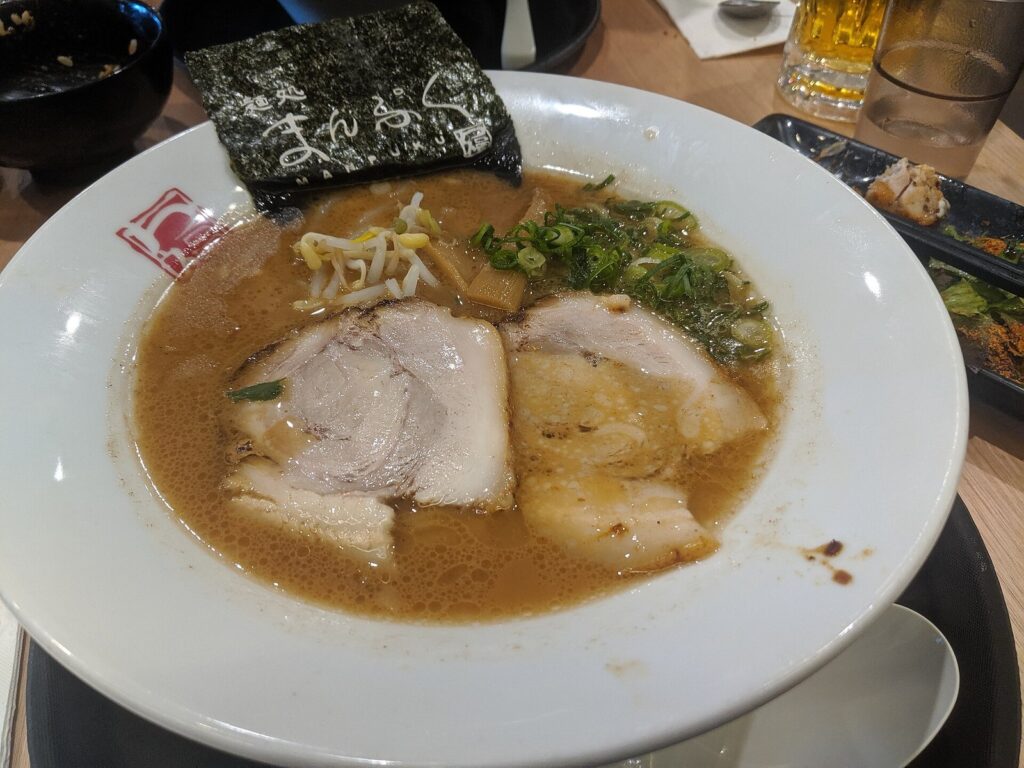
I live in Japan, and ramen is everywhere here in a way that’s easy to take for granted — the chain shop by the station, the vending machine that takes your order, the single-counter place with a line out the door at 11:58am. What’s less obvious, until you look into it, is that almost nothing about ramen is as “traditionally Japanese” as the bowl in front of you suggests. It’s a dish built from Chinese noodles, Japanese resourcefulness, and one man’s obsession with solving hunger after a war — and the instant version of it may be the single most consumed food invention of the 20th century.
The quick answer
- Ramen descends from Chinese wheat-noodle dishes brought to Japan by Cantonese immigrants in the late 1800s, concentrated in Yokohama’s Chinatown.
- It was originally called shina soba (“Chinese soba”) or chuka soba, not “ramen” — that name only became standard after World War II.
- Postwar food shortages and American wheat imports turned noodle stalls into a cheap, filling staple across Japan in the late 1940s and 1950s.
- Momofuku Ando invented instant ramen in 1958 and Cup Noodles in 1971, both still made by Nissin today.
- Ramen split into strong regional styles — Sapporo miso, Hakata tonkotsu, Kitakata shoyu, and more — each tied to a specific city’s broth and noodle preferences.
- In 2015, Tokyo’s Tsuta became the first ramen shop anywhere to earn a Michelin star.
- Instant noodles now account for roughly 124 billion servings eaten worldwide every year, more than any other country’s noodle export.
From Canton to Yokohama
Ramen’s story starts not in Japan but in Guangdong province, China. When Japan opened its ports to foreign trade in the 1850s and 1860s, Chinese merchants and laborers settled in treaty port cities, and Yokohama’s Chinatown — still the largest in Japan today — became the center of that community. Chinese cooks there served a simple wheat-noodle soup to homesick immigrants and curious locals alike: thin noodles in a light broth, topped with sliced pork and scallions. The Japanese called it shina soba, using an old word for China that later fell out of favor, or chuka soba (“Chinese-style soba”), even though the noodles had nothing to do with buckwheat soba at all.
Through the early 20th century the dish spread from Yokohama to Tokyo and other cities, carried by street vendors who pushed noodle carts through neighborhoods at night, ringing a distinctive horn to announce themselves. It stayed a working-class food — cheap, hot, and filling — rather than anything resembling the destination dining it’s become today.
Hunger, wheat, and the birth of a national dish
The transformation into something recognizably modern happened after 1945. Japan’s cities were flattened, food was scarce, and American flour aid flooded in as part of postwar reconstruction. Wheat was suddenly more available than rice in many places, and black-market noodle stalls sprang up around train stations and bombed-out lots to feed people who had almost nothing. These stalls are where the dish got cheap, where regional cooks started improvising with whatever broth ingredients they could find, and — by most accounts — where the word “ramen” itself started to replace shina soba in common use during the 1950s, as the China-referencing name became politically and socially outdated.
This is also the period when ramen stopped being one dish and became dozens. A bowl in Sapporo, Hokkaido, developed a rich miso-based broth suited to the cold winters there. Hakata, in Fukuoka, built its reputation on a cloudy, intensely porky tonkotsu broth with thin, fast-cooking noodles designed for a quick lunch. Kitakata, a small city in Fukushima prefecture, became known for a lighter shoyu broth and thick, curly noodles. None of this was centrally planned — it was shops competing block by block, city by city, each claiming a regional identity that tourists and food writers only started cataloguing decades later.
Momofuku Ando and the instant noodle
The single biggest leap in ramen’s history, in terms of sheer reach, came from one entrepreneur rather than from any restaurant. Momofuku Ando, the Taiwanese-born founder of a small Osaka food company called Nissin, had watched long lines form outside noodle stalls in the postwar years and became convinced that ramen should be something people could make at home in minutes, without a cook or a simmering pot of broth. After experimenting in a backyard shed, he found that flash-frying noodles in oil dehydrated them in a way that let them rehydrate almost instantly in hot water. On August 25, 1958, Nissin released Chikin Ramen, the world’s first commercial instant noodle product.
It was an immediate hit, and Ando kept iterating. In 1971, he packaged dried noodles in a heat-resistant foam cup with a foil lid, creating Cup Noodles — a product needing nothing but hot water and no bowl at all. Instant noodles were exported from Japan that same decade and never really stopped spreading. Today, the World Instant Noodles Association estimates global demand at roughly 124 billion servings a year, with China and Hong Kong, Indonesia, and India now eating far more of them than Japan itself does. Ando’s invention outgrew the country that made it.
If you want to see where this part of the story is preserved, the Cupnoodles Museum in Yokohama (general admission 500 yen, open 10:00–18:00, closed Tuesdays) sits close to the Chinatown where the whole dish began, and lets you build your own custom cup of noodles on-site. A second, larger branch in Ikeda, Osaka — near Momofuku Ando’s original workshop — has free entry and a similar make-your-own noodle factory for 500 yen.
From survival food to Michelin star
For most of the 20th century, ramen stayed firmly in the category of cheap, fast, unpretentious food — the opposite of the multi-course kaiseki dining Japan is also known for. That started to change in the 1980s and 1990s as a new generation of shop owners began treating broth-making the way a French chef might treat a sauce: simmering bones for a full day, sourcing specific soy varieties, obsessing over noodle thickness down to the millimeter. Ramen guidebooks and rankings appeared, and shops began building cult followings with lines that could stretch for hours.
That culinary ambition reached an unlikely peak in December 2015, when Tsuta, a tiny Tokyo shop using soy sauce aged for two years in Wakayama cedar vats, became the first ramen restaurant anywhere in the world to receive a Michelin star. It wasn’t a one-off either; a handful of other Tokyo ramen shops have since been Michelin-recognized, cementing ramen’s unusual double life as both a budget lunch counter staple and, in rare cases, destination dining that rewards a reservation.
FAQ
Is ramen originally Japanese or Chinese? Both, depending on what you mean. The wheat noodles and soup format trace directly to Chinese immigrant cooking introduced in Yokohama in the late 1800s. The regional broths, the postwar noodle-stall culture, and instant ramen are all genuinely Japanese innovations built on top of that Chinese foundation.
Why was it called “shina soba” instead of ramen? Shina was a common word for China at the time, and the dish was marketed honestly as a Chinese import. The word fell out of use after World War II as it took on a negative connotation, and “ramen” — likely adapted from the Chinese word lamian (pulled noodles) — became the standard term instead.
When did instant ramen get invented? Momofuku Ando’s company Nissin released Chikin Ramen, the first instant noodle product, on August 25, 1958. Cup Noodles followed in 1971.
Which ramen style should I try first in Japan? That depends more on where you’re traveling than history — Hakata-style tonkotsu in Fukuoka, miso ramen in Sapporo, and shoyu ramen in Tokyo are the three most distinct regional starting points. Types of Ramen in Japan has a fuller breakdown of the styles and how to order.
The verdict
Ramen’s history is a good reminder that Japan’s most iconic foods aren’t always ancient — sushi took over a century to go from fermented fish to fine dining, and ramen’s entire arc, from Yokohama Chinatown stall to instant noodle megabrand to Michelin star, happened in roughly 140 years, with most of the interesting part compressed into the postwar decades. None of that history changes how you order a bowl, but it’s a useful thing to know the next time you’re slurping noodles at a counter in Fukuoka or Sapporo: you’re eating something that’s been reinvented by nearly every generation that’s touched it.
Written from Japan by the Wayfarer Japan team — real routes, real prices, and the details that only come from living here.
Featured image: “RamenSyd” by MDRX, CC BY-SA 4.0, via Wikimedia Commons