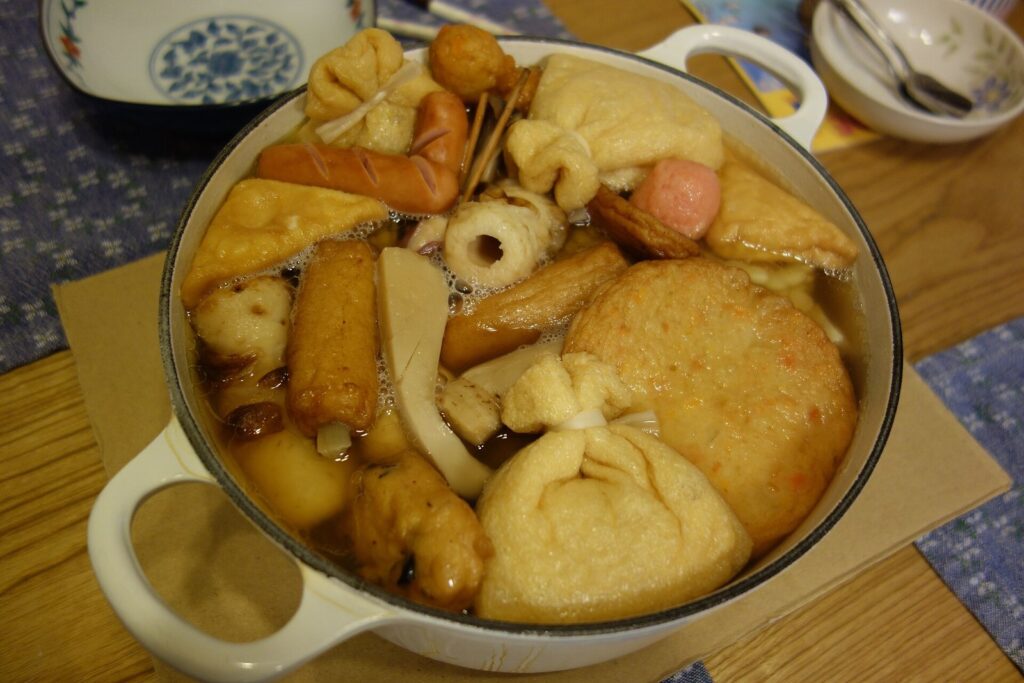
I live in Japan, and I know winter has arrived not from a weather app but from the smell of dashi drifting out of the convenience store by the register. That simmering metal tray of oden, and the cast-iron pot of nabe on a restaurant table a few weeks later, are two of the most ordinary and most loved things about a Japanese winter. Neither is flashy. Both are everywhere. If you’re visiting between late autumn and early spring, you will run into one or both, often without meaning to.
The quick answer
- Oden is a one-pot dish of ingredients — daikon radish, boiled eggs, konjac, fish cakes, skewers — simmered for hours in a soy-and-dashi broth. You’ll find it at convenience stores, street stalls, and dedicated restaurants.
- Nabe (short for nabemono, “things in a pot”) is the broader category of Japanese hot pot, cooked and often eaten tableside, with regional specialties like sukiyaki, shabu-shabu, chanko-nabe, kiritanpo-nabe and motsunabe.
- Convenience store oden season typically runs from around September through March; it’s one of the few hot, ready-to-eat meals you can grab at 7-Eleven, Lawson or FamilyMart for roughly ¥100–200 per piece (prices vary by chain and item — always check the register display).
- Nabe is usually a shared, sit-down meal, not grab-and-go, and it’s one of the most social ways to eat in Japan in winter.
- Neither dish requires a reservation or a special trip — they’re woven into daily life, which is part of why they’re worth understanding rather than skipping past.
Where oden actually comes from
Oden’s roots go back further than most tourists assume. Its ancestor is dengaku-dofu, a Muromachi-period (1333–1573) snack of tofu skewered on sticks and coated in sweet miso, grilled over a fire. “Dengaku” originally referred to the music and dance performed at rice-planting festivals; court ladies reportedly nicknamed the skewered-tofu snack “o-dengaku,” which eventually shortened to “oden.”
By the Edo period, dengaku had spread from street stalls alongside grilled dango and unagi, and expanded beyond tofu to include vegetables and, in Osaka, blocks of konnyaku (konjac) prepared the same grilled-and-miso-topped way. The decisive shift came later, when a version called nikomi dengaku (“simmered dengaku”) swapped the miso glaze for a broth of soy sauce, sugar and mirin. Sometime between the late 1800s and early 1900s, cooks started boiling a whole mix of ingredients together in that dashi-based broth rather than grilling them individually — and the dish we now call oden was born.
That history explains why oden still feels like street food even in its most modern form: a convenience store register, a steaming metal tray, a simple paper cup. It was never meant to be fussy.
What’s actually in the pot
A typical oden tray holds a rotating mix of:
- Daikon radish — simmered until it turns translucent and soaks up the broth; often considered the dish’s signature piece.
- Boiled eggs — simmered long enough that the yolk firms up and takes on the broth’s flavor.
- Konjac (konnyaku) — a chewy, almost flavorless gel that carries whatever broth it sits in.
- Fish cakes (chikuwa, hanpen, satsuma-age) — processed fish paste in different shapes and textures, mild and slightly sweet.
- Skewered items — beef tendon, rolled cabbage, tofu pouches stuffed with mochi, and other regional add-ins.
Convenience stores sell these à la carte — you pick a container, use tongs to add whatever looks good, and pay by the piece. It’s genuinely one of the easiest “real” hot meals for a traveler to order with zero Japanese, since you can just point.
Nabe: the same idea, at the table
Where oden is individual and often solitary — eaten standing at a stall, or alone on a cold walk home with a convenience store cup — nabe is built around sharing. A pot of broth sits on a portable burner at the center of the table, ingredients go in raw, and everyone eats as things finish cooking. It’s a format that turns dinner into something closer to a slow, communal activity, and it’s one of the more memorable ways to eat with Japanese friends or coworkers in the colder months.
A few regional nabe styles worth knowing:
- Sukiyaki — thin-sliced beef simmered in a sweet soy-mirin-sugar broth, traditionally dipped in raw egg before eating. One of the oldest and most recognizable nabe dishes, it became a celebration meal during the Meiji era when beef consumption spread.
- Shabu-shabu — paper-thin meat swished (“shabu-shabu” mimics the sound) through a lighter, clearer broth for just a few seconds, then dipped in sesame or ponzu sauce. It’s a 20th-century invention, newer than it feels.
- Chanko-nabe — the dish most associated with sumo wrestlers, who eat it in enormous quantities to bulk up. The name likely comes from “chanko,” a term for the cook (often a senior wrestler) who prepared stable meals. It’s less about any single recipe and more about volume and protein.
- Kiritanpo-nabe — a specialty of Akita Prefecture, made with kiritanpo: mashed rice molded onto cedar skewers and lightly grilled, then simmered with chicken and vegetables in soy-based broth.
- Motsunabe — a Fukuoka specialty built on beef or pork offal, garlic chives and cabbage, in a broth seasoned with soy, miso, salt, or even kimchi for a spicier version.
If you want to try a few of these without committing to a restaurant specializing in just one, many izakaya add nabe to the menu specifically in winter — it’s worth asking what’s seasonal, the same way you’d ask about a daily special anywhere else.
FAQ
Is convenience store oden safe/good for tourists to try? Yes — it’s one of the most approachable hot foods in any konbini. Point at what you want, staff bag it with chopsticks and a little packet of mustard, and you eat it on the spot or take it back to your hotel.
How much does oden cost? Individual pieces generally run about ¥100–200 depending on the chain and ingredient (fish cakes and skewers tend to cost more than daikon or konjac). This is approximate and worth checking at the register display, since chains run seasonal sales and prices shift.
Can I eat nabe alone, or is it always a group thing? It’s traditionally a shared dish, but plenty of restaurants now serve single-portion nabe sets (hitori nabe) for solo diners, especially in cities.
When is “oden season”? Convenience stores generally start stocking oden around September as the weather cools and keep it through winter into early spring, though exact timing varies by chain and by how early a cold snap arrives.
Is nabe spicy? Not by default — most broths are soy-, miso-, or dashi-based and mild. Spicier versions (like kimchi-style motsunabe, or the increasingly popular “moto-yu” hot-and-sour style pots) exist but are the exception, not the rule.
The verdict
Oden and nabe aren’t tourist attractions, and that’s exactly why they’re worth knowing about. One is the thing you grab on a cold night walking back from Shinjuku Station because the convenience store smelled too good to pass up; the other is the dinner a Japanese friend might invite you to share around a single pot in January. Neither needs a booking, a guidebook entry, or a special trip — just cold weather and a willingness to try something simmering.
Written from Japan by the Wayfarer Japan team — we live here and write from first-hand experience.
Featured image: “Oden (22231246201)” by pelican, CC BY-SA 2.0, via Wikimedia Commons