I live not far from Nihonbashi, the bridge that has marked the zero-kilometre point for every road in Japan since 1603. The current bridge is stone, built in 1911, and sits under an expressway that Tokyo built over the river for the 1964 Olympics rather than pay to buy the land. Stand on it and you are standing on the exact spot Tokugawa Ieyasu chose as the centre of his new capital, in a city that has since been leveled by fire, earthquake and bombing and rebuilt from the ground up more than once. Almost nothing here looks four hundred years old. Almost everything here is laid out the way it was four hundred years ago.
That gap — a city with barely any old buildings but an intact old skeleton — is the whole story of Tokyo, and once you can see it, the megacity looks different.
The quick answer
- Tokyo was called Edo until 1868. It began as a minor fishing settlement and castle town, not a planned capital.
- Ota Dokan built the first real castle here in 1457, on a strategic rise above the marshy Sumida River delta in Musashi Province.
- Tokugawa Ieyasu made it his base in 1590 and the shogunate’s capital in 1603, and Edo grew into the largest city in the world by the 1700s — over a million people, while London and Paris were still under half that.
- The emperor moved there and renamed it Tokyo (“Eastern Capital”) in 1868, ending 265 years of Tokugawa rule and Kyoto’s run as the seat of government.
- Tokyo has been almost completely destroyed twice in the last century: the 1923 Great Kanto earthquake and fires killed over 100,000 people, and the March 1945 firebombing killed roughly the same number in a single night.
- It rebuilt fast both times, and the 1964 Olympics marked its arrival as a modern global city. Tokyo proper now holds about 14 million people; Greater Tokyo, at roughly 37 million, is the largest metropolitan area on the planet.
A fishing village becomes a castle town
Before it was anything else, the area was a shallow bay edge and marshland where the Sumida River met Edo Bay — good for fishing, bad for building. The name Edo itself likely means something close to “estuary” or “cove entrance,” which tells you what the place actually was.
The first meaningful fortification went up in 1457, when a local warlord and scholar named Ota Dokan built a castle on the high ground overlooking the marsh. It was a modest, sensible outpost for over a century, one castle town among many in a fragmented, warring Japan — nothing that suggested it would ever outgrow Kyoto, Osaka or the old capital cities of the west.
The turn came in 1590, when the warlord Tokugawa Ieyasu was handed the Kanto region as his territory and chose Edo, of all the available towns, as his base. Historians still debate whether this was a demotion by his rival Toyotomi Hideyoshi or a shrewd long game by Ieyasu himself. Either way, Ieyasu spent the rest of his life building it up, and after he won the decisive battle of Sekigahara in 1600 and was named shogun in 1603, Edo stopped being a provincial castle town and became the military capital of all Japan — even though the emperor, and the country’s ceremonial capital, stayed in Kyoto.
Tokugawa’s capital: how Edo became the world’s biggest city
What made Edo swell wasn’t trade or geography so much as a deliberate policy. Under the sankin-kotai (“alternate attendance”) system, every regional lord in the country was required to maintain a residence in Edo and spend roughly every other year living there, hostage-style, leaving family behind when he returned home. Multiply that by hundreds of feudal domains, add their retainers, servants and suppliers, and Edo filled with samurai households almost overnight.
Merchants, craftsmen and laborers followed the money, and by the early 1700s Edo had passed a million residents — very likely the largest city on Earth at the time, at a moment when London and Paris were still well under half that size. Out of this crowded, cashed-up, largely male population grew a distinct urban culture: kabuki theatre, the woodblock prints known as ukiyo-e, and a brash, quick-witted local identity — the Edokko, or “child of Edo” — that Tokyoites still half-jokingly claim today. Fire was the price of all that density: wood-and-paper construction packed tight meant Edo burned constantly, so often that residents called fires “the flowers of Edo.”
Kyoto kept the emperor and the old aristocracy. Edo had the money, the population and the guns. For two and a half centuries, Japan effectively ran on two capitals.
From Edo to Tokyo: the Meiji Restoration
That arrangement ended in 1868. The Tokugawa shogunate collapsed, imperial rule was formally restored, and the young Emperor Meiji relocated from Kyoto to the shogun’s former castle — the site of today’s Imperial Palace. The city was renamed Tokyo, literally “Eastern Capital,” and for the first time in its history Japan’s political, military and now imperial center were the same place.
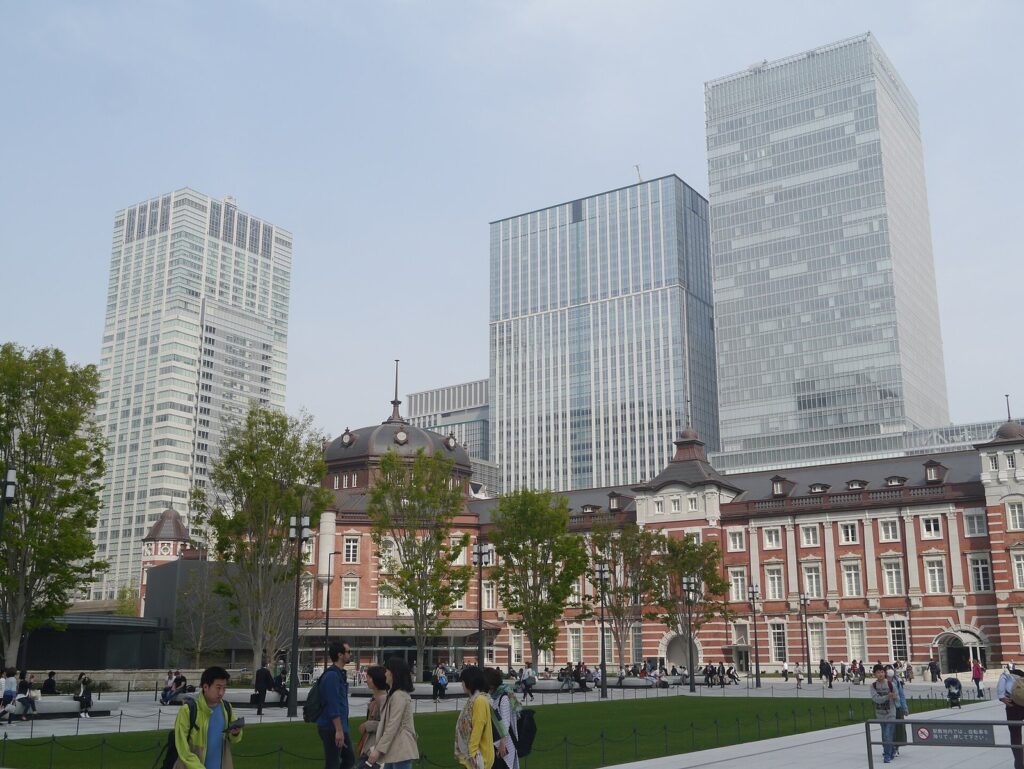
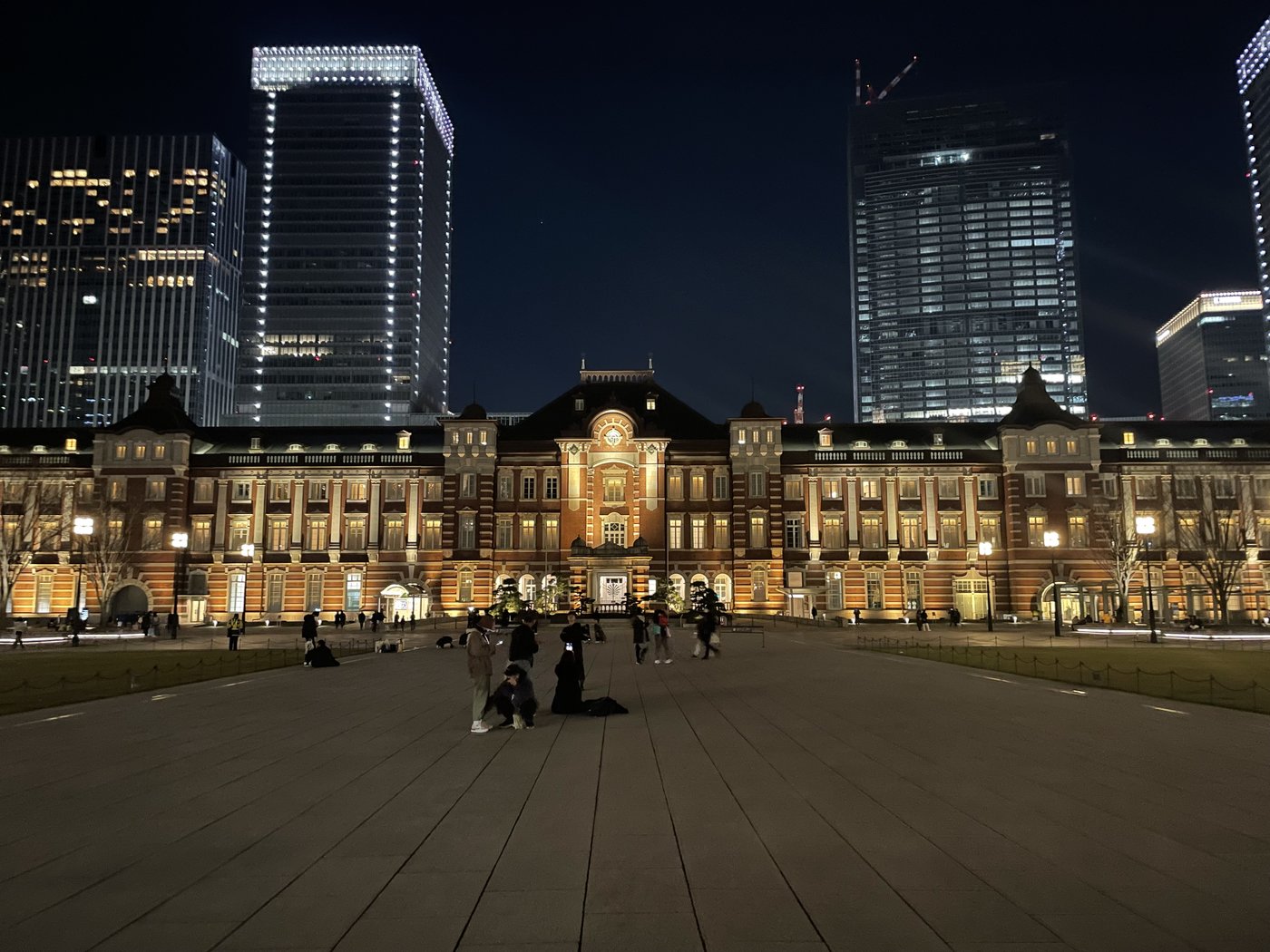
The following decades were a deliberate sprint to look modern to the Western powers Japan was suddenly negotiating with as equals. Ginza was rebuilt in brick after an 1872 fire, gas lamps and horse-drawn trams appeared, and Japan’s first railway opened between Tokyo and Yokohama in 1872. Tokyo Station, an ornate red-brick Beaux-Arts building that still stands as the city’s grandest piece of Meiji-era architecture, opened in 1914 as the physical proof that Tokyo now belonged among the world’s capitals.
Two destructions in one century
Tokyo’s twentieth century was defined by rebuilding from almost nothing, twice.
On 1 September 1923, the Great Kanto Earthquake struck at magnitude 7.9 near midday, when cooking fires were lit across the city. The quake itself was survivable for many; the firestorms that followed were not. Over 100,000 people died, most of them in the fires rather than the collapse, and roughly 370,000 homes were destroyed. Tokyo rebuilt with wider roads and some fire breaks, but wood construction returned quickly, and density crept back.
Then came the war. On the night of 9–10 March 1945, American B-29s carried out a deliberate low-altitude incendiary raid on Tokyo’s densely packed wooden neighborhoods. The firebombing killed an estimated 100,000 people in a single night — one of the deadliest bombing raids in history, on any city, from any war — and burned out roughly 16 square miles of the capital. By the end of the war, much of Tokyo was ash.
The postwar rebuild and the 1964 Olympics
What followed was reconstruction on a scale that reshaped the city’s geography rather than just its buildings. Rivers and canals were paved over or built above with expressways, in the same rushed, cost-driven spirit that Ieyasu had once used to fill in Edo’s marshes. The Shinkansen made its debut in 1964, running between Tokyo and Osaka in time for the Tokyo Olympics that October — an event both countries and Tokyo itself treated as proof that the city, and the nation, had come all the way back. The monorail to Haneda Airport, new expressways and a wave of new hotels were all built in the same rush.
From there the growth compounded: the postwar boom, the bubble-era construction of the 1980s, and decades of incremental rebuilding turned Edo’s old center into the dense high-rise skyline visitors see today. Tokyo Metropolis now holds about 14 million people, and Greater Tokyo — the metropolis plus its surrounding prefectures — is home to roughly 37 million, making it the most populous metropolitan area in the world.
Reading Edo in today’s Tokyo
Almost none of Edo’s wooden city survives — fire, earthquake and bombs saw to that — but its shape does. The Imperial Palace sits inside the moats of the old Edo Castle, and you can still trace parts of the original defensive spiral of canals around it. The Yamanote Line loosely follows the old edge between the high ground where samurai lived (Yamanote, “hand of the mountain”) and the low-lying merchant districts by the river (Shitamachi, “downtown”), a distinction Tokyoites still use to describe neighborhood character. Asakusa’s Senso-ji temple actually predates Edo Castle by eight centuries and survived close to its old layout, which is part of why the area feels different from the rest of the city.
If Tokyo’s relationship to its own past interests you, our guide to The History of Kyoto: 1,000 Years as Japan’s Capital covers the city Tokyo took the job from, and Japanese Gardens: The Hidden Meaning Behind the Design explains a design tradition that survived the rebuilding intact even where the buildings didn’t. For visiting now, Tokyo Travel Guide for First-Timers (2026) and Where to Stay in Tokyo cover the practical side.
FAQ
When exactly did Edo become Tokyo? In 1868, when the Meiji Restoration ended shogunate rule and the emperor relocated from Kyoto. The renaming was part of the same announcement.
Was Tokyo always Japan’s capital? No. Kyoto was the imperial capital for over a thousand years. Edo was the shogunate’s military and administrative capital from 1603, but only became the single, undisputed capital in 1868.
Is anything physically left from the Edo period? Very little in central Tokyo, because of the 1657 Great Fire of Meireki, the 1923 earthquake and the 1945 bombing. Scattered gardens, gates, moats and a handful of temples survive; most “Edo-period” buildings you can visit elsewhere in Japan, like castles in other cities, actually fared better than Edo itself.
Why is Kyoto called the old capital but not Tokyo? Kyoto held the title for over a millennium before Tokyo existed as a capital at all, and it was never destroyed on Tokyo’s scale, so far more of its old fabric survived visibly.
How big is Tokyo today, exactly? Tokyo Metropolis has around 14 million residents. Greater Tokyo, including neighboring prefectures like Kanagawa, Saitama and Chiba, is around 37 million — the largest urban agglomeration in the world.
The verdict
Tokyo’s defining trait isn’t its age — it’s how many times it has started over. A fishing village became a shogun’s capital through sheer policy, that capital became an emperor’s city through revolution, and that city was leveled twice in one century and rebuilt both times into something bigger than before. What you’re walking through today is not four centuries of accumulated history so much as four centuries of the same address, rebuilt again and again on the same footprint Ota Dokan picked out on a marshy rise above the bay in 1457.
Written from Japan by the Wayfarer Japan team.
Featured image: “Marunouchi & Tokyo Station 1” by Zairon, CC BY-SA 4.0, via Wikimedia Commons