I live in the Kansai region, and Kansai Airport to Osaka is a trip I make often enough to have a firm opinion on it. It is one of the easiest airport transfers in Japan on paper, but first-time visitors still get tangled up choosing between the four different companies that all sell the same journey. Here is what actually gets you into the city fastest, and what saves you the most money, sorted out plainly.
Osaka is the reason Kansai Airport (KIX) exists in the first place, sitting on reclaimed land in Osaka Bay specifically to serve the city. That means, unlike some airport transfers in Japan, you are never more than about an hour from downtown Osaka no matter which option you pick. The real decision is whether you want speed, a guaranteed seat, or the lowest possible price.
The quick answer
- Cheapest and no reservation needed: the Nankai Airport Express to Namba, roughly ¥930 one-way, about 45 minutes.
- Fastest and most comfortable: the Nankai Rapi:t limited express to Namba, about 38 minutes, with a reserved seat.
- Best for Osaka Station / Umeda: JR’s Kanku Kaisoku (Kansai-Airport Rapid Service), one seat to Osaka Station, no surcharge.
- Easiest with heavy luggage: the airport limousine bus, door-to-door with no stairs or transfers, about ¥1,800.
- Fastest with a group or very late arrival: taxi, roughly ¥18,000–¥23,000 split between passengers.
- All prices and journey times are approximate for 2026 and change occasionally — confirm the current fare on the operator’s site or app before you travel.
Nankai Electric Railway: the classic route to Namba
Kansai Airport sits at the southern end of the Nankai Line, and Nankai has been running trains straight into Namba, in the heart of southern Osaka, since the airport opened. There are two ways to ride it.
The Nankai Airport Express is a regular-fare rapid train with no reserved seats and no surcharge. It costs around ¥930 one-way and takes about 45 minutes to Namba, stopping at a handful of stations along the way. You can walk straight onto the platform with an ICOCA or Suica-type IC card and never touch a ticket machine — this is the option I send visiting friends toward when they are travelling light and don’t mind standing for part of the ride.
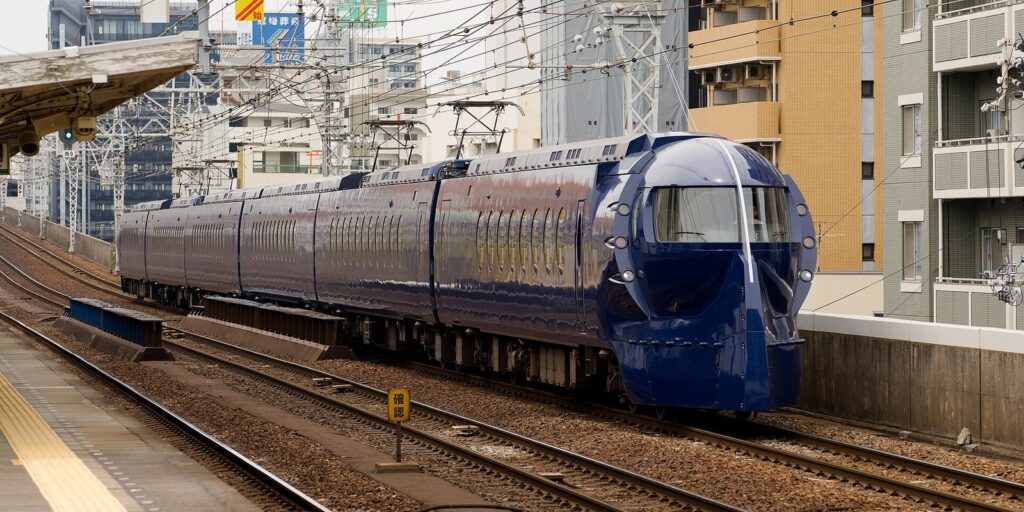
The Rapi:t is Nankai’s limited express, instantly recognisable by its retro-futuristic rounded nose. It runs nonstop or near-nonstop to Namba in about 38 minutes, with assigned seats in either a Regular or Super Seat car. You pay the base fare plus a limited express charge — regular seats add about ¥700, working out to roughly ¥1,630 total. Nankai also sells a bundled Kanku Toku-Wari Rapi:t ticket that covers the fare and the seat charge together for about ¥1,560, which is usually a little cheaper than paying separately, and slightly less again if bought cashless through the ticketless service.
👉 Klook for the discounted Nankai Rapi:t ticket, which can be booked online before you land and exchanged at the airport counter.
JR West: one seat to Osaka Station or Tennoji
If your hotel is north of the river, around Umeda or Osaka Station, JR is usually the more direct choice. The Kanku Kaisoku (Kansai-Airport Rapid Service) runs directly from the airport to Osaka Station via Tennoji and Shin-Imamiya, with no limited express charge — you just pay the regular JR fare, which comes to roughly ¥1,210 to Osaka Station and a bit less, around ¥1,080, if you are only going as far as Tennoji. The ride takes about an hour to Tennoji and closer to 70 minutes through to Osaka Station, since it makes more stops than the Nankai limited express.
There is also the Haruka limited express, but it is really built for Kyoto and Shin-Osaka passengers; it does stop at Tennoji, so it can work if that is your neighborhood, but it is not the efficient choice if Osaka Station or Namba is your actual destination — you would be paying a limited express surcharge to save only a few minutes over the Kanku Kaisoku.
One quirk worth knowing: JR Namba station, near the Namba/Dotonbori area, is not served directly by the airport line. You would need to change at Shin-Imamiya onto the Yamatoji Line, which adds a wait and a platform change. For that part of town, Nankai’s train into Namba proper is simpler.
Limousine bus: no stairs, no transfers
The Kansai Airport Transportation Enterprise (KATE) limousine bus is the easiest option if you are travelling with a stroller, a stiff back, or more suitcases than hands. Your luggage goes in a cargo hold underneath the bus, and you sit for the entire ride with nothing to carry between platforms. Buses run to both Osaka Station/Umeda and to Namba (OCAT), with the one-way fare to Osaka Station around ¥1,800 and the trip taking roughly 60 minutes to Terminal 1, a little longer from Terminal 2. It is not the cheapest option, but for anyone who has just landed after a long-haul flight, the lack of stairs and transfers is worth the extra yen.
👉 Klook for airport limousine bus tickets to central Osaka, bookable in advance.
Taxi: fast, private, and priced for it
A taxi from Kansai Airport into central Osaka typically runs somewhere in the ¥18,000–¥23,000 range depending on traffic and exact destination, with the ride itself taking 45 to 60 minutes. That sounds steep next to a ¥930 train ticket, but split four ways among a family or group arriving on a late flight after the trains have stopped for the night, it can work out close to what everyone would have paid individually on the bus — and it goes directly to your hotel’s front door. Fixed-fare airport taxi services also operate from KIX, which can be worth booking ahead if you want price certainty rather than watching a meter run in traffic.
FAQ
Is there a train that goes straight from Kansai Airport to Osaka without changing? Yes. Both the Nankai Airport Express/Rapi:t (to Namba) and the JR Kanku Kaisoku (to Tennoji and Osaka Station) run directly with no transfer required.
Can I use my ICOCA, Suica or Welcome Suica for these trains? For the regular-fare Nankai Airport Express and the JR Kanku Kaisoku, yes — tap in and out like any other IC card journey. The Rapi:t and Haruka limited express services require a separate reserved-seat ticket in addition to (or instead of) the IC fare, since you are paying for an assigned seat.
Which is better for Namba: Nankai or JR? Nankai. Its line runs straight into Namba station. Reaching JR Namba station from the airport line requires an extra transfer at Shin-Imamiya, so it is rarely the more convenient option for that neighborhood.
Do I need to reserve a seat in advance? Only for the Rapi:t or Haruka limited express services. The regular-fare Airport Express, Kanku Kaisoku and limousine bus can usually be boarded on arrival, though buying the bus ticket online ahead of a late flight guarantees you a seat on a popular departure.
Is the train or the bus faster? The train, in almost every case. The Rapi:t at about 38 minutes is the fastest single option; the bus at around 60 minutes is more comfortable but slower, since it depends on expressway traffic.
The verdict
For most travellers landing at Kansai Airport with normal-sized luggage and a hotel near Namba or Dotonbori, the Nankai Airport Express is hard to beat: cheap, direct, and no reservation to think about. If your hotel is up near Osaka Station or Umeda, take the JR Kanku Kaisoku instead and skip the transfer. Save the Rapi:t for when you want the fastest ride and don’t mind paying a bit more for a guaranteed seat, and save the limousine bus or a taxi for whenever your luggage situation makes stairs and platform changes feel like a bad idea. None of these choices is really wrong — Osaka is simply one of the most airport-friendly cities in Japan to arrive in.
Written from Japan by the Wayfarer Japan team — practical, honest guides for travelers, from someone who actually lives here.
Featured image: “Nankai 50000 series Rapit at Imamiyaebisu Station 2026 dllu” by Daniel Lu ( User:dllu ), CC BY-SA 4.0, via Wikimedia Commons