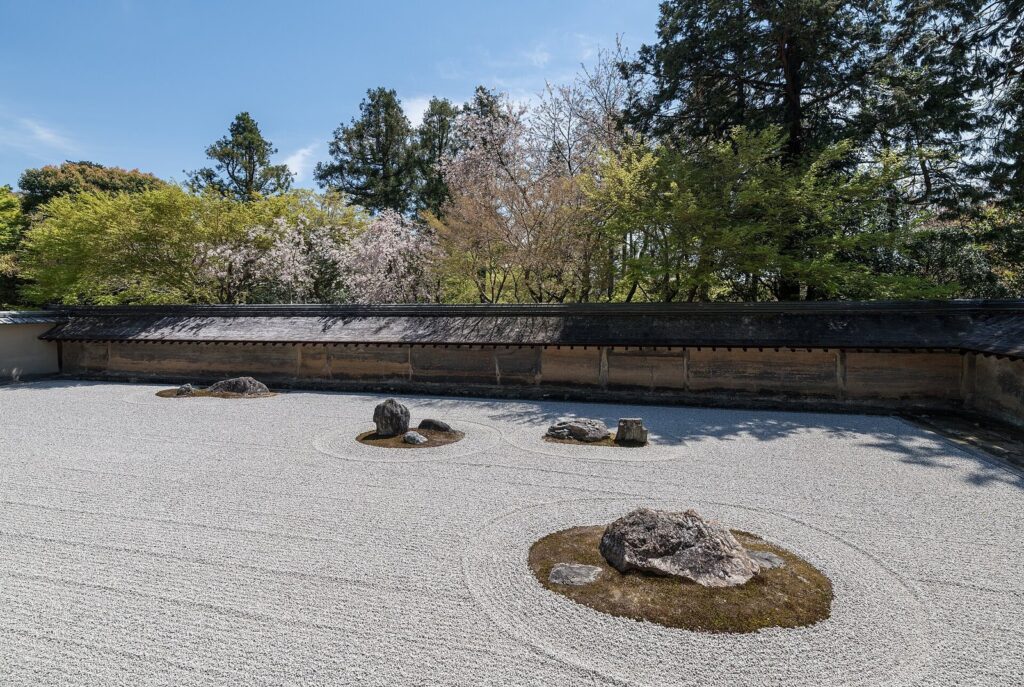
I live in Japan, and one of the questions I get asked most by visiting friends is some version of “so what’s the deal with the gravel gardens?” They’ve seen a photo of Ryoan-ji’s rock garden in a guidebook — fifteen stones on raked white gravel, no flowers, no color — and assume it’s decorative. It isn’t. It’s a diagram of a way of thinking that has quietly shaped an enormous amount of what visitors come to Japan to see: the tea ceremony, the pared-back aesthetic of a ryokan room, even the discipline of a sushi chef. That way of thinking is Zen.
Zen is a school of Buddhism, but it behaves differently from most religions a Western visitor might be used to. It has very little interest in doctrine or scripture and a lot of interest in direct experience — the idea that you can’t think your way to insight, you have to sit still long enough to notice it. That single idea, more than any temple or statue, is what actually explains the gravel.
The quick answer
- Zen (禅, from the Chinese Chan, itself derived from the Sanskrit dhyana, meaning meditation) is a branch of Mahayana Buddhism that arrived in Japan from China in the 12th and 13th centuries.
- Its central practice is zazen — seated meditation — rather than chanting, ritual, or study of scripture.
- Zen was adopted enthusiastically by the samurai class, which is why its fingerprints are all over “traditional” Japanese culture: the tea ceremony, ink painting, swordsmanship, and dry rock gardens (karesansui).
- Famous Zen sites in Kyoto include Ryoan-ji (the rock garden), Daitoku-ji, and Myoshin-ji, several of which offer beginner zazen sessions in English.
- You don’t need to understand Buddhist philosophy to visit a Zen garden — but knowing roughly what it’s “for” changes what you notice.
Where Zen came from
Buddhism itself reached Japan from Korea around the 6th century, developing for centuries alongside — and blending with — the native Shinto tradition, which I’ve written about separately in Shinto vs Buddhism: Japan’s Two Religions Explained. Zen is a later, specific strand within that broader tradition. It developed in China as Chan Buddhism, a fusion of imported Indian meditation practice with existing Chinese Taoist philosophy — which is partly why Zen emphasizes nature, simplicity, and paradox rather than elaborate cosmology.
Zen crossed to Japan in two main waves during the Kamakura period: the monk Eisai brought the Rinzai school from China in 1191, and Dogen founded the Soto school after his own training there in the 1220s. Both still exist today and differ mainly in method. Rinzai leans on koans — unanswerable riddles like “what is the sound of one hand clapping,” designed to short-circuit ordinary logical thinking — while Soto favors shikantaza, or “just sitting,” a quieter, more gradual practice.
Why the samurai loved it
Zen’s arrival in Japan coincided almost exactly with the rise of the samurai as the ruling class, and the two proved a remarkably good fit. A warrior facing the real possibility of death in the next battle had practical use for a discipline that trained the mind to stay calm and present. Zen didn’t ask samurai to believe elaborate doctrines; it asked them to train attention, which is a skill, not a belief. That’s largely why Zen became the semi-official philosophy of Japan’s military and administrative elite for centuries — a thread I cover in more detail in Samurai and Bushido: The Warriors Who Shaped Japan.
That same discipline of trained attention is also why Zen shaped so many Japanese arts that, on the surface, have nothing to do with religion. The tea ceremony, formalized by the Zen-trained tea master Sen no Rikyu, turns making a bowl of matcha into a meditative act — I cover the ritual itself in The Japanese Tea Ceremony: History and Meaning. Swordsmanship, calligraphy, and flower arranging all absorbed the same idea: repeated, disciplined practice of an ordinary action as a way of training the mind, not just the skill.
The gravel garden, explained
So back to Ryoan-ji. A karesansui, or dry landscape garden, uses raked gravel to represent water, and carefully placed rocks to represent mountains or islands — a whole landscape suggested rather than depicted. The point isn’t to admire clever symbolism the way you might read a painting. It’s to give your eyes and mind something spare enough to sit with, so the constant background noise of ordinary thought has a chance to settle. Zen temples in general favor this kind of restraint: unpainted wood, empty space, asymmetry, a single flower instead of a bouquet. That aesthetic has a name of its own, wabi-sabi, which I explain in more depth in Wabi-Sabi: The Japanese Art of Beauty in Imperfection, and it runs through Japanese garden design generally, covered in Japanese Gardens: The Hidden Meaning Behind the Design.
At Ryoan-ji specifically, there are fifteen stones arranged in five groups, and the garden is built so that from any single viewing point on the veranda, you can only ever see fourteen of them at once. Nobody agrees on exactly why, and the temple itself doesn’t offer an official interpretation — which is very on-brand for Zen. The ambiguity is arguably the point: you’re meant to look, not to solve it.
Visiting a Zen temple as a tourist
Most visitors experience Zen through its gardens rather than its practice, and that’s a perfectly good way to encounter it. Ryoan-ji, in northwest Kyoto, is the classic stop: admission is roughly 600 yen for adults, open 8:00 AM–5:00 PM March through November and 8:30 AM–4:30 PM in winter (double-check before you go, since hours shift slightly year to year). Go as early as you can — the veranda facing the rock garden is narrow and fills with tour groups by mid-morning.
If you want to go beyond looking and actually sit zazen, several Kyoto temples run English-friendly sessions for visitors with no experience required — Myoshin-ji’s sub-temples and Daitoku-ji’s Daisen-in are commonly recommended starting points. A monk talks you through posture and breathing before a short sitting period, often followed by matcha and a sweet. Expect the session to run about an hour, and expect your legs to fall asleep. That’s normal, and in a very Zen way, kind of the point — noticing discomfort without immediately reacting to it is the whole exercise.
Wear something you can sit on the floor in, and don’t worry about the “right” outfit — nobody expects visitors to show up in anything special, and if you’re cold, Kyoto has convenience stores and Uniqlo everywhere for an extra layer.
FAQ
Is Zen a religion or a philosophy?
Technically it’s a school of Buddhism, so it counts as a religion, but many practitioners — Japanese and foreign — approach it more as a mental discipline than a set of beliefs. You don’t need to accept any particular doctrine to sit zazen or benefit from it.
What’s the difference between Zen and Shinto?
They’re different traditions that coexist in Japan, often at the same sites. Shinto is Japan’s indigenous belief system, focused on kami (spirits) associated with nature and ancestors, typically housed in shrines with torii gates. Zen is an imported school of Buddhism, practiced in temples, focused on meditation. Many Japanese people move between both without seeing a contradiction — see Shinto vs Buddhism: Japan’s Two Religions Explained for more on how that works.
Can I really do a zazen session with no experience?
Yes. The beginner sessions aimed at tourists assume zero background and usually run about an hour, including instruction. You sit on a cushion (or a chair, at some temples), someone explains posture and breathing, and you sit quietly for two shorter periods rather than one long one.
Why do Zen gardens have no flowers or color?
It’s a deliberate aesthetic choice, not an oversight. Removing color and ornament is meant to strip a scene down to something calm enough to actually look at without your mind wandering off — the same instinct behind minimalist tea rooms and unpainted wood temple halls.
Is Ryoan-ji worth the trip if I only have one day in Kyoto?
If your day is tightly packed with Kiyomizu-dera, Fushimi Inari, and Arashiyama, Ryoan-ji is a bit out of the way and easy to cut. If you have a second day or care specifically about gardens and quiet, it’s worth the detour — just go early. For a broader look at how to prioritize, see Best Things to Do in Kyoto: Temples, Gardens and More.
The verdict
Zen isn’t something you need to study before visiting Japan, but knowing roughly what it’s doing changes a gravel garden from “empty space with rocks” into something you can actually sit with for ten minutes and get something out of. If you have the time, book one of the beginner zazen sessions in Kyoto rather than just photographing a garden from behind a rope — twenty minutes of trying and failing to quiet your mind will tell you more about Zen than any explanation, including this one.
Written from Japan by the Wayfarer Japan team — practical, honest travel advice from people who actually live here.
Featured image: “Kare-sansui zen garden, Ryōan-ji, Kyoto 20190416 1” by DXR, CC BY-SA 4.0, via Wikimedia Commons