I live in Japan, and one of the first things that confused me here was a simple counting problem. The government’s own religious statistics list roughly 86 million Shinto adherents and about 80 million Buddhists, in a country of around 123 million people. The numbers don’t add up because the question is wrong. Ask a Japanese friend whether they are Shinto or Buddhist and you will usually get a shrug, or a laugh, or the honest answer: both, and neither, depending on the day of the year.
That is not evasion. It is an accurate description of how religion works here, and once you understand it, half the things you see on a trip stop being mysterious.
The quick answer
- Shinto is Japan’s indigenous religion: local kami (gods, spirits, forces) tied to specific places, mountains, rivers and families. It has no founder, no scripture, and no single doctrine.
- Buddhism arrived from the Asian mainland in the 500s via Korea, bringing scripture, philosophy, temples, statues and an organized priesthood.
- They are not rivals. For over a thousand years they were formally merged, and most Japanese people still use both without contradiction.
- The everyday split is by life event: Shinto handles birth, childhood, weddings and the New Year; Buddhism handles death, funerals and the ancestors.
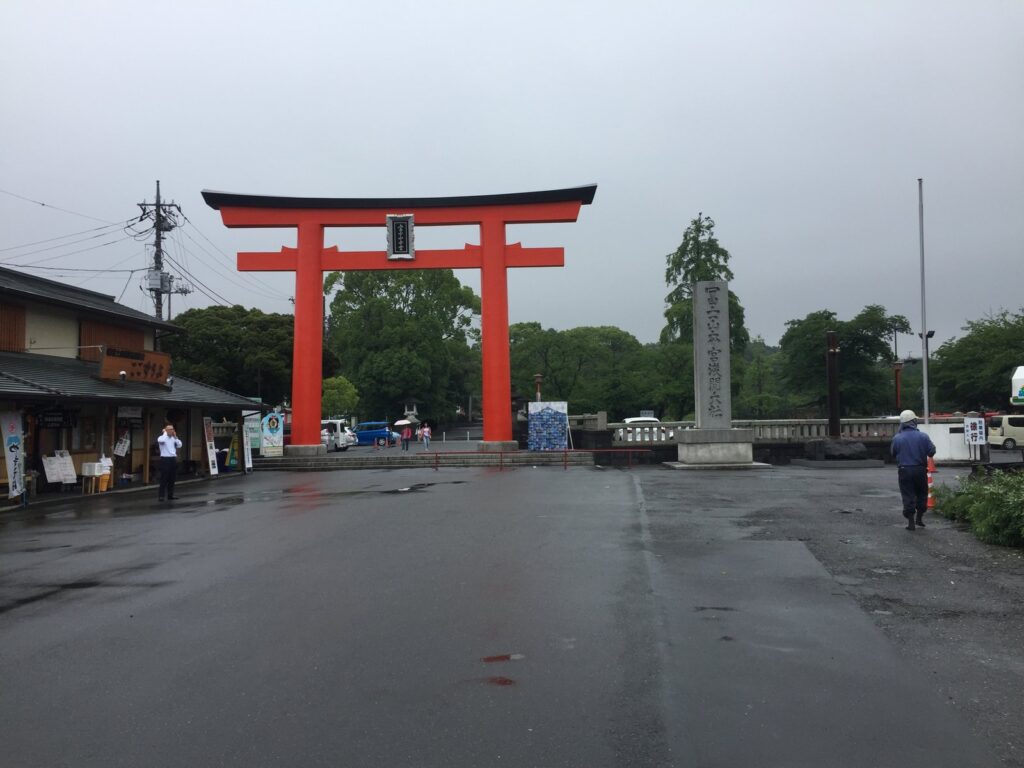
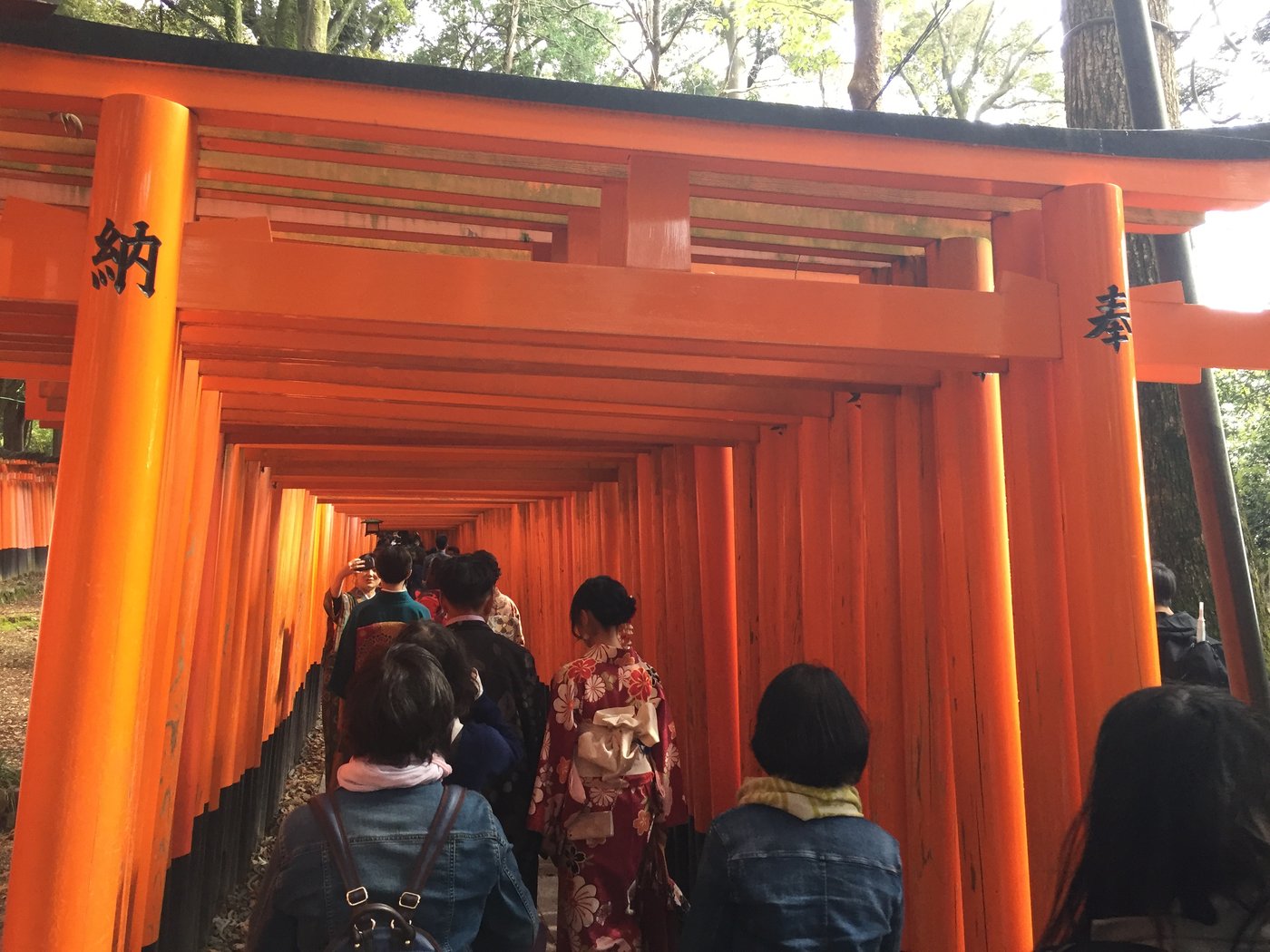
- The visual test is the gate: a torii means a shrine (Shinto). A heavy roofed gate with statues, incense and a graveyard means a temple (Buddhism).
- They were forcibly separated in 1868 by government decree, which is why the two look distinct today. Before that, they routinely shared the same grounds.
The division of labor, by calendar
The clearest way to see it is to follow a Japanese life through the year rather than through a belief system.
A baby is taken to a shrine at about a month old (omiyamairi). At ages three, five and seven, children go back to a shrine in formal dress for shichi-go-san. Weddings, if they are traditional, are Shinto — though a large share of couples now choose a chapel-style ceremony purely for the look of it, with no Christian faith involved. Exam season fills shrines with students buying academic charms. New Year’s hatsumode is a shrine event on a scale that is genuinely hard to convey: Meiji Jingu in Tokyo alone draws somewhere around three million visitors over the first three days of January.
Then somebody dies, and the family calls a Buddhist priest. The overwhelming majority of Japanese funerals are Buddhist. The deceased receives a posthumous Buddhist name, the ashes go into a family plot at a temple, and the household keeps a small altar (butsudan) where the ancestors are greeted. During Obon in August the ancestors are believed to come home for a few days, which is why the entire country travels at once and why train tickets vanish in mid-August. See Japan in Summer for what that means practically.
On December 31, temples ring their great bells 108 times. A few hours later, the same people are at a shrine buying an arrow-shaped talisman. Nobody experiences this as switching teams.
Where each one came from
Shinto has no origin date because it was never founded. It is the accumulated ritual practice of an agricultural society that treated striking natural features as inhabited: a waterfall, an old cedar, a mountain, a rock. Kami are not omnipotent creator gods. They are closer to presences with jurisdiction — over a village, a rice crop, a craft, a clan. The imperial line traces itself to the sun kami Amaterasu, the mythology I cover separately in Shrines, Shinto and Japanese Mythology. The word “Shinto” itself only became necessary once there was something to distinguish it from.
Buddhism arrived as a diplomatic gift. The traditional date is 538 (some sources say 552), when the Korean kingdom of Baekje sent an image of the Buddha and sutras to the Japanese court. It caused an immediate political fight: the Soga clan backed the foreign religion, the Mononobe opposed it, and the Soga won. Prince Shotoku became its patron, and Horyu-ji near Nara — founded in 607, rebuilt in the early 700s — still contains what are generally considered the oldest surviving wooden buildings in the world.
What Buddhism brought was not just belief but infrastructure: writing, continental art, architecture, medicine, and a state-scale project in the form of the Great Buddha at Todai-ji, dedicated in 752. Visit Nara and you are standing in the physical evidence of that decision.
The thousand years they were the same thing
Here is the part that surprises most visitors. From roughly the 700s to 1868, Shinto and Buddhism were not two religions in practice. They were one system.
The theological glue was a doctrine called honji suijaku: the local kami were understood as Japanese manifestations of buddhas and bodhisattvas. Hachiman, a war kami, was also a bodhisattva. Shrines built Buddhist temples inside their grounds (jingu-ji); temples enshrined kami as guardians. Buddhist monks conducted rituals at shrines. A pilgrim in 1600 walking up to a mountain sanctuary would not have been able to draw the line you are being asked to draw today, and would not have wanted to.
Then came 1868. The new Meiji government needed a national identity centered on the emperor, and issued the shinbutsu bunri order — the separation of kami and buddhas. Shrines were required to expel Buddhist objects, priests and buildings. What followed was worse than the policy intended: a wave of anti-Buddhist violence called haibutsu kishaku in which temples were closed, statues smashed or sold abroad, and countless artifacts lost. Estimates of temples destroyed run into the tens of thousands. Shinto was then reorganized into a state ideology that lasted until 1945, when the Occupation dismantled it and the emperor publicly renounced his divine status.
So the tidy distinction you can see today — shrine over here, temple over there — is not ancient. It is about 150 years old, and it was imposed by a government. Traces of the older arrangement survive everywhere if you look: pagodas on shrine hillsides, torii gates standing inside temple precincts, and mountains like Koya, Hiei and Dewa where the two never fully came apart.
Telling them apart, in ten seconds
| Shrine (Shinto) | Temple (Buddhism) | |
|---|---|---|
| Entrance | Torii gate | Roofed gate, often with guardian statues |
| Name ends in | -jinja, -jingu, -gu, -taisha | -ji, -dera, -in |
| Staff | Kannushi priest, miko attendants | Monks and priests, shaved heads common |
| Incense | Rarely | Usually, a large burner out front |
| At the hall | Bow twice, clap twice, bow once | Hands together, no clapping |
| Graves | Almost never | Very often |
| Object of worship | Usually hidden, no statue on display | Statues, openly displayed |
The clapping rule is the one visitors get wrong most often, and it is also the one nobody will mind if you get wrong. Japan Etiquette covers the rest of the practicalities. Both shrines and temples issue goshuin, the calligraphy-and-seal records collected in a dedicated book; expect roughly ¥300 to ¥500, increasingly ¥500, and pay in coins.
The Buddhist schools you’ll actually meet
Japanese Buddhism is not one thing. Four families of it produced most of what you will see:
Tendai and Shingon (early 800s) are the esoteric schools, founded by Saicho on Mount Hiei and Kukai on Mount Koya. Koyasan is still the most atmospheric place to encounter Japanese Buddhism, and temple lodgings there let you stay overnight and attend the morning service.
Pure Land (Jodo-shu, and Jodo Shinshu founded by Shinran) simplified salvation to sincere recitation of the Buddha Amida’s name. It made Buddhism accessible to ordinary people, and Jodo Shinshu remains the largest denomination in Japan by membership.
Zen (Rinzai from 1191, Soto from 1227) shaped far more than meditation — the tea ceremony, dry rock gardens, ink painting and much of what people call Japanese aesthetics run through it. Most of Kyoto’s famous gardens are Zen.
Nichiren (1253) staked everything on the Lotus Sutra and remains a large, socially visible movement.
One structural detail explains a lot: during the Edo period every household was required to register with a Buddhist temple as an anti-Christian measure. That is why almost every Japanese family still has “our temple” as an inherited fact, regardless of belief.
FAQ
So are Japanese people religious? Most will say no. Surveys consistently show low rates of self-identified faith, yet the same people visit shrines at New Year, keep an altar for their grandparents and buy a charm before an exam. It is better understood as practice and custom than as belief and membership. Neither religion asks you to choose exclusively, so nobody does.
Can I visit if I’m not Buddhist or Shinto? Yes, at both, without exception. Nobody will ask. Behave as you would in any place people take seriously: quiet voice, no climbing on things, follow photography signs.
Which should I visit if I only have time for a few? Do both, deliberately, on the same day — a shrine in the morning and a temple in the afternoon — and pay attention to how differently they feel. Nara and Kyoto make this easy. Nara Day Trip Guide and The History of Kyoto both work as a frame for it.
Is Shinto nationalistic? The state version between 1868 and 1945 was, and Yasukuni Shrine in Tokyo remains politically contested for that reason. Ordinary neighborhood shrines are not. Treating the two as the same thing would be like judging every church by one government’s use of it.
What about the third religion I keep seeing? Christian-style wedding chapels, Christmas illuminations and Halloween are all widely enjoyed and almost entirely secular here. Under 1 percent of the population is Christian.
The verdict
Stop trying to work out which religion a Japanese person “is.” Look instead at what each one is for. Shinto handles the living world: purification, luck, the seasons, the local place you belong to. Buddhism handles time and death: ancestors, memory, impermanence. A country that kept both never had to make one of them answer questions it was bad at.
The practical payoff on a trip is that you stop seeing an undifferentiated blur of old wooden buildings. You walk under a torii and know you are in a space concerned with the here and now. You smell incense and step past a graveyard and know you are somewhere concerned with what comes after. And when you find a pagoda standing on a shrine hillside where the rules say it shouldn’t be, you will know you have found a survivor of the thousand years when there was no line at all.
Next: Shrines, Shinto and Japanese Mythology for how to actually visit one, and The History of Kyoto for the city where all of this played out.
Written from Japan by the Wayfarer Japan team.
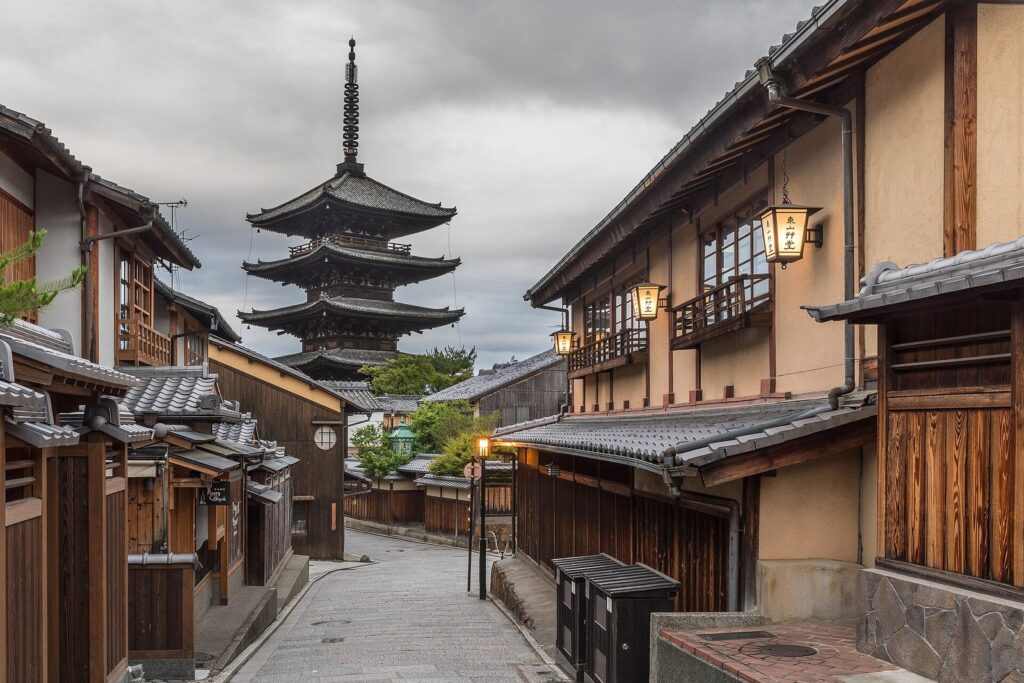
Featured image: “Yasaka-dori early morning with street lanterns and the Tower of Yasaka (Hokan-ji Temple), Kyoto, Japan” by Basile Morin, CC BY-SA 4.0, via Wikimedia Commons