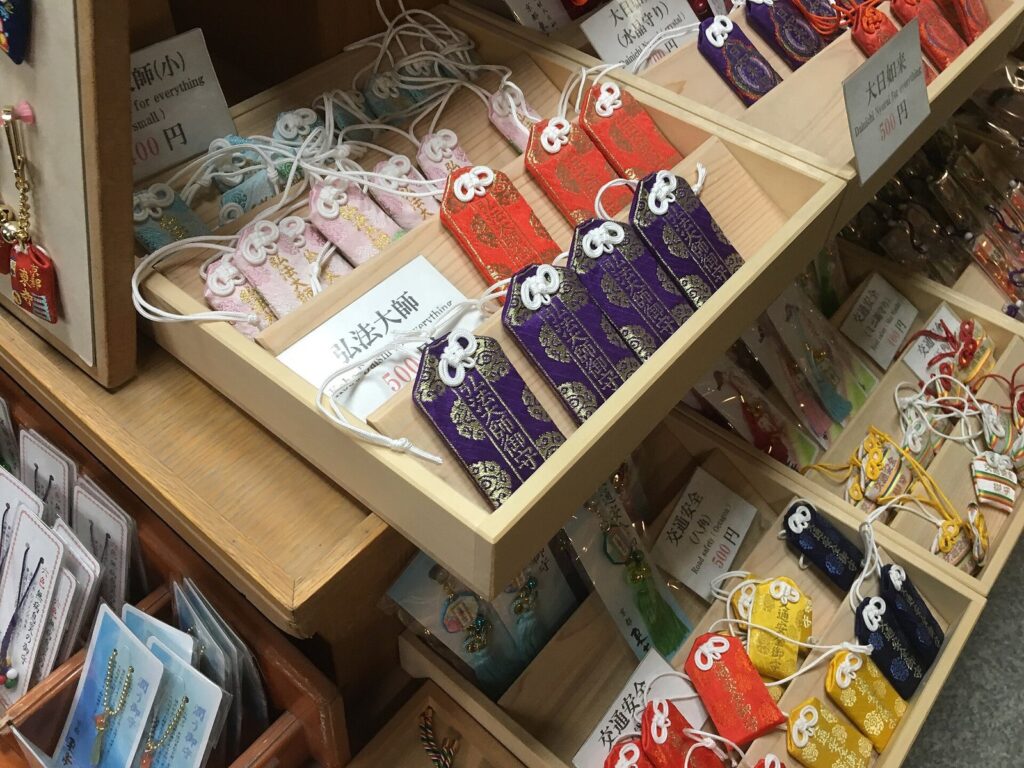
If you’ve walked past a shrine stall in Japan, you’ve probably seen them: little brocade pouches, usually a few centimeters long, hanging from racks in neat rows of color. These are omamori, and almost every visitor ends up holding one at some point, whether they bought it themselves or someone handed it to them as a gift. Most tourists treat it as a cute souvenir and move on. It’s worth knowing what it actually is first, because the way you’re supposed to treat it is a little different from a keychain or a fridge magnet.
I live in Japan, and I still have a handful of omamori in a drawer that I haven’t gotten around to returning — which, as you’ll see below, is a very normal thing to admit.
The quick answer
- Omamori means “something that protects,” from the verb mamoru (to protect). It’s a small sealed pouch containing a paper or wooden talisman blessed by a shrine’s kami or a temple’s Buddhist deity.
- You don’t open it. The protection is believed to come from the sealed item inside, and opening the pouch is thought to let that protection out.
- Prices usually run from about ¥500 to ¥1,500, with more elaborate designs (car safety charms, some novelty shapes) running higher.
- Each one is for a specific wish: safe travel, exam success, good relationships, safe childbirth, money, health, or general good luck.
- Tradition says you return it to a shrine or temple after about a year, where it’s ritually burned. In practice, nobody checks, and plenty of people keep theirs indefinitely.
What’s actually inside
Inside the outer pouch is a small inner wrapping — paper, wood, or sometimes metal — inscribed with a prayer or the name of the shrine’s enshrined deity. A priest performs a blessing ritual over a batch of these before they’re sold, which is what separates an omamori from a regular souvenir item sold at the same gift counter. That blessing is also the reason you’re not supposed to open the outer pouch: once it’s unsealed, the idea is that whatever protective power it held has been let out into the open rather than carried with you.
This is also why you’ll see omamori sold already sealed, rather than assembled in front of you. The shrine or temple has already done the part that matters before it ever reaches the stall.
Where to get one
Omamori are sold at the entrance or near the main hall of most Shinto shrines and Buddhist temples across Japan, usually at a stall staffed by a priest, shrine maiden (miko), or temple attendant. Large, well-known sites — Senso-ji in Tokyo, Fushimi Inari in Kyoto, Meiji Jingu — sell dozens of varieties, often including designs specific to that location. Smaller neighborhood shrines might only stock two or three types. If you’re visiting shrines as part of a trip through Shrines, Shinto and Japanese Mythology, picking up an omamori at each stop is a reasonable way to bring home something more specific than a generic souvenir.
Common types, and what they’re for
The design and color usually hint at the wish:
| Type | Japanese | What it’s for |
|---|---|---|
| Kōtsū anzen | 交通安全 | Safe travel (cars, flights, trains) |
| Gakugyō jōju | 学業成就 | Exam success, academic achievement |
| En-musubi | 縁結び | Love, good relationships, finding a partner |
| Anzan | 安産 | Safe, easy childbirth |
| Kaiun / Kōun | 開運 / 幸運 | General good luck |
| Yaku-yoke | 厄除け | Warding off bad luck or misfortune |
| Shōbai hanjō | 商売繁盛 | Business success and prosperity |
Buying the right one matters to the extent that giving someone a kōtsū anzen charm for their car, or an anzan charm to a pregnant friend, carries a clear meaning. Buying a general kaiun charm as a souvenir for yourself is always a safe choice if you’re not sure.
How to carry one
The usual advice is to keep it somewhere close to you rather than buried in a suitcase — a bag, a wallet, or clipped to a phone or car mirror for travel-safety charms. There’s no strict rule about visibility; plenty of people keep them tucked inside a bag pocket. The one firm rule is simply not opening the pouch to look inside, even out of curiosity.
A question that comes up a lot: can you mix omamori from different shrines, or from a shrine and a temple, without them “conflicting”? The common belief that the gods will fight each other in your bag is mostly treated as folklore today — most Japanese people carry several at once without a second thought. If you want to be cautious, there’s no harm in keeping them in separate pockets, but you won’t offend anyone either way.
Returning it
The traditional lifespan of an omamori is about one year. After that, you’re meant to bring it back — ideally to the shrine or temple you got it from, though any shrine will usually accept omamori originally from elsewhere — and place it in a labeled collection box near the entrance. These are burned in a purification fire called otakiage, often around New Year, as a way of releasing the year’s accumulated protection and starting fresh.
For a visitor, this part is genuinely optional. If you’re not coming back to Japan within the year, nobody expects you to mail a charm back. Keeping it as a memory of the trip is common and accepted; it just won’t get the formal send-off a year-round resident might give theirs.
FAQ
Can I buy an omamori if I’m not religious or Shinto/Buddhist? Yes. Shrines and temples sell them to anyone, tourists included, and most Japanese buyers aren’t strictly religious either — it’s closer to how many people treat a four-leaf clover than a formal religious object.
Is it rude to give one as a gift? No, it’s a common gift, especially a travel-safety charm before someone’s trip or a general luck charm as a souvenir. Just try to match the type to the occasion if you can.
What if the pouch gets worn out or the string breaks? This is treated the same as it reaching the end of its service — return it to a shrine for otakiage rather than trying to repair it yourself.
Are temple omamori different from shrine omamori? Temple versions are blessed through Buddhist ritual rather than Shinto, and may reference a bodhisattva or Buddhist figure instead of a kami, but they serve the same basic purpose and are used the same way.
Can I take omamori home as a souvenir without the “religious” meaning bothering me? Most visitors do exactly this, and it’s not considered disrespectful as long as you don’t open the pouch or treat it as a joke item in front of the priest selling it.
The verdict
Omamori are one of the easiest pieces of Japanese culture to take home — cheap, small, and sold at nearly every shrine and temple you’ll walk through. The only real etiquette is not opening the pouch and giving some thought to which type fits the wish, whether that’s for yourself or a friend back home. Whether you return it in a year or keep it in a drawer for the next decade, as I have, nobody is going to mind.
Written from Japan by the Wayfarer Japan team — real routes, honest prices, and the details that actually matter for first-time visitors.
Featured image: “Toji omamori – Kyoto – Nov 24 2019 21 28 26 132000” by Nesnad, CC BY 4.0, via Wikimedia Commons