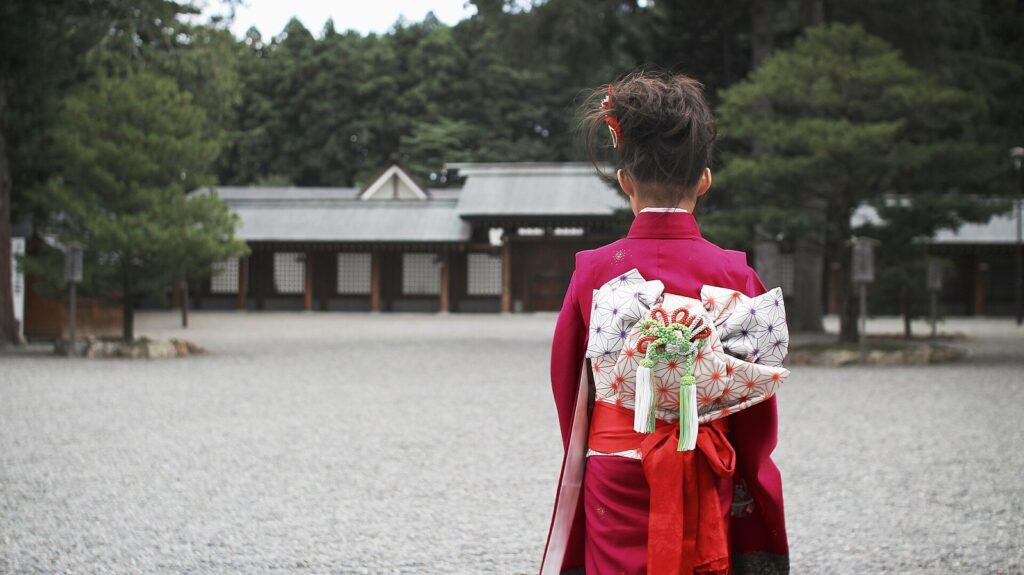
If you happen to be walking through a shrine precinct in Japan sometime in October or November and see a three-year-old in a miniature kimono clutching a long striped candy, or a seven-year-old girl having her obi sash adjusted by a very patient grandmother while a photographer circles for the perfect shot, you haven’t wandered into a costume event staged for tourists. You’ve walked into Shichi-Go-San, one of the most quietly moving traditions in Japanese family life, and one that almost no foreign visitor has heard of before they see it with their own eyes.
I live in Japan, and every November I notice the same thing: shrines that are usually quiet on a weekday suddenly fill up with small children dressed more formally than most adults ever get to dress, trailed by parents holding garment bags and grandparents holding cameras. It’s one of my favorite things to stumble across by accident, and it’s worth understanding what you’re looking at.
The quick answer
- Shichi-Go-San (七五三, literally “seven-five-three”) is a rite-of-passage festival for children aged three, five and seven, held around November 15 each year.
- Boys are celebrated at ages three and five; girls at ages three and seven (ages are sometimes counted the traditional Japanese way, so families may celebrate a year “early” by Western counting).
- Families visit a Shinto shrine to thank the gods for the child’s health so far and pray for continued growth, then often have formal portraits taken and eat a meal together.
- Children wear kimono (girls) or haori jacket and hakama trousers (boys) — often many sizes more formal than anything they’ll wear again until a wedding.
- The date isn’t a public holiday, so in practice families spread visits across all of October and November, usually on a weekend near the 15th.
- If you’re in Japan in autumn and want to see it, well-known shrines like Meiji Jingu in Tokyo or Fushimi Inari and Heian Jingu in Kyoto are reliable places to spot families dressed up, especially on weekends.
Where the tradition comes from
The ages three, five and seven aren’t arbitrary. In the Heian period (794–1185), child mortality was high enough that reaching these milestones was genuinely something to celebrate, and each age corresponded to a specific marker of growing up. Children’s heads were traditionally kept shaved until around age three, when they were allowed to start growing their hair out — a custom called kamioki. At five, boys wore hakama trousers in public for the first time, a ritual called hakamagi, marking their entry into boyhood. At seven, girls graduated from a kimono tied with simple cords to one fastened with a proper obi sash, called obitoki — effectively their first “grown-up” kimono.
The custom of visiting a shrine specifically on November 15 is often traced to the Edo period, tied to a prayer offered by the shogun Tokugawa Tsunayoshi for his own son’s health. Over the following centuries it spread from samurai families to merchants and eventually to the whole country, becoming the version of Shichi-Go-San still practiced today.
Unlike Hinamatsuri or Tsukimi, which are tied to a specific day on the calendar and observed roughly the same way nationwide, Shichi-Go-San is really a family’s individual milestone that happens to cluster around one date. That’s part of why it’s so easy for a visitor to stumble onto it without ever having heard of it — it isn’t a festival with a parade or public program, just thousands of individual families quietly doing the same thing at shrines across the country over about a six-week window.
What actually happens on the day
The core of Shichi-Go-San is simple: parents bring the child to a shrine, often the local ujigami (guardian shrine) tied to the family’s neighborhood, and a Shinto priest performs a blessing called o-harai, waving a wand of paper streamers over the child to purify them, followed by a short prayer for the child’s continued health. Families usually make a small offering to arrange this in advance.
Everything around that few minutes of ritual, though, is where the spectacle comes from. Girls are dressed in kimono with elaborate hair ornaments; younger girls sometimes wear a simpler hifu vest over a kimono instead of a full formal one. Boys wear a haori jacket over hakama, sometimes with a small sword accessory for older boys, echoing samurai dress. Because almost no modern family owns these outfits, most are rented for the day from a kimono shop or photo studio, which is also where many families schedule a formal portrait session — sometimes weeks before or after the actual shrine visit, since trying to wrangle hair, makeup, and a toddler’s patience on the same day as a shrine trip is asking a lot.

Afterward, it’s common for the family to go out for a meal, and almost every child leaves the shrine grounds holding a bag of chitose-ame — “thousand-year candy.” It’s a long, thin stick of red-and-white candy sold in a paper bag printed with cranes and turtles, both traditional symbols of longevity in Japan. The symbolism is the whole point: a long, unbroken stick of candy as a wish for a long, healthy life.
If you want to see it as a visitor
You don’t need to do anything to “attend” Shichi-Go-San — it isn’t a ticketed event or a performance, and treating a family’s blessing ceremony as a photo opportunity would be rude. But a few things help if you want a chance to see it happening naturally around you:
- Weekends beat weekdays. November 15 isn’t a public holiday, so most families visit on the closest Saturday or Sunday, making shrines noticeably busier with dressed-up families on weekends than on an ordinary Tuesday.
- Large shrines see more of it than small ones. Meiji Jingu in Tokyo, Kasuga Taisha in Nara, Heian Jingu and Fushimi Inari in Kyoto, and Atsuta Jingu in Nagoya are all good bets for spotting several families on a mid-November weekend.
- It isn’t limited to exactly November 15. Families celebrate anywhere from early October through early December depending on school schedules, kimono rental availability, and grandparents’ travel plans, so you have a wide window to catch it.
- Keep your distance and your lens polite. Stick to wide shots of the shrine grounds rather than close-ups of someone else’s child, and always ask before photographing a specific family directly.
This is one of those moments where being in Japan at the right time of year, not following a checklist, is what gets you the memorable experience. No tour books it and no ticket gets you access — you just have to be walking past the right shrine on the right autumn weekend, which is a good reason to build a shrine visit into an otherwise ordinary afternoon in Kyoto or Tokyo.
FAQ
Is Shichi-Go-San a public holiday? No. Shrines and businesses operate normally; only individual families take time off or visit on a weekend.
What age counts — the child’s age now, or their age last year? Families can use either traditional age-counting (where a child is considered one year older than their Western birthday age) or standard counting. Many families choose whichever makes the ceremony fall at a convenient year, so you’ll see some three-year-olds who are, by Western counting, still two.
Do all children do this? It’s widely practiced but not universal, and families with mixed cultural backgrounds or non-Shinto beliefs may skip it entirely or visit a Buddhist temple instead of a shrine.
Can I visit a shrine during Shichi-Go-San season as a regular tourist? Yes — shrines stay open to the public as normal. You’ll simply be sharing the grounds with more dressed-up families than usual, which for most visitors is a bonus rather than an inconvenience.
Is there a male and female version of the festival? Yes. Girls are celebrated at three and seven; boys at three (in some regions) and five. Three-year-old celebrations for boys vary more by region than the five and seven milestones.
The verdict
Shichi-Go-San isn’t something you book, buy a ticket for, or plan a special trip around — it’s a piece of ordinary Japanese family life that happens to be strikingly photogenic and, for most visitors, completely unexpected. If your trip lines up with October or November, it’s worth treating any shrine visit as a chance to notice it rather than walk past it: look for the kimono, the candy, and the slightly exhausted-looking grandparents, and you’re watching a tradition that’s been going since the Edo period play out in real time, for free, with absolutely nothing required of you except being there.
Written from Japan by the Wayfarer Japan team — real routes, honest prices, and tips you can use before you land.
Featured image: “A Japanese girl wearing kimono for Shichi-go-san; September 2015” by MIKI Yoshihito from Sapporo City, Hokkaido, Japan, CC BY 2.0, via Wikimedia Commons