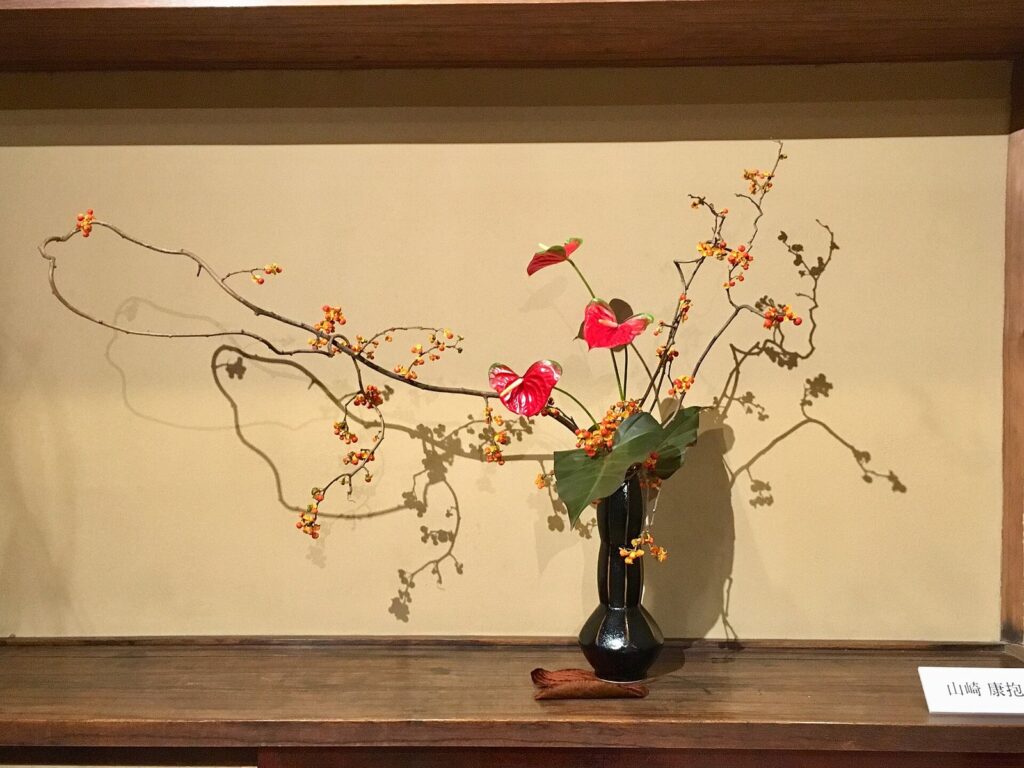
I live in Japan, and the first time I really noticed ikebana was in the lobby of a business hotel, of all places. One branch, two blooms, and a surprising amount of empty space around them, sitting on a plain wooden stand like it had been placed there with real thought. It looked almost unfinished next to the kind of dense, symmetrical bouquet you’d get from a Western florist. That was the point. Ikebana isn’t about how many flowers you can fit into a vase. It’s about what you leave out.
You’ll see it everywhere once you start looking: department store entrances, ryokan alcoves, temple halls, the corner of a tea room. Almost none of it is explained to visitors, which is a shame, because the rules behind it are more interesting than the flowers themselves.
The quick answer
- Ikebana (生け花, “living flowers”) is the traditional Japanese art of flower arranging, rooted in Buddhist flower offerings brought from China and Korea between the 6th and 8th centuries.
- The oldest formal school, Ikenobo, traces back to Kyoto’s Rokkaku-do temple and was first recorded around 1462 — it’s still the largest school today.
- The goal isn’t abundance. It’s structure: asymmetry, negative space, and a few carefully chosen stems standing in for a whole landscape.
- Three schools dominate: Ikenobo (classical, rule-based), Ohara (naturalistic, landscape-style), and Sogetsu (modern, allows almost any material).
- Beginner classes in English run in both Tokyo and Kyoto, usually around 60–90 minutes, with materials included — no experience needed.
From temple offering to formal art
Ikebana’s roots are religious, not decorative. When Buddhism arrived in Japan, flowers placed before an image of the Buddha were a standard offering, a practice imported along with the religion itself. For centuries that’s mostly what it stayed: flowers on an altar, arranged with care but no particular system.
The shift into something closer to an art form happened in Kyoto, at a small temple called Rokkaku-do, where Buddhist monks responsible for the altar flowers lived in quarters beside a pond — ikenobo literally means “the priest’s hut by the pond.” A monk there named Senno is usually credited with the leap from “offering” to kado, the “way of flowers”: a practice with ideas behind it, not just technique. The year 1462 is the first documented reference to this style, which makes Ikenobo the oldest continuously practiced ikebana school in the world.
For a long time ikebana stayed close to its religious and aristocratic origins, practiced alongside the tea ceremony by monks, samurai and, later, the wealthy merchant class of the Edo period. If you’ve read our piece on the Japanese tea ceremony, the connection isn’t a coincidence — a seasonal flower in the tokonoma alcove is part of the same aesthetic world as the tea itself, and the same restraint shows up in Japanese gardens: less is deliberately more.
It wasn’t until the late 19th and early 20th centuries that ikebana branched out from that single lineage. As Japan modernized and Western flowers, vases and ideas entered the country, two breakaway schools reshaped what the art could be.
Ikenobo, Ohara and Sogetsu: three ways to arrange three stems
- Ikenobo is the original, rule-based school. Arrangements traditionally follow a strict structural logic built around three main lines, often described through the idea of ten-chi-jin — heaven, earth and person — where each stem represents a different role in a small, deliberate composition. It’s the most formal of the three, and the one most associated with temples and tea ceremony settings.
- Ohara, founded in the late 1800s by Unshin Ohara, broke away because he wanted to capture something Ikenobo’s rules didn’t allow: the look of an actual landscape. Ohara arrangements use a flat, wide-mouthed container called a moribana bowl to recreate scenery — a riverbank, a hillside — rather than an abstract structure.
- Sogetsu, founded in 1927 by Sofu Teshigahara, went further still. Frustrated by what he saw as rigid tradition, he opened the practice to any material — driftwood, wire, dyed branches, even plastic — and to any container, including no container at all. Sogetsu is the school most likely to produce something that looks like modern sculpture rather than a flower arrangement.
All three are still actively taught today, often in the same city, sometimes in the same building.
What actually makes an arrangement “right”
A few ideas recur across schools, even the looser ones:
- Asymmetry over symmetry. Western arranging tends to build a round, even shape. Ikebana almost never does — stems are usually different lengths, leaning at different angles, because a scene in nature is never perfectly balanced either.
- Ma — meaningful empty space. The gaps between stems aren’t leftover space, they’re part of the composition, the same concept that shows up in Japanese architecture and garden design. A good arrangement is judged as much by what isn’t there.
- The season has to be visible. A single camellia branch reads as winter. A sprig with autumn leaves reads as, well, autumn. Using flowers obviously out of season is considered a mistake, not a creative choice — the same seasonal awareness behind why cherry blossoms matter so much here and the autumn tradition of momijigari.
- Line matters more than color. Where a Western bouquet is judged on color harmony, ikebana is judged first on the angles and lines the stems create against the empty space around them.
Where you’ll actually see it as a visitor
You don’t need to seek out a special venue — ikebana shows up constantly in ordinary places. Hotel and ryokan lobbies almost always have a seasonal arrangement near the entrance, usually changed weekly. Department stores like Isetan or Takashimaya often keep one near the main doors. Temples and shrines display them near altars, and any proper tea ceremony room will have one in the tokonoma, the recessed alcove, timed to the season and sometimes to the specific tea being served that day.
If you want to do more than look, beginner workshops exist in both Tokyo and Kyoto, usually taught in English and aimed squarely at visitors with zero experience. Traditional schools like Ohara run trial lessons at their own studios for around ¥5,000, materials included, while tourist-oriented workshops in both cities typically run 60–90 minutes for somewhere between $90 and $170. Treat those numbers as a rough guide and check current pricing before booking — formats and prices shift. No special clothing or tools are expected; scissors and containers are provided, and you take your arrangement home afterward.
FAQ
Is ikebana the same as Western flower arranging?
Not really. Western arranging generally aims for fullness and color balance. Ikebana is built around line, asymmetry and the empty space between stems, with far fewer flowers than you’d expect.
Do I need any experience to try a class?
No. Beginner workshops assume you’ve never touched ikebana before and walk you through one small arrangement, usually in under 90 minutes.
Is ikebana religious?
Its origins are Buddhist, but modern practice — especially Sogetsu — is treated as a secular art form. You don’t need any religious background to learn or enjoy it.
Which school should I try first if I only have time for one class?
Ikenobo if you want the traditional, structured version; Sogetsu if you’d rather work with more freedom and less rule-following. Ohara sits in between.
The verdict
Ikebana rewards exactly the kind of attention most tourists don’t have time to give it — which is also what makes it worth a short detour. You don’t need to understand the three schools to notice an arrangement in a ryokan lobby and realize it wasn’t an afterthought. But once you know what to look for — the empty space, the uneven lines, the single stem doing more work than a dozen would — it’s hard to walk past one again without stopping.
Written from Japan by the Wayfarer Japan team — real routes, real prices, no tourist-trap detours.