Every December, Tokyo fills with the same visual language as any Western capital in winter: fir trees in hotel lobbies, carols looping through department stores, lights strung along Omotesando. I live here, and the first December I spent in Japan I made the same assumption most visitors make — that under all that decoration, the country was about to shut down for the holidays the way mine did. It wasn’t. On the morning of December 25, my neighbors went to work, my kids’ school ran a normal day, and the only queue I saw was outside a fried chicken shop.
Christmas in Japan is real, widely celebrated, and almost entirely disconnected from what the word means in a country with a Christian majority. It’s a date night, a marketing season, and a excuse for extraordinary lights — not a family gathering, not a day off, and not remotely the biggest holiday of the winter. That title belongs to New Year, which arrives about a week later and actually does close the country down (I’ve written separately about Japanese New Year and why it dwarfs Christmas here). This is what the in-between week actually looks like, and how to enjoy it as a traveler without being confused by it.
The quick answer
- December 25 is not a public holiday in Japan. Offices, schools and banks run a normal schedule; only the shops and restaurants built around the occasion treat it as special.
- Christmas Eve, not Christmas Day, is the main event, and it’s treated as a romantic date night for couples — closer to Valentine’s Day in tone than to a family holiday.
- KFC is the de facto Christmas dinner for a huge number of households, a tradition dating to a 1974 marketing campaign. Pre-order weeks ahead if you want one on the day itself.
- Christmas cake means a strawberry shortcake — sponge, whipped cream, strawberries — bought whole from a bakery or convenience store, not a fruitcake.
- Illuminations are the best free spectacle, running from mid-November into February in most cities, well past December 25.
- Fewer than 1-2% of Japan’s population is Christian, so the holiday here is secular and commercial by design, not religious.
Why Christmas never became a day off
The modern Japanese Christmas was built almost entirely by department stores and confectioners in the decades after the war, as an imported seasonal promotion rather than a religious observance — which is also why it never got a public holiday attached to it. There’s a specific historical footnote here that most visitors never hear: for the twenty-nine years Emperor Akihito reigned, December 23 was a national holiday (his birthday), which meant a lot of workers effectively got a long weekend bundled right next to Christmas without anyone planning it that way. When Emperor Naruhito’s reign began in 2019, the holiday moved to his birthday on February 23, and that accidental Christmas long weekend quietly disappeared. December 25 in Japan has always stood on its own as an ordinary Thursday or Tuesday that happens to have lights on it.
Christmas Eve is the actual holiday — just not the kind you’re expecting
If you want to understand how Japan slots Christmas into its calendar, Christmas Eve is the night to watch. Restaurants that take reservations are booked out for dinner, hotels in Tokyo and Osaka raise their rates the way they would for a major event, and couples dress up for an evening out that has more in common with a Western Valentine’s Day than a Western Christmas.
Christmas Day itself is quieter and more domestic — a day to share a cake with family or just carry on as normal, since nobody has the day off to extend it further. If you’re visiting as a couple, book a nice dinner well in advance; December 24 evening is the one night all season when popular restaurants are tightest.
Why everyone eats fried chicken
This is the detail that surprises visitors the most, and it has a real origin story. In 1974, a KFC Japan store manager named Takeshi Okawara ran a holiday promotion built around the idea that fried chicken was a reasonable stand-in for the turkey dinner that doesn’t naturally exist in Japanese home cooking. The slogan, “Kurisumasu ni wa Kentakkii” — “Kentucky for Christmas” — stuck, and decades of national advertising later, ordering a KFC barrel for December 24 or 25 is now a genuine household tradition for a large share of Japanese families, not a tourist gimmick.
The barrels are pre-order items, and that matters if you want one. In the 2025 season, KFC Japan’s standard Christmas Party Barrel — eight pieces of Original Recipe chicken plus sides and a small strawberry cake — ran about ¥5,490, with an early-bird price around ¥4,990 for orders placed by mid-December; exact 2026 pricing is usually confirmed by KFC Japan in November, so treat those numbers as a close estimate rather than gospel. Walk-in customers without a reservation do get chicken, but expect long lines and the real possibility that a branch sells out before you reach the counter. If this is a tradition you want to try rather than just read about, place the order through the KFC Japan app or website at least a week ahead.
The cake tradition that has nothing to do with fruitcake
Ask for “Christmas cake” in Japan and you’ll be handed a short, round sponge cake layered with whipped cream and whole strawberries — a style that traces back to a Tokyo confectioner’s prewar marketing and became the default after the war, when it was cheap to produce and visually matched the season’s red-and-white color scheme. Convenience stores, department store basements and neighborhood bakeries all sell whole cakes in the week before Christmas, meant to be bought on the 24th and shared at home that evening, which is one more piece of evidence that the holiday here is built around a single shared evening rather than a multi-day occasion.
What to actually do if you’re here for it
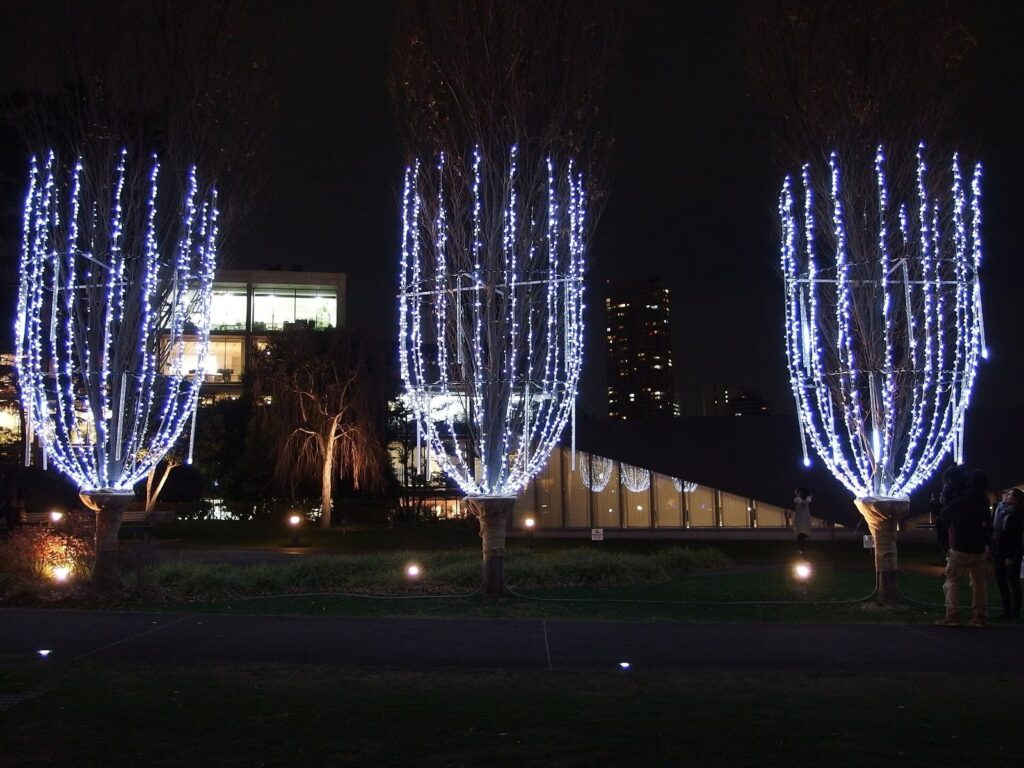
The illuminations are the main reason to adjust a visit around this season rather than skip past it. Most cities start lighting up in mid-November and keep the displays running well into February, so December 25 isn’t a deadline — our Tokyo Winter Illuminations guide covers the specific light-up spots and when each one runs if that’s the centerpiece of your trip.
For something closer to a European holiday market, both Tokyo and Yokohama run seasonal Christmas markets modeled on German originals, with wooden stalls, mulled wine and craft stands. In 2026, the Yokohama Red Brick Warehouse market and Tokyo’s own Christmas Market (split between the Shin-Toyosu and Shiba Park sites) both run from November 20 through December 25 — check current opening hours before you go, since they tend to extend later into the evening as December progresses.
You don’t need to be in Japan for a family dinner to try the KFC tradition, either — a barrel ordered for lunch on any December day gets you the same chicken people line up for on the 24th.
FAQ
Is December 25 a public holiday in Japan? No. It’s a normal working and school day. Shops, offices and trains run on their usual schedule.
Do I need to reserve a restaurant for Christmas Eve? If you want a sit-down dinner in a city center on December 24, yes — reserve well ahead. It’s the single most booked-out night of the season because of the date-night tradition.
Can I get KFC’s Christmas barrel without pre-ordering? Sometimes, but expect long lines and a real chance of sell-outs, especially at smaller branches. Pre-ordering through the app or in person a week or more ahead is the reliable route.
Is Christmas a bigger deal than New Year in Japan? No — the opposite. New Year (Shogatsu) is the holiday that actually closes banks, government offices and many restaurants, and it’s the one most locals treat as the real end-of-year occasion.
Will illuminations still be running if I visit in January? In most cities, yes. Many light-up displays continue well past Christmas, often into early or mid-February.
The verdict
Christmas in Japan is worth building a little time around if you’re here in December — the illuminations alone are reason enough — but don’t plan your trip assuming it works like a holiday at home. Nothing closes, nothing slows down, and the version of Christmas on display is a couples’ night out and a fried chicken order more than a family gathering. Enjoy it as the specifically Japanese, specifically commercial occasion it is, and save your “everything is closed” expectations for the New Year week that follows.
Written from Japan by the Wayfarer Japan team — residents sharing what we’ve learned living here, so you can travel with the confidence of a local.
Featured image: “Christmas Illuminations @ Tokyo Midtown (11421176205)” by Guilhem Vellut from Annecy, France, CC BY 2.0, via Wikimedia Commons