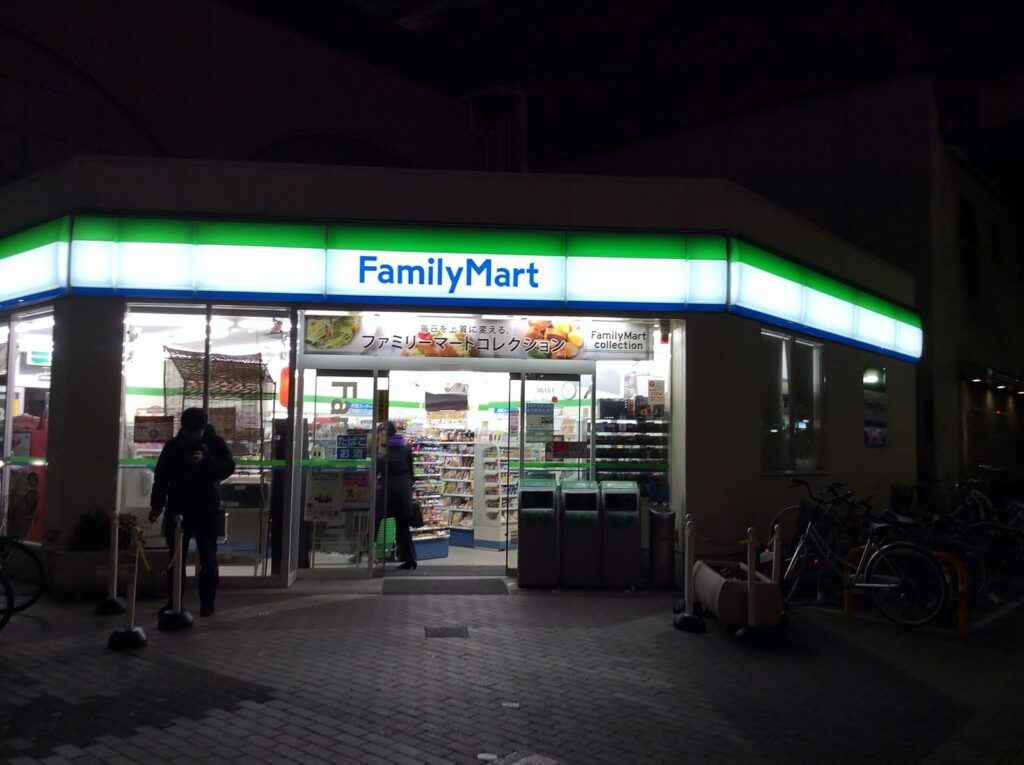
I live in Japan, and I am in a convenience store most days without thinking about it. Not for a treat — to pay an electricity bill, print a document, drop a parcel, buy a coffee that costs less than a vending machine can manage. The konbini is not really a shop. It is a piece of small public infrastructure that happens to sell rice balls.
Visitors usually discover this on about day three, standing in a 7-Eleven at eleven at night realising the egg sandwich is genuinely good and that the machine by the door will give them cash when the bank ATM in the station would not. This is how to use konbini the way people who live here do — including the one thing they no longer do that half the internet still says they do.
The quick answer
- There are more than 55,000 convenience stores in Japan, and roughly nine in ten are 7-Eleven, FamilyMart or Lawson. In any city you are rarely more than a few minutes from one.
- The food is real food, delivered fresh several times a day rather than sitting under a lamp since morning.
- 7-Eleven’s ATMs are the most reliable cash machines in Japan for foreign cards, open 24 hours, with fees of ¥0–¥220 per withdrawal depending on your card network, plus whatever your own bank adds.
- They do far more than sell things: tickets, printing, luggage forwarding, bill payment, clean toilets, hot water for instant noodles.
- The free Wi-Fi is gone. 7-Eleven ended 7SPOT in March 2022 and FamilyMart ended Famima_Wi-Fi in August 2022. Only Lawson still runs an open network. Do not build your trip around konbini Wi-Fi.
- Prices below are approximate 2026 figures and vary by chain, region and season — check the shelf label.
The food is the reason, and it is not a low bar
What surprises people is not that the food exists but that it is treated seriously. Chains reformulate their standard egg sandwich the way car companies revise a bestselling model, and a bad season on the fried chicken counter makes the business press.
- Onigiri (rice balls), roughly ¥150–¥260. Tuna mayonnaise and grilled salmon are the safe entry points; ume (salted plum) is the acquired taste. Follow the numbered three-step diagram on the wrapper — it keeps the seaweed crisp until the second you eat it.
- Egg salad sandwich, around ¥250–¥320. The famous one. Soft milk bread, absurdly smooth filling.
- The hot counter by the till — fried chicken (FamiChiki at FamilyMart, Karaage-kun at Lawson), croquettes, steamed buns in winter, roughly ¥200–¥300 each. Point at what you want.
- Oden, the simmered fish-cake stew in a partitioned tray, from about October to March, priced per item.
- Bento and pasta, ¥450–¥800. Staff will ask if you want it heated: say atatamete kudasai, or nod when they gesture at the microwave.
- Self-serve coffee, around ¥120–¥200. Buy a plastic cup at the register, then use the machine yourself.
Seasonal items are the local sport: sakura-flavoured everything in spring, chestnut and sweet potato in autumn, and in late summer a wall of chilled noodles that exists because the heat makes anything else unbearable — see Japan in Summer: Surviving the Heat, Festivals and Obon.
The ATM that will actually take your card
Foreign cards fail in a lot of Japanese ATMs. They do not usually fail in 7-Eleven.
Seven Bank operates machines in essentially every 7-Eleven — over 28,000 nationwide — with an English interface and 24-hour service. As of 2026, Mastercard and Maestro cards pay no Seven Bank handling fee; Visa-network cards are charged ¥110–¥220 per withdrawal. That fee is per transaction, not proportional to the amount, so taking out ¥20,000–¥30,000 at once rather than ¥5,000 four times is simply cheaper. Your own bank’s foreign-transaction fee applies on top.
Japan Post ATMs and the machines in Lawson and FamilyMart also take many foreign cards, but 7-Eleven is the one I would send a visiting friend to without hesitating. The full picture is in Cash or Card in Japan? How to Pay for Everything (2026).
The machine in the corner does more than you think
Every chain has a multifunction terminal: Loppi in Lawson, the Famiport-style screen in FamilyMart, the multi-copy machine in 7-Eleven. Between them they handle:
- Ticket collection and purchase for concerts, museums and attractions. Some things are sold only this way — Ghibli Museum tickets go through Lawson and are on no travel platform, which is why How to Get teamLab and Ghibli Museum Tickets Before They Sell Out (2026) spends so long on it.
- Printing and scanning from a USB stick, a cloud account or your phone, around ¥20–¥30 for a black-and-white A4 page.
- Bill payment, which is how much of the country pays for utilities and online orders.
You can also top up transport IC cards with cash at the register and pay with almost anything — cards, contactless, QR codes, or Suica straight off your phone, which is the fastest option and is explained in How to Use a Suica Card in Japan: A Tourist’s Guide (2026).
Sending your bags on ahead
This is the service travellers most often wish they had known about on day one. Hand a suitcase over at the counter and collect it at your next hotel, usually the following day, for roughly ¥2,000–¥2,500 for a medium bag between major cities.
Look for the courier sticker on the door: 7-Eleven and FamilyMart generally handle Yamato takkyubin (the black-cat logo), Lawson handles Japan Post’s Yu-Pack. Partnerships shift, so check the door rather than assuming. Staff will help with the waybill if you have the destination hotel’s address in Japanese — ask your current hotel to write it down. Do not send anything you need that night. What to Do With Your Luggage in Japan: Lockers, Storage and Takkyubin (2026) has the prices and the shinkansen oversized-baggage rule that catches people out.
The things you forgot are all here
If you left something at home, breathe. A konbini stocks umbrellas (about ¥600–¥900, and everyone who lives here owns four), socks, plain T-shirts and underwear, phone cables, toothbrushes, razors, mild painkillers and hand warmers in winter. For anything larger, Uniqlo and the electronics chains fill the gap — the point of Japan Packing List: 15 Things You’ll Actually Need (2026) is that panic-buying before you fly is nearly always unnecessary.
Toilets are the other quiet service. Most konbini have one, most are clean, and using it without buying anything is tolerated rather than encouraged. Buy the coffee.
The Wi-Fi myth, and what to do instead
Plenty of guides still tell you to duck into a 7-Eleven for free internet. That advice expired in 2022: 7-Eleven shut down 7SPOT on 31 March 2022 and FamilyMart ended Famima_Wi-Fi that August. Lawson still runs LAWSON_Free_Wi-Fi and FamilyMart can be used with a free d Wi-Fi account, but neither is something to plan a day of navigation around.
As a resident I use an ordinary Japanese carrier contract rather than a tourist product, so I have not tested travel eSIMs myself — but the friends I advise arrive with one already installed and never think about connectivity again, which is the correct outcome. Set it up before you fly.
The comparison, including the providers I would avoid, is in Best eSIM for Japan in 2026: An Honest Local’s Guide.
Small habits that mark you out as someone who has done this before
- Answer the eat-in question honestly. If a store has seating and you say you will eat there, food is taxed at 10% instead of 8%. It is a difference of a few yen — just answer truthfully.
- A plastic bag costs a few yen since the 2020 nationwide charge. Staff will ask; a small nod or fukuro wa iranai desu declines it.
- Take your rubbish with you or use the bins by the door — they are for konbini purchases, not for the whole day’s accumulation. Street bins are famously scarce, as Japan Etiquette: 15 Dos and Don’ts for Visitors (2026) explains.
- Tax-free shopping is essentially irrelevant here. The ¥5,000 minimum and the paperwork mean almost nobody claims it on a sandwich, and from 1 November 2026 Japan switches to paying tax up front and claiming a refund at the airport instead.
FAQ
Which chain is best?
7-Eleven for ATMs, coffee and general consistency; Lawson for ticket machines and Karaage-kun; FamilyMart for FamiChiki and its own-brand clothing basics. The differences are real but small. Use whichever is nearest.
Are they genuinely open 24 hours?
Most are, though a slow shift toward shorter hours means some suburban and rural branches now close overnight. In city centres, assume yes.
Can I pay with a foreign credit card?
Almost always, including contactless. Very small purchases are sometimes easier with an IC card or coins, so keep a little cash.
Is konbini food safe to eat every day?
Safe, yes — turnover is fast and dates are printed to the hour. Balanced is another question; salt levels are high. Add a salad and a bottle of tea.
The verdict
A konbini is not a corner shop with better sandwiches. It is a bank, a post office, a print shop, a ticket agency and a decent kitchen, open all night, on almost every block. That is why the affection for them is not a meme — it is what happens when a country decides that basic errands should be effortless.
Used properly they absorb most of the small friction of travelling here: the cash you could not get, the bag you did not want to carry up three flights of station stairs, the umbrella the forecast did not warn you about, the 11pm dinner after a delayed train. Just do not count on the Wi-Fi.
Written from Japan by the Wayfarer Japan team.