I have lived in Japan for years and I still remember the first time I walked into the National Noh Theatre in Tokyo expecting something close to kabuki — bright costumes, shouted lines, a bit of spectacle. What I got instead was almost the opposite: a masked actor crossing a bare cypress stage so slowly that a single step could take thirty seconds, a chorus chanting in a register that sounded more like weather than speech, and a silence in the audience that felt deliberate rather than bored. It took me a second visit, with a program that explained the plot in advance, to realize Noh is not trying to entertain you in the way a Western play does. It is trying to put you inside a mood. Once you stop waiting for something to “happen,” it becomes one of the most striking things you can see in Japan.
Noh gets far less attention from first-time visitors than kabuki, sumo, or a tea ceremony, mostly because it is quieter and harder to explain in a guidebook caption. That is exactly why it is worth a closer look if you want to see something that most tourists in Tokyo never do.
The quick answer
- Noh (能) is Japan’s oldest surviving professional theater form, developed in the 14th century and still performed essentially unchanged today.
- It combines masked dance, extremely slow and stylized movement, and a chanting chorus, usually telling stories of ghosts, gods, or grief-stricken historical figures.
- It is not the same as kabuki — Noh is older, slower, and mask-based; kabuki is louder, more colorful, and came about 200 years later partly as a popular reaction to it.
- UNESCO recognized Noh (and its comic sibling, kyogen) as Intangible Cultural Heritage in 2008.
- You can watch it with English subtitles at the National Noh Theatre in Tokyo and at dedicated Noh theaters in Kyoto and other cities; tickets for a standard program run roughly ¥3,500–¥7,300 depending on seat (confirm current pricing before booking, as it varies by program).
Where Noh actually came from
Noh traces back to 1374, when a travelling performer named Kan’ami and his twelve-year-old son Zeami danced a form of popular entertainment called sarugaku in front of the teenage shogun Ashikaga Yoshimitsu in Kyoto. The shogun was captivated, and under his patronage, father and son spent the following decades refining sarugaku into something far more austere and literary — pulling in classical poetry, Buddhist themes, and courtly aesthetics until it became a theater form fit for the ruling class rather than street crowds.
Zeami, in particular, is the reason Noh looks the way it does today. He wrote roughly fifty of the plays still performed now, and he also wrote some of the first serious theory of acting anywhere in the world — essays on timing, restraint, and the idea that the most powerful moment on stage is often the one just before or after an action, not the action itself. That philosophy, called yugen (a kind of profound, understated beauty that is felt rather than explained), is still the organizing idea behind every Noh performance six hundred years later.
What actually happens on stage
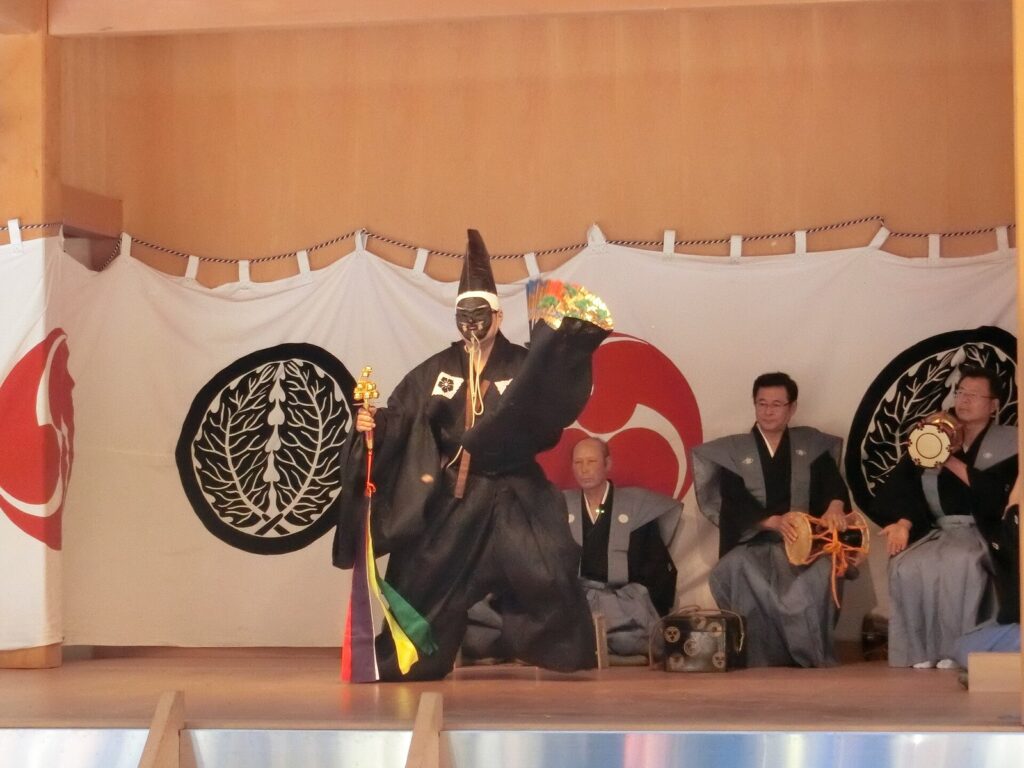
A Noh stage is a plain wooden platform, roofed like a shrine even indoors, with a single pine tree painted on the back wall and a narrow bridge (the hashigakari) running off to one side, where performers make slow, loaded entrances. There is no set, almost no props beyond a fan, and lighting that barely changes.
The lead actor, the shite, usually wears a carved wooden mask even when playing a character who is technically unmasked in the story, because the mask is read as revealing an inner truth — a ghost’s grief, a woman’s jealousy, a god’s detachment — rather than hiding a face. A small chorus sits to one side, chanting narration and the characters’ inner thoughts in unison. Musicians play flute and several types of drum, often shouting short, sharp cries between phrases that function almost like punctuation.
Plays are built around waiting, not plot twists. A traveling monk meets a mysterious local woman who turns out to be the ghost of someone from a famous legend; she dances out her unresolved emotion and either finds peace or doesn’t. That’s often the entire story. Most full Noh programs break up two or three of these intense plays with kyogen — short, broadly comic interludes performed without masks that poke fun at monks, servants, and foolish husbands. The contrast is intentional: kyogen exists partly so the audience’s concentration doesn’t collapse under the weight of pure Noh.
Noh vs. kabuki: the confusion resident Japan has to untangle constantly
Visitors (and plenty of Japanese people) mix these two up, so it’s worth being precise. Noh came first, developed for military and aristocratic patrons in the 14th century, and stayed deliberately slow, masked, and minimal. Kabuki arrived around 1600 as entertainment for ordinary townspeople in Edo-period cities, and it leaned the opposite direction: loud music, elaborate makeup instead of masks, rapid-fire dialogue, trapdoors, and stage tricks. If kabuki is closer to opera crossed with a magic show, Noh is closer to a slow-motion requiem. The two art forms actually influenced each other over the centuries — some kabuki plays are direct adaptations of Noh stories, performed at normal speed with kabuki’s showier style — so watching one helps you appreciate the other.
How to actually see one as a visitor
The easiest entry point is the National Noh Theatre (Kokuritsu Nohgakudo) near Sendagaya Station in Tokyo, which runs regular programs roughly twice a month, plus occasional performances with live commentary aimed at newcomers. English-language program notes and seat-back subtitle screens are provided for many shows, which makes the plot far easier to follow than it sounds. Ticket prices vary by seat and program, running from roughly ¥3,500 for a middle seat up to around ¥7,300 for front-row seating — check the current schedule and pricing before you go, since programs change monthly.
Kyoto has its own long-running Noh tradition and several dedicated theaters, including the Kanze Kaikan, and the city occasionally hosts takigi noh — outdoor Noh performed after dark by torchlight, traditionally held at temples and shrines in late spring and early autumn. It’s a genuinely different experience from a theater seat: the smoke, the fire, and the open night sky do a lot of the emotional work the stage usually does on its own. If you’re planning a Kyoto trip around this kind of thing, it’s worth checking local event listings a few months out, since dates shift year to year.
For first-timers anywhere, a performance billed as a “beginner” or “commentary” program is worth seeking out over a standard one — the explanation beforehand changes the entire experience, the same way reading a one-paragraph plot summary before an opera makes it click.
FAQ
Is Noh boring for someone who doesn’t speak Japanese?
It can be if you walk in cold. With an English program or subtitle device, most visitors find it unexpectedly hypnotic rather than boring — the slowness is the point, not a flaw.
How long is a typical performance?
A full program with two Noh plays and a kyogen interlude usually runs two and a half to three hours, including an intermission. Single-play “highlights” programs aimed at visitors run shorter.
Do I need to dress up or follow special etiquette?
No formal dress code exists for the audience. Normal theater etiquette applies: arrive on time, stay quiet during the performance, and keep phones off.
Is Noh connected to Zen Buddhism?
Loosely, yes. The restraint, emptiness, and focus on a single suspended moment that define Noh share a lot of aesthetic DNA with Zen ideas that also shaped Japanese gardens and the tea ceremony, even though Noh itself isn’t a religious practice.
Can I see Noh outside Tokyo and Kyoto?
Yes — most major cities have at least one Noh theater or touring company, and shrine festivals around the country occasionally host outdoor performances, though Tokyo and Kyoto offer the most regular, visitor-friendly schedules.
The verdict
Noh is not an easy sell next to a shinkansen ride or a bowl of ramen, and it doesn’t need to be on everyone’s itinerary. But if you have one evening free in Tokyo or Kyoto and you’ve already done kabuki or a tea ceremony, it’s one of the few experiences left in Japan that hasn’t been shaped at all by tourism — the same plays, performed the same way, for six centuries. Go in with an English program, lower your expectations for plot, and let the slowness do what it’s designed to do.
Written from Japan by the Wayfarer Japan team — real experience, checked facts, no fluff.
Featured image: “Noh and Kyōgen of Nōgō, Sanbasō, Motosu, 2019” by 大野 一将, CC BY-SA 4.0, via Wikimedia Commons