I live about ninety minutes from two castles, and I still stop and stare every time I pass one. There’s something about the silhouette — the stacked, tapering roofline, the pale walls catching the evening light, the stone base that curves outward like a wave frozen mid-crash — that doesn’t look like European fortification at all. It looks like something else entirely, and there’s a good reason for that: Japanese castles solved a completely different set of problems.
Most visitors see one or two castles on a trip — Osaka, Himeji, maybe Matsumoto — and assume they’re all roughly the same age and roughly authentic. Almost none of that is true, and once you know why, castles get a lot more interesting to visit.
The quick answer
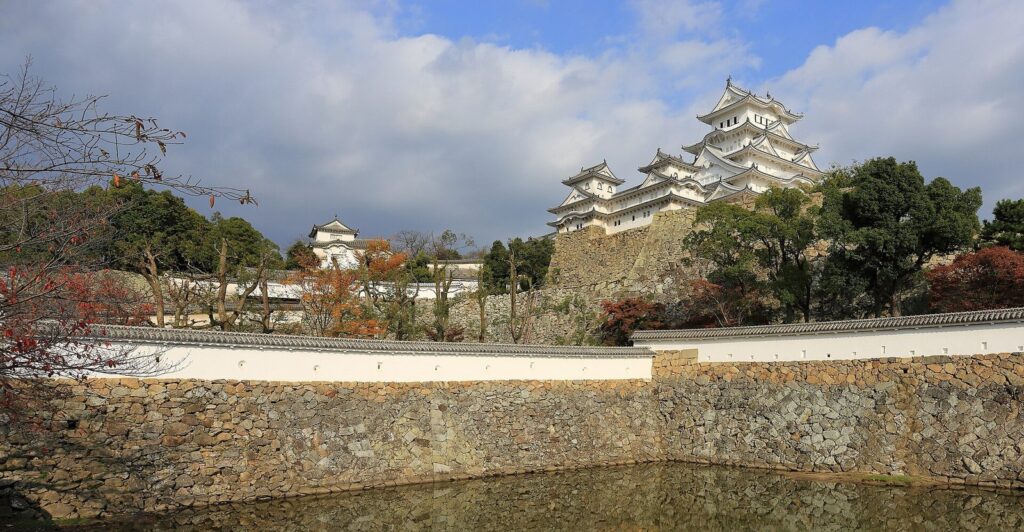
- The tapering, curved stone base is called a nobori-ishigaki or simply ishigaki, and the curve (called ōgi no kōbai, “fan slope”) isn’t decorative — it made the wall harder to scale and more resistant to earthquakes.
- The main keep is called the tenshu. It was the last line of defense and the lord’s symbolic seat, not usually a full-time residence — daily life happened in lower palace buildings that rarely survive today.
- Black castles (Matsumoto, Kumamoto’s original) used lacquered wood siding; white castles (Himeji, Kumamoto’s rebuilt walls) used fire-resistant plaster. Both were practical choices, not regional styles competing for prettiness.
- Only 12 original tenshu survive in all of Japan. Everything else you see, including Osaka Castle’s tower, is a 20th-century concrete reconstruction.
- Most castles were destroyed not by war but by the Japanese government itself — a demolition order in 1873, followed by fires and American bombing in 1945.
Why the walls curve like that
The stone base of a Japanese castle is one of the most photographed and least understood parts of it. Unlike a European curtain wall, which tends to run straight and vertical, Japanese ishigaki curve outward at the bottom and steepen as they rise — engineers call it a fan curve because it echoes the shape of an open folding fan.
Two reasons drove the design. Defense: the curve made it nearly impossible to keep a ladder flush against the wall, and the steepening upper section meant a climber lost their grip exactly where they needed it most. Stability: Japan sits on some of the most active fault lines on Earth, and a curved, loosely fitted stone base absorbs seismic shock far better than a rigid straight wall — some of these walls have survived multiple major earthquakes over 400 years with the stones barely shifting.
Look closely at the stonework and you’ll usually spot one of two techniques. Older walls use nozura-zumi, unshaped natural stones wedged together with small filler stones — rougher looking but genuinely ancient. Later walls use the more refined kiri-komi-hagi, where stones are cut and fitted with almost no visible gaps. If a castle’s walls look suspiciously crisp and uniform, that’s often your clue that the stone base was rebuilt or heavily restored in the last century, even if the layout is original.
The tenshu wasn’t really a home
It’s easy to assume the tall central tower — the tenshu — is where the lord and his family lived day to day, the way a European keep sometimes was. In practice, most tenshu were built as a defensive strongpoint and a visible statement of power, not living quarters. They’re dim, cold, and vertical, with steep wooden staircases that function almost like ladders. The lord’s actual residence and the castle’s administrative business happened in sprawling low palace buildings — the honmaru goten — built around the base of the keep.
That distinction matters for visitors because it explains why some of the “best” castle experiences aren’t really about the tower at all. Nijo Castle in Kyoto, for instance, is famous less for its modest keep (long gone) and more for the surviving Ninomaru Palace, with its nightingale floors that chirp underfoot to warn against intruders — a detail that tells you far more about how a lord actually lived and feared assassination than any tower does.
Black castle, white castle
Matsumoto Castle, in the Japanese Alps, is nicknamed Karasu-jō — the Crow Castle — for its black lacquered wood exterior. Himeji, by contrast, is Shirasagi-jō, the White Heron, coated in white plaster (shikkui) that also happens to be highly fire-resistant. The color isn’t regional taste; it’s a trade-off. Black lacquer was cheaper and faster over large wooden surfaces, and common in earlier castle-building periods. White plaster cost more but cut fire risk, which mattered more as castle towns grew denser. Kumamoto Castle mixes both: black lower sections with white-plastered upper walls, a hybrid from a transitional period.
Original, reconstructed, or pure concrete
This is the part that surprises most first-time visitors. Japan built somewhere around 170 castles with proper tenshu during the feudal era. Today, only twelve original tenshu still stand, unrestored by fire or war: Himeji, Matsumoto, Inuyama, Hikone, Matsue, Kochi, Bitchu-Matsuyama, Marugame, Maruoka, Uwajima, Hirosaki, and Matsuyama Castle in Ehime, Shikoku.
Everything else — including the instantly recognizable towers at Osaka, Nagoya, and Kumamoto — is a modern reconstruction, usually built from reinforced concrete in the 1950s–60s as postwar national and civic pride projects, often with an elevator inside and a museum where the top-floor observation deck used to be strategic lookout space. That doesn’t make them not worth visiting — Osaka Castle’s museum floors are genuinely good for understanding the site’s history, and the view from the top over the moat and park is worth the climb regardless of what year the concrete was poured. It just means “castle” in Japan covers a wider range of authenticity than it first appears.
Kumamoto Castle is the clearest case of that distinction still visibly in progress. A major earthquake struck Kumamoto in April 2016 and badly damaged the complex, toppling stone walls and cracking the main tower. The tenshu itself has since reopened to visitors, but reconstruction of structures like the Uto-yagura turret and sections of stone wall continues, and full restoration of the site — including the Honmaru Goten palace — isn’t expected for decades. Visit today and you’ll see active repair work alongside finished sections, which is its own kind of interesting: you’re watching castle-building happen in real time.
Why so few survived
The story of why only twelve originals remain isn’t really about warfare — most of these castles survived centuries of conflict just fine. It’s about the modern Japanese state. In 1873, the new Meiji government, dismantling the old feudal order and its symbols, ordered castles nationwide demolished or repurposed. Many towers were torn down for scrap or left to rot. A further wave was lost to Allied bombing in 1945 — Nagoya’s original tenshu, a national treasure, burned in an air raid that May, part of why the tower there today is a postwar rebuild.
Related reading if this sent you down a castle-shaped rabbit hole: our guide to the History of Tokyo covers how Edo Castle — once the largest castle complex in the world — shaped the city that grew around it, and our Nagoya Travel Guide covers visiting Nagoya Castle in more practical detail, including its reconstructed Honmaru Goten interior. If you’re building samurai-era context, Samurai and Bushido is a natural next stop.
FAQ
Which Japanese castles are the “real” ones?
Twelve original tenshu survive nationwide, with Himeji and Matsumoto as the two most visited. Everything else — Osaka, Nagoya, Kumamoto’s tower, Odawara, and most others — is a 20th-century reconstruction, usually in concrete.
Is Himeji Castle worth the extra cost over a reconstructed one?
If you only visit one castle in Japan, make it Himeji. It’s the largest and best-preserved original, a UNESCO World Heritage Site, and the interior — real wooden staircases, original defensive slits, unmodernized floors — feels genuinely different from a concrete rebuild with an elevator.
Can you still visit Kumamoto Castle during reconstruction?
Yes. The main tower and all six floors are open to visitors as of 2026, with an entry fee around ¥800. Some surrounding structures and walls remain under repair, so expect scaffolding in parts of the grounds — check current details before you go, since restoration areas shift over time.
Why are some castle towers black and others white?
Black castles used lacquered wood cladding, more common in earlier construction; white castles used fire-resistant plaster, which became preferred as fire risk to growing castle towns increased. It’s a practical difference, not a regional style.
Do I need to book castle tickets in advance?
For most castles, same-day tickets at the gate are fine. Himeji and a few of the most popular sites occasionally use timed-entry e-tickets during peak cherry blossom or autumn leaf season, so it’s worth checking the official site the week before if you’re visiting in late March–early April or November.
The verdict
A Japanese castle rewards you more the less you assume about it. The tower that looks ancient might be sixty years old and poured in concrete; the unglamorous stone base under your feet might be the one part that’s genuinely four centuries old and has outlasted three earthquakes. None of that makes the reconstructed ones less worth seeing — Osaka and Kumamoto both tell real history inside modern shells — but knowing the difference changes what you’re actually looking at, and for my money, it’s worth the short trip out to Himeji or Matsumoto at least once to stand inside one of the twelve that never stopped being what it was built to be.
Written from Japan by the Wayfarer Japan team — practical, first-hand advice for travelers, updated for 2026.
Featured image: “Himeji Castle, November 2016 -02” by Martin Falbisoner, CC BY-SA 4.0, via Wikimedia Commons