I live in Japan, and one of the first things that surprised me here is how rarely I actually see kimono on the street. Visitors often arrive expecting them to be everyday wear, then wonder why almost everyone around them is in jeans and a jacket instead. That gap between the image and the reality is worth understanding, because kimono didn’t disappear so much as get reassigned: from daily clothing to a formal language people still read fluently, even if they never wear one themselves. Once you know how to read that language, a wedding, a graduation ceremony or a stroll through Asakusa or Gion looks completely different.
The quick answer
- Kimono means “thing worn,” a T-shaped, straight-seamed robe wrapped left-over-right and secured with an obi (sash) rather than buttons or zippers.
- It evolved from the kosode, an underlayer worn in the Heian period (794-1185), which became outerwear in its own right by the Edo period (1603-1868), when it was standard daily dress for everyone.
- After Japan opened to the West in the Meiji era, Western clothing gradually took over daily life, and by the mid-20th century kimono had shifted almost entirely to formal and ceremonial occasions.
- Sleeve length, pattern placement and color tell you a huge amount at a glance: long swinging sleeves usually mean a young, unmarried woman; a plain dark robe with crests near the hem usually means a married woman at a formal event.
- Yukata, the light cotton robe sold in convenience stores and worn at summer festivals and ryokan, is a related but distinct, far more casual garment, not a “summer kimono” in the formal sense.
- Wearing one yourself doesn’t require planning ahead. Rental shops near major temples in Kyoto and Asakusa handle everything, from the robe to the obi to the sandals, in about 30 minutes.
Where the kimono actually comes from
The word kimono simply means “thing to wear,” which tells you it wasn’t originally a specific, formal garment so much as clothing in general. Its direct ancestor is the kosode, a small-sleeved robe that Heian-period aristocrats wore as an underlayer beneath more elaborate, multi-layered court dress. As fashion simplified over the following centuries, the kosode moved outward and became the main visible garment rather than something hidden underneath.
By the Edo period, the kosode had essentially become what we now call kimono, and it was universal. Samurai, merchants, farmers and city dwellers all wore versions of it, with wealth and status expressed through fabric quality, dyeing technique and pattern rather than through the cut, since the T-shaped silhouette stayed fairly constant across classes. This is also the era that produced much of the visual vocabulary still associated with kimono today, including elaborate resist-dyed patterns and the rise of the obi from a simple cord into a wide, decorative sash.
The break came after 1868, when the Meiji government pushed rapid Westernization, including in dress. Government officials, the military, and eventually schoolchildren adopted Western-style uniforms, and Western clothing slowly filtered into everyday civilian life over the following decades. Kimono didn’t vanish, but its role narrowed. By the postwar period, most Japanese people wore Western clothes daily and reserved kimono for weddings, funerals, graduations, tea ceremony and other formal or ceremonial moments, which is essentially the arrangement that still holds today.
How to read a kimono at a glance
This is the part most visitors never get explained, and it’s genuinely useful once you know it, because Japanese people are reading these signals constantly without thinking about it.
Sleeve length signals age and marital status. The clearest example is furisode, the kimono with the longest sleeves, sometimes 75 to 125 centimeters, worn almost exclusively by young, unmarried women at events like Coming of Age Day (Seijin no Hi, the second Monday of January) or as a bridesmaid-equivalent guest outfit. The long, swinging sleeves are meant to draw the eye and signal youth. Once a woman marries, she typically moves to shorter-sleeved styles.
Pattern placement and color signal formality. Tomesode, usually black with a solid background and patterns confined below the waist, is the most formal kimono a married woman wears, reserved for the mother of the bride or groom and close relatives at weddings. Iromuji, a single solid color with no pattern at all, sits in the middle of the formality ladder and is common for tea ceremony, since a plain surface doesn’t distract from the ritual itself. Komon, covered edge to edge in a small repeating pattern, is the most casual type most people actually own, suitable for a day out rather than a formal occasion.
Family crests (mon) add weight. A kimono stamped with one, three or five small circular crests is more formal than the same design without them, with five crests marking the highest level of formality, typically seen on tomesode and certain ceremonial men’s kimono.
The obi is doing more work than it looks like. A wide, elaborately tied obi with a large decorative knot signals formality and effort. Simpler, flatter ties are for everyday or semi-casual wear. If you’re at a wedding, festival or graduation and want to guess who the guest of honor is, the sleeve length and obi are often faster tells than anything else in the room.
Kimono vs. yukata: not the same garment
Visitors often assume yukata is just a summer kimono, but they’re different garments with different rules. Yukata is unlined cotton, worn without the multiple undergarments a proper kimono requires, tied with a simpler obi, and historically closer to loungewear or post-bath clothing than formal dress. That’s exactly why it’s the one you’ll find folded in your ryokan room and why festival-goers wear it in July and August without anyone treating it as dressing up for a special occasion. If someone hands you a robe in a hotel and calls it a kimono, it’s almost always a yukata; real kimono, with its layered underlayers and stiffer, more structured silk, is a different level of garment entirely.
Trying one yourself
If wandering around Kyoto’s Higashiyama district or Asakusa in Tokyo has you tempted to rent one, you don’t need to plan ahead or bring anything special. Rental shops cluster near major sightseeing areas because so many visitors decide on the spot, and staff dress you, tie the obi and send you off with sandals in around half an hour. You’re almost certainly renting a komon-level casual kimono or a yukata rather than anything approaching furisode or tomesode formality, which is exactly the right choice for a few hours of temple photos, and far more comfortable to walk around in besides.
FAQ
Is it disrespectful for tourists to wear kimono? No. Renting and wearing kimono is a normal, welcomed tourist activity in Kyoto, Tokyo and elsewhere, and the rental industry exists specifically to serve visitors. The main etiquette point is treating it as clothing rather than a costume prop, so walk normally, sit carefully in the narrower skirt, and follow staff instructions on how to move.
What’s the difference between kimono and yukata again? Kimono is a layered, typically silk garment with a formal role, worn over several undergarments. Yukata is a single-layer cotton robe, historically loungewear and now also festival and ryokan wear, tied more simply and treated as casual.
Why don’t Japanese people wear kimono every day anymore? Western clothing became standard daily wear after the Meiji era opened Japan to Western influence, a shift that accelerated through the 20th century. Kimono itself didn’t disappear; its role shifted to weddings, funerals, tea ceremony, Coming of Age Day and other formal or ceremonial occasions, similar to how a Western suit or gown is now reserved for specific events rather than daily wear.
Do geisha and maiko wear regular kimono? Not exactly. Their kimono and obi styles follow their own strict conventions, and a maiko’s (apprentice geisha’s) longer sleeves and more elaborate obi knot are part of how insiders tell a maiko from a full geisha at a glance, similar in spirit to how sleeve length signals age for ordinary kimono wearers, as we cover in our guide to the real story of the geisha.
Can men wear kimono too? Yes, though men’s kimono formality works differently, relying more on fabric, subdued color and the presence of family crests than on sleeve length, and is most visible today at weddings, coming-of-age ceremonies and traditional arts like tea ceremony, which we cover separately in our guide to the Japanese tea ceremony.
The verdict
A kimono is never just an outfit; it’s a set of signals about age, status, marital state and the formality of the moment, built up over more than a thousand years and still read fluently by the people around you, even after Western clothing took over daily life. You don’t need to decode all of it to enjoy Japan, but once you can spot a furisode’s swinging sleeves at a January coming-of-age ceremony, or notice that the plain-colored robe at a tea gathering is deliberately keeping quiet so the tea takes center stage, the country’s formal occasions stop being just pretty scenery and start making a lot more sense.
Written from Japan by the Wayfarer Japan team, residents who cover the country’s culture and history alongside practical travel planning.
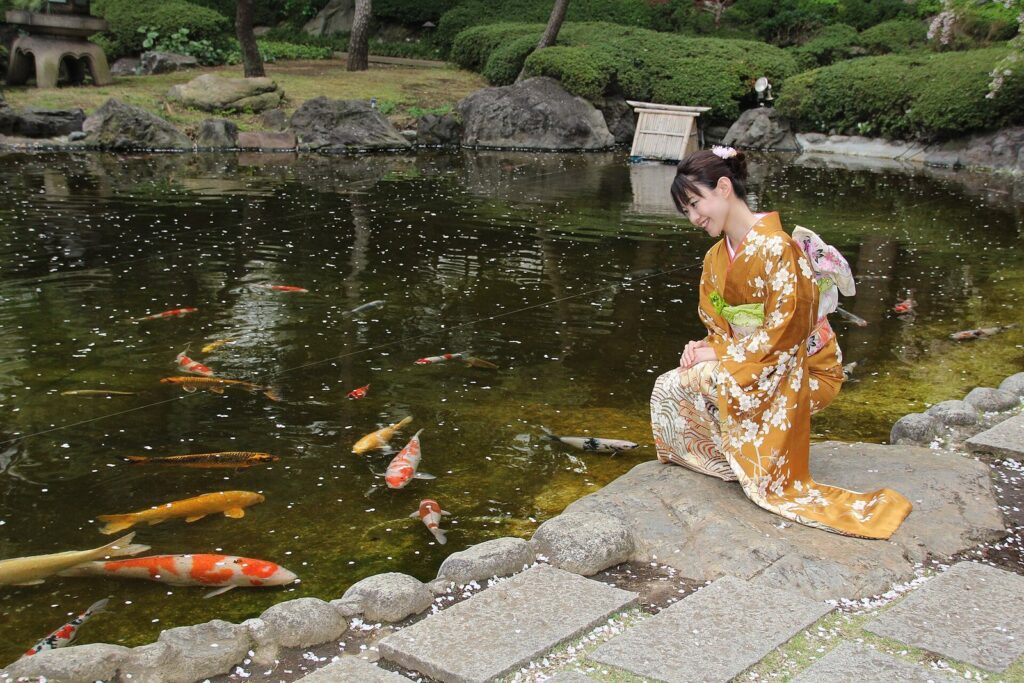
Featured image: “A Japanese woman wearing a Kimono and Koi Fish” by H.Hmoderato, CC BY-SA 4.0, via Wikimedia Commons