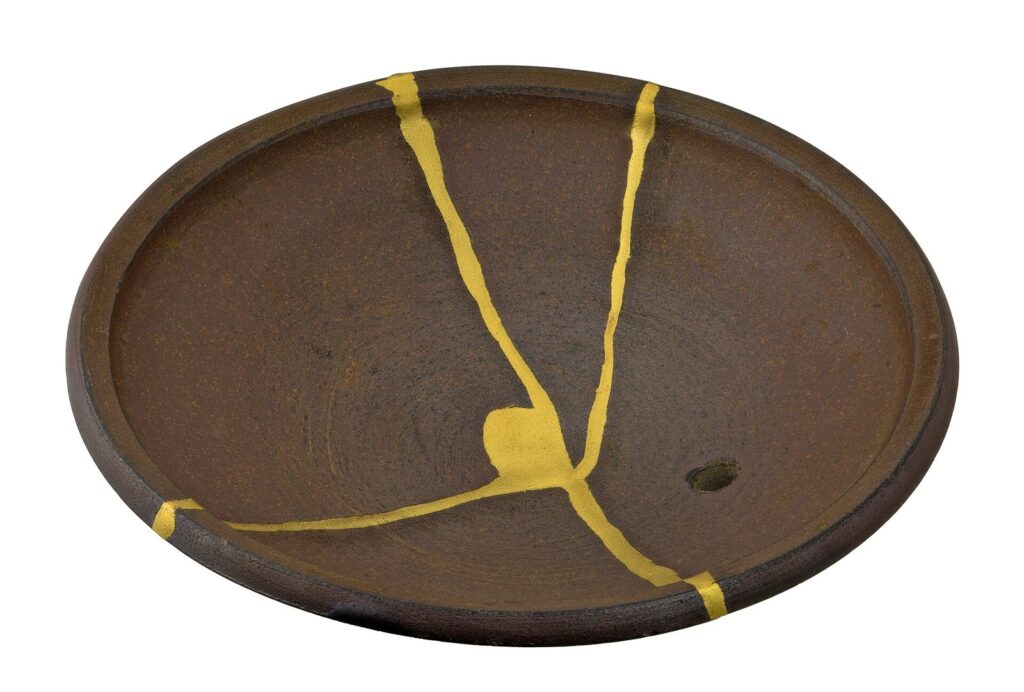
I live in Japan, and the first time I understood what kintsugi actually was, it wasn’t in a museum — it was in a friend’s kitchen, looking at a rice bowl with a thin gold seam running across it like a lightning bolt. I assumed it was decorative, a pattern baked in on purpose. It wasn’t. The bowl had been dropped years earlier, and instead of throwing it away, she’d had it repaired by a craftsman who filled the crack with lacquer and dusted it with gold powder. The break hadn’t been hidden. It had been highlighted.
That’s the whole idea behind kintsugi, and it’s a more specific, slower, and stranger craft than the version that’s been flattened into a metaphor for resilience online. Here’s what it actually involves, where the famous origin story comes from, and where you can see — or try — the real thing.
The quick answer
- Kintsugi (金継ぎ, “golden joinery”) is the traditional Japanese technique of repairing broken ceramics with urushi lacquer, then dusting the seam with gold, silver or platinum powder.
- The crack isn’t disguised — it’s deliberately highlighted, treating the object’s damage and repair as part of its history rather than a flaw to erase.
- A popular origin story credits 15th-century shogun Ashikaga Yoshimasa, though historians note the real origin of kintsugi is undocumented and the story may be partly legend.
- A proper urushi repair isn’t fast: the lacquer needs weeks to months of humidity-controlled curing between stages, which is why it was historically reserved for pieces worth the wait.
- Visitors can see museum-quality examples in Tokyo and Kyoto, or try a simplified, same-day version of the craft in a beginner workshop.
What kintsugi actually is
Strip away the philosophy for a second and kintsugi is, mechanically, a repair technique. A broken piece — usually a tea bowl, plate or vase — is rejoined using urushi, a natural lacquer tapped from the sap of the urushi (lacquer) tree, the same material used in Japanese lacquerware generally. The pieces are glued back together with a lacquer-and-flour paste, any gaps are filled, and the surface is built up in thin layers, each one needing time in a humid box called a muro to cure properly before the next layer goes on.
Only at the very end does the gold show up. While the final layer of lacquer is still tacky, the craftsman dusts the seam with fine gold, silver or platinum powder, which bonds to the lacquer and gets sealed in with a last coat. The metal isn’t filling the crack — the lacquer is doing the structural work. The gold is simply making sure you notice where the repair happened, instead of trying to hide it.
Done properly, a single repair can take weeks, sometimes months, almost entirely because of curing time rather than active work. That’s one reason kintsugi was historically a repair for objects worth that investment — a prized tea bowl, not an everyday dish.
The Yoshimasa story — probably legend, but revealing anyway
The story most often told about kintsugi’s origin involves Ashikaga Yoshimasa, the eighth Ashikaga shogun, who ruled in the late 15th century. According to the account, a favorite Chinese tea bowl of his broke, and he was unhappy with the clumsy metal-staple repairs available at the time. So he had Japanese craftsmen find a better way, and kintsugi was born.
It’s a tidy story, and it’s worth knowing because you’ll hear it repeated constantly — but historians are honest that the actual origin of kintsugi is undocumented, and the Yoshimasa tale may be partly or entirely later invention. What does line up historically is the timing: kintsugi only became established practice around the same period the Japanese tea ceremony was taking shape, when a worn or imperfect tea bowl wasn’t a problem to be solved but a quality to be appreciated. That’s not a coincidence. Kintsugi is really a physical expression of the same aesthetic behind wabi-sabi — the idea that age, wear and asymmetry make an object more interesting, not less.
Not a weekend DIY project — at least, not the real version
If you’ve seen “kintsugi kits” sold online for repairing your own broken mug in an afternoon, know that most of them use colored epoxy resin, not urushi. That’s not necessarily a scam — epoxy is food-safe once cured and far faster and safer to work with than raw urushi, which can cause a nasty skin reaction similar to poison ivy if handled without care. But it’s a different material doing a similar-looking job, closer to a craft project than the traditional practice.
The real thing, done by a trained repair artisan, is slow for a reason: urushi needs specific humidity to cure at each stage, and rushing it produces a weaker, less durable seam. That gap between the quick version and the traditional one is worth knowing before you buy a souvenir kit expecting museum-grade results in a weekend.
Where you can actually see or try it
Kintsugi-repaired ceramics show up in the decorative arts collections of major Japanese museums — pieces in the Tokyo National Museum and the Nezu Museum in Tokyo have included tea bowls with visible gold-seam repairs, usually displayed as objects of real value precisely because of the repair, not despite it. Antique shops in Kyoto’s Teramachi and Shinmonzen areas occasionally carry genuine kintsugi-repaired pieces too, though prices for anything old and well-documented can run high.
For visitors who want to try the craft rather than just look at it, beginner kintsugi workshops run in both Tokyo and Kyoto, usually lasting two to three hours and taught in English. Most of these use a simplified, faster-curing lacquer or resin so you can finish and take home a repaired piece the same day, rather than the months a traditional urushi repair would need. Expect somewhere in the range of $70–150 for a session, materials included — treat that as a rough guide and check current pricing before booking, since workshop offerings change.
If you’re spending time in a tea house or Japanese garden setting during your trip, it’s worth glancing at the tableware. Kintsugi repairs turn up in working tea bowls more often than you’d expect — they’re not only museum objects, they’re still sometimes just the bowl someone is using.
FAQ
Is kintsugi just about gluing broken pottery back together?
Mechanically, yes — but the point isn’t an invisible repair. The gold seam is left visible on purpose, treating the break as part of the object’s history rather than damage to hide.
Did Ashikaga Yoshimasa really invent kintsugi?
Probably not exactly as the popular story tells it. The timing lines up with his era and the rise of the tea ceremony, but the true origin of the technique isn’t documented, and the Yoshimasa story is likely at least partly legend.
Can I buy a kintsugi repair kit and do this myself?
You can, but most consumer kits use epoxy resin rather than traditional urushi lacquer. It’s a reasonable weekend craft project, just not the same material or timescale as a professional repair.
Is urushi lacquer dangerous to work with?
Raw, uncured urushi can cause a skin reaction similar to poison ivy in people sensitive to it, which is part of why trained specialists handle traditional repairs rather than hobbyists.
The verdict
Kintsugi is one of those crafts that’s more interesting the more you learn about the actual mechanics — the humidity-controlled curing, the specific role of the gold, the honest uncertainty around where it even started. It’s become a popular shorthand for turning damage into beauty, and that’s a fair reading of the philosophy. Just don’t expect a $30 kit and a free afternoon to produce what a trained repair artisan spends months building, one patient layer at a time.
Written from Japan by the Wayfarer Japan team — real routes, real prices, no tourist-trap detours.
Featured image: “Kintsugi on broken Kyūsu lid-bottom oblique PNr°1260” by D-Kuru, CC BY-SA 4.0, via Wikimedia Commons