Walk into almost any Japanese elementary school in January and you’ll find rows of eight-year-olds kneeling at low tables, sleeves rolled up, grinding ink and trying not to splatter their classmates. The assignment is kakizome, the year’s first calligraphy, and it’s one of the only art forms in Japan that every single person has actually practiced, not just admired. I’ve watched my own kids do it. It’s also, unexpectedly, one of the more accessible ways for a visitor to spend an hour doing something a local does too, rather than just watching one.
Shodo literally means “the way of writing,” and the “way” part is not decorative. Like judo, kendo and sado (the tea ceremony), the do suffix signals a discipline you practice for a lifetime, not a skill you finish learning. That framing matters for understanding why a 1,500-year-old writing tradition still gets taught in schools, sold as a souvenir, and occasionally drawn in giant characters down the side of a sake label.
The quick answer
- Shodo arrived from China around the 6th–7th century, carried by Buddhist monks alongside the kanji script itself.
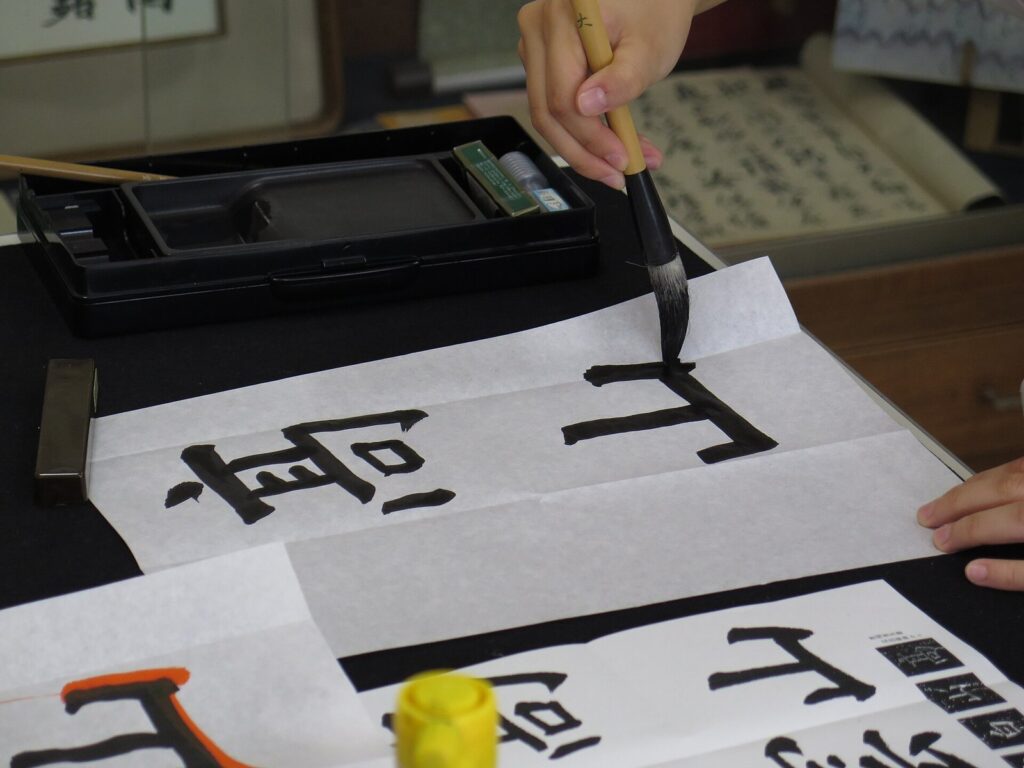
- It uses four tools, traditionally called the “Four Treasures”: a brush (fude), an ink stick (sumi), an inkstone (suzuri) and paper (washi).
- Japan developed its own calligraphic identity once hiragana and katakana emerged in the Heian period, since those flowing native scripts called for a softer brush style than blocky Chinese kanji.
- There are three main script styles: kaisho (block, legible, learned first), gyosho (semi-cursive) and sosho (fully cursive, closer to abstract art than text).
- Tourist workshops exist in Tokyo and Kyoto, usually 30–90 minutes, roughly ¥2,000–6,000 (confirm current pricing when booking), no experience needed.
Where it came from
Calligraphy reached Japan the same way most of its early high culture did: through Buddhism. Monks copying sutras from China in the 6th and 7th centuries brought both the kanji writing system and the brush technique for writing it well, and for a few centuries Japanese calligraphy was essentially an extension of Chinese practice, judged by Chinese standards.
That started to change in the Heian period (794–1185), when the imperial court developed hiragana and katakana out of simplified kanji forms. Hiragana in particular was associated with court women, who used it to write poetry and diaries in a looser, more flowing hand that Chinese-style block calligraphy wasn’t built for. This era also produced Japan’s first calligraphy legends: the monk Kukai, founder of Shingon Buddhism, is still named alongside Emperor Saga as one of the “Three Brush Masters” of the early Heian court.
By the time Zen Buddhism took hold in the Kamakura and Muromachi periods, calligraphy had picked up a second job: spiritual practice. Zen monks produced bokuseki, “ink traces,” spare and often deliberately imperfect brushwork meant to capture a single unrepeatable moment of mind, the same idea behind the tea ceremony and the rock garden. If you’ve read our guide to Zen Buddhism in Japan, this is the same philosophy with a brush instead of a garden rake: the stroke can’t be corrected, so it has to be honest.
The four tools, and why they’re called treasures
Every shodo set, from a child’s school kit to a master’s lacquered box, comes down to four objects, a set the Chinese tradition called the “Four Treasures of the Study” long before they crossed to Japan:
- Fude (brush): made from bundled animal hair — goat, horse or weasel are common — set into a bamboo or wood handle. Softer hair holds more ink and gives thicker, more expressive strokes; stiffer hair gives more control.
- Sumi (ink stick): solid soot-and-glue sticks that are ground by hand against water on a stone, rather than poured from a bottle. Grinding your own ink is part of the ritual — it slows you down and is usually the first thing a workshop instructor has you do.
- Suzuri (inkstone): the grinding stone, usually carved slate, with a shallow well that collects the liquid ink.
- Washi (paper): traditional Japanese paper, absorbent enough that a brush stroke can’t be taken back once it lands. That one-shot quality is most of what makes calligraphy nerve-wracking and, once you get the hang of it, satisfying.
Japanese kanji script on signs and menus can look intimidating to a first-time visitor; our guide to reading Japanese writing on signs covers the practical side of that. Shodo is the opposite experience: the same characters, slowed down to the point where their shape and balance become the whole point, rather than information to decode in a hurry.
Three scripts, three speeds
Students learn calligraphy in a fixed order, and the order tells you something about how the art works:
- Kaisho (block style): each stroke fully separated, closest to printed text, the style used in textbooks and most signage. This is what every schoolchild learns first.
- Gyosho (semi-cursive): strokes start to connect and simplify, faster to write, slightly harder to read if you don’t already know the character.
- Sosho (cursive/”grass” style): strokes flow into each other almost continuously. Trained calligraphers can read it; most Japanese adults, honestly, cannot — it has become closer to abstract visual art than a practical writing system.
A framed sosho piece in a ryokan alcove or a temple gift shop isn’t meant to be read character by character the way you’d read a menu. It’s meant to be looked at the way you’d look at a brushstroke painting, for balance, rhythm and the speed of the hand that made it.
Where calligraphy still shows up in daily life
Shodo isn’t a museum piece in Japan; it’s closer to cursive handwriting lessons in a Western school, minus the decline in relevance. Elementary and middle school students take shūji (calligraphy) class as a standard subject, and kakizome — writing an auspicious phrase on January 2nd as the year’s first brushwork — is still common enough that convenience stores sell starter kits every December.
Outside school, the same brush aesthetic turns up on sumo tournament banners, sake labels, shop noren curtains, temple goshuin stamp books, and chapter-title cards in anime and period dramas. None of it requires reading ability to appreciate — commercial calligraphy signals craft and a human hand in a country that also runs on vending machines and bullet trains.
Trying it yourself
This is one of the more approachable hands-on experiences for a visitor, mainly because the instructor does not expect skill, only attention. Typical tourist-facing shodo sessions in Tokyo and Kyoto run 30 to 90 minutes and cost roughly ¥2,000–6,000 per person (confirm current pricing when booking, as it varies by studio and whether tea or a kimono rental is bundled in). Most sessions start with grinding your own ink — genuinely part of the experience, not a stalling tactic — then move to practice strokes on scrap paper before you commit to a final piece, often your own name written in kanji, or a single word chosen for its meaning. If you’re curious how your name would actually look in Japanese characters before you go, our piece on how to write your name in Japanese is a useful warm-up.
No Japanese ability is required, and most studios run the lesson in English or with picture instructions. Studios cluster around Asakusa and the Yanesen neighborhood in Tokyo, and around Kyoto’s older machiya-lined streets and temple complexes — both areas where you’re likely already walking between other sights, so it slots into half a day rather than eating a whole one.
FAQ
Is shodo the same as Chinese calligraphy? They share the same root — Chinese brush calligraphy, imported to Japan via Buddhism in the 6th–7th century — but diverged once Japan developed hiragana and katakana. Japanese calligraphy routinely mixes kanji with these softer native scripts, which Chinese calligraphy doesn’t use, and has its own stylistic lineage from there.
Do I need to know Japanese to try a calligraphy workshop? No. Most tourist-oriented studios in Tokyo and Kyoto run sessions in English, and you’re usually writing a single word or your name rather than composing original text.
What’s the difference between shodo and sumi-e? Shodo is writing — characters and words. Sumi-e is ink-wash painting — landscapes, bamboo, animals — using the same brush, ink and paper. They’re taught by overlapping traditions and sometimes by the same teacher, but shodo is specifically about script.
Can I buy calligraphy supplies as a souvenir? Yes — basic brush-and-ink sets are sold at stationery stores, department stores and some temple gift shops, and are light enough to pack. A full inkstone set is heavier and more fragile, so check your luggage allowance; our guide to getting your luggage through Japan covers what else tends to catch travelers out at this stage of a trip.
The verdict
Shodo rewards the kind of attention that most travel itineraries don’t leave room for: one brush, one piece of paper, no do-overs. You don’t need to read Japanese, draw well, or stay more than an hour to get something real out of it — a finished piece with your name on it, and a better feel for why Japan still treats handwriting as a discipline worth a lifetime, not a skill you finish in grade school.
Written from Japan by the Wayfarer Japan team — residents who actually live here, not a travel agency.
Featured image: “Japanese calligraphy in action 02” by Douglas Perkins, CC BY 4.0, via Wikimedia Commons